Western Historic Radio Museum

~ Broadcast and Communications Microphones ~

~ Vintage Radio Broadcasting Equipment ~
 

The First Radio Broadcast
 Reginald Fessenden first transmitted voice in 1900 using a spark transmitter but the audio quality was not commercially useable due to distortion from the poor quality of the carrier wave available from a spark transmitter. As early as 1903, Fessenden had been experimenting with mechanical transmitters - high frequency alternators - as a source of a pure continuous wave carrier for audio transmissions. NESCO (National Electric Signaling Company) was formed  to finance Fessenden's research and his high frequency alternators were built by General Electric. In early December, 1906, Fessenden's rotary spark gap transmitter established the first two-way trans-atlantic communications via International Morse. Fessenden had received a high frequency alternator from GE that was designed by Ernst Alexanderson that operated at 50kc. By inserting a water-cooled carbon microphone into the antenna feed, Fessenden could voice modulate the alternator's output. The system was demonstrated on December 21, 1906. Fessenden then decided to test broadcast a short voice and music program on Christmas Eve. The broadcast consisted of violin music (played by Fessenden) and recitation of Bible passages. Though the program was a test, it was picked up by some shipboard radio operators around Cape Cod, Massachusetts. Fessenden repeated the broadcast program on New Year's Eve, 1906. At the time, very little was mentioned of Fessenden's two pioneer broadcasts and they were almost forgotten. However, letters from Fessenden preserved the experiment which is now considered one of the important events in radio history. Though Fessenden had successfully demonstrated the concept of broadcasting, he was actually more interested in providing point-to-point voice communications and, as a scientist, he preferred to continue on with this and his other radio developments and inventions. He eventually retired to Bermuda.
 

  Dr. Reginald A. Fessenden  photo right from: "Every Man's Guide to Radio," published by Popular Radio, Inc. - 1926

This webpage is best viewed with a resolution of 1280 x 960 pixels

Vintage Microphones - Broadcast and Communications


Double Button Carbon Microphone

Manufacturer Unknown

carbmic.jpg (16969 bytes)

Single Button Carbon Microphone

Manufacturer Unknown

Carbon Microphones

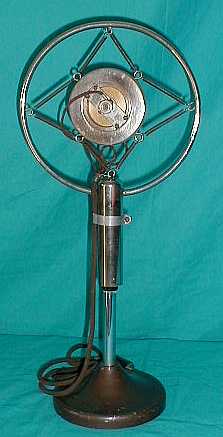
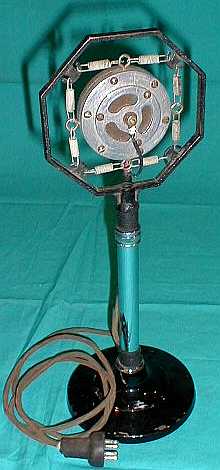
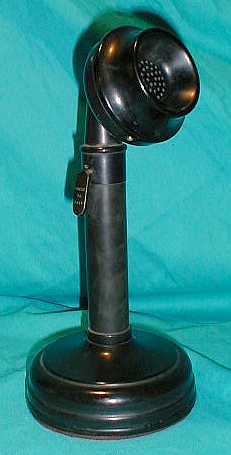
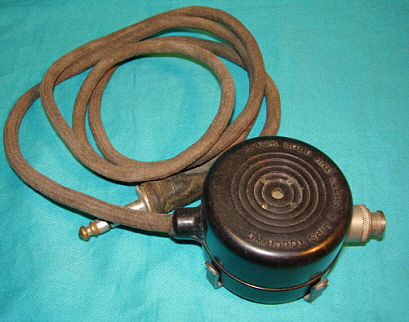
Carbon microphones were very popular in  radio broadcast stations in the 1920s. They featured high output but did have the disadvantage of a noticeable "hiss" level. A single-button carbon mic is made up of a stretched diaphragm in contact with  carbon granules contained in a small housing. The pressure of the sound upon the diaphragm changes the pressure that the carbon granules are under, which causes the total resistance of the carbon granules to change. This variable resistance results in a varying voltage when a small bias voltage is applied to the microphone. A double-button mic is essentially two small carbon housings on each side of a stretched diaphragm resulting in a "push-pull" type of output. The double-button carbon mic's fidelity was considered equal to the condenser mics of the 1920s. By the early thirties, the carbon mic was on the way out (except for telephones, hams and the military) and was soon replaced by the velocity ribbon microphone. The "ring and spring" suspension was used to prevent feedback and other noises. While carbon microphones generally are considered to have inferior audio quality and are only suitable for communications, a high-quality carbon microphone (that was designed for broadcast work and is in proper adjustment) will have surprising fidelity. It is unfortunate that nearly all carbon microphones are poor representatives of the technology and its audio capabilities. 


US Army Signal Corps


Single-Button Carbon Microphone  

Type T-32


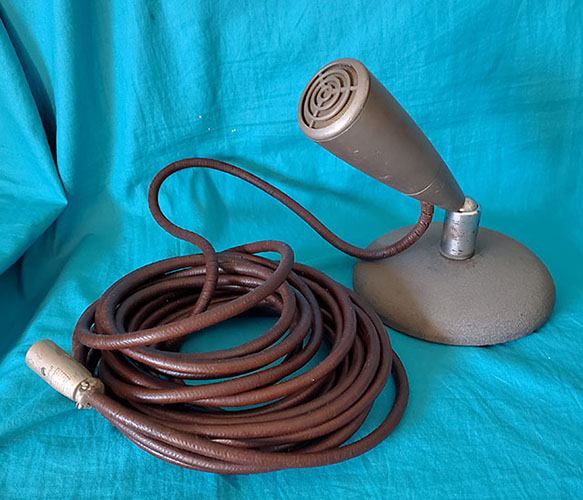
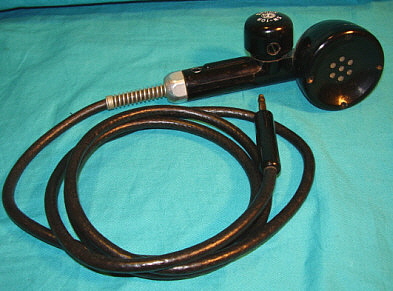
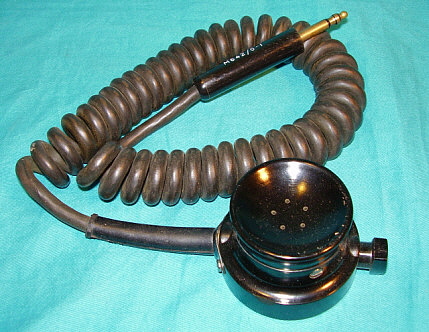
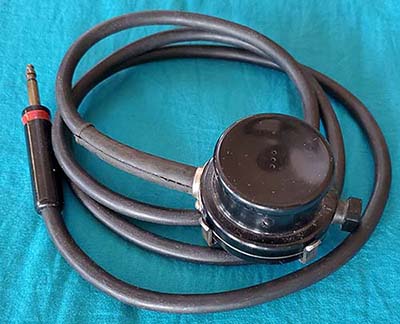
The T-32 was manufactured for the US Army Signal Corps by Kellogg. The microphone is a single button carbon element that requires a small bias voltage. The bias voltage is supplied by the transmitter or other equipment that the T-32 was used with. Audio reproduction is communications quality. The element can be readily replaced, if necessary. The push-to-talk switch can be used to actuate the equipment that the microphone is to be used with. The T-32 dates from the late twenties and was mainly used for military communications up to WWII and sometimes even beyond into the early fifties. A popular microphone with the Signal Corps.  


Western Electric


  Condenser Microphone - 660


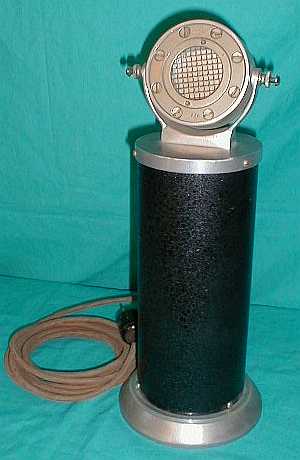
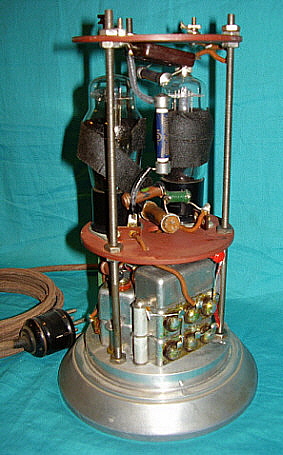
This high quality microphone dates from the mid- 1930s. The condenser type of microphone was used in many radio stations of the twenties (if they could afford them.) By the thirties, other types of quality mics had replaced the condenser type, (later, this would change back again, with modern, high output condenser mics.) The response is good, (though directional as the frequency is increased.) The output is extremely low requiring an amplifier to be mounted near by to boost the output to a useable level. This Western Electric 660 features the condenser microphone on top of a two tube amplifier housed in the canister. A five pin connector provides filament and B+ voltages for the amplifier in addition to the +180vdc polarizing voltage between the diaphragm and the back plate. The tubes used are a 76 triode amplifier and a 77 duplex diode/triode tube. The tubes have friction tape wrapped on them probably to reduce microphonics. Also, a phone jack on the backside of the canister allows for an output meter (or monitor) to be connected and the 77's dual diode provides the rectification for the meter. Condenser microphones were also used in sound recording, both for movies or records, in addition to broadcasting.


Western Electric


Cardioid Directional Microphone  639A


The 639A was introduced in 1938 and provided broadcasters with a microphone that could be set to various direction patterns while maintaining high quality performance. Using a velocity ribbon microphone in combination with a dynamic pressure microphone, the 639A offered three selectable patterns. "R" provided a "figure-8" pattern by utilizing just the velocity microphone. "D" selected just the pressure microphone for a non-directional pattern. "C" provided a cardioid pattern by combining the two microphones in series. The selector switch is located on the back of the 639A housing. Frequency response in any setting was 40Hz to 10KHz. An internal transformer provided amplification and impedance matching for the velocity ribbon section. Western Electric also built a "B" version with six selectable pattern settings. In 1941, ALTEC began producing the 639 series with the ALTEC name on their models. The 639A/B was nick-named the "Birdcage" microphone. This particular WE639A was used at the San Francisco shortwave station KGEI (General Electric International), famous as a broadcast/relay station to the Pacific during WWII.


Turner


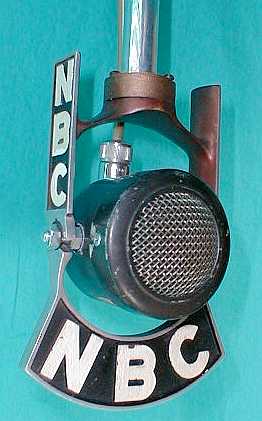
Variable Impedance Dynamic Microphone - U9S


These rugged microphones were popular when the program called for close talking or for use at a windy, outdoor location. Velocity ribbon microphones could be easily damaged from either environment while dynamic microphones were quite durable. Dynamic mics have a moveable coil that is driven by the air pressure on a diaphragm. The movement of the coil over the pole-piece of the magnet causes a small voltage to be generated across the coil. A transformer amplifies this voltage and provides impedance matching. In the U9S, the transformer has a selectable output impedance via a switch located on the back of the microphone housing. This U9S is mounted in an interesting NBC flag that doubles as the mounting for the microphone.


Electro-Voice

  Velocity Ribbon Microphone  -  V2

This is Electro-Voice's answer to RCA's 44B series of velocity ribbon microphones. It is much smaller and lighter weight but provided good sound quality at a very reasonable price. The E-V V-2 was available from Montgomery-Wards' "Simplified Sound Systems" 1941 catalog for the bargain price of $20.58, cash, (Mfg.List Price was $35 at the time.) The catalog states that the fidelity is 35Hz-11,000 Hz and that the pattern can be directional or non-directional. Sensitivity was -64db (compared to the 44BX's -55db.) The price was raised to $29.40 (from Wards) after WWII. While the V-2 ribbon mics may have been used in some of the smaller BC stations, it's more likely that they were mainly for PA applications.


RCA 

 77-C1 - Directional Ribbon Microphone

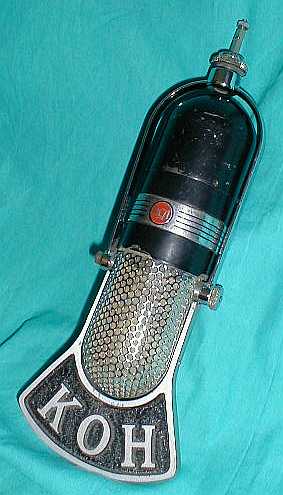
RCA introduced the 77 series of all-purpose ribbon microphones in 1932 (designed in 1929) to provide a uni-directional pick-up pattern and wide frequency response. The designer was Harry F. Olson. The early 77 series featured two ribbon microphones in series to create a uni-directional pattern. A switch provided operation of either mic individually or both in series. A labyrinth tube behind the pressure mic's ribbon directed the air movement into sound absorbing material. When using only the pressure mic, the pattern was non-directional. When using only the velocity mic, the pattern was bi-directional. Later, the 77-D series utilized a single ribbon and inserted a moveable shutter assembly between the ribbon and the labyrinth tube which allowed various directional patterns to be realized. Also in the "D" series, a reactor could be placed into the signal path to reduce low frequency response and compensate for "close talking." Frequency response with the 77-C series depended on the directional pattern selected but 50Hz-10KHz was typical. The 77-C1 was only made in 1940 and was replaced with the 77-D, which later evolved into the famous 77-DX. This 77-C1 was used for sometime at Reno's radio station, KOH, but eventually it was "dumped" as obsolete equipment.


RCA

  44-BX - Velocity Ribbon Microphone

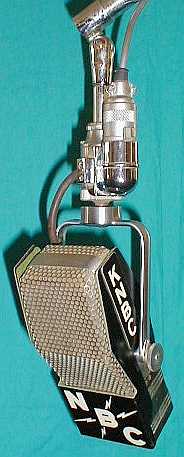
RCA introduced the 44 series of velocity ribbon microphones in 1931. It was designed by Harry F. Olson. The 44 became the mainstay of broadcast microphones due to its bi-directional pattern and excellent reproduction. The 44-B series was introduced in 1938 and the 44-BX dates from the 1940s and was produced up into the mid-1950s. Velocity ribbon microphones use a light-weight, metal ribbon suspended between the poles of a horseshoe magnet (2 magnets on the 44B series.) The motion of the ribbon corresponds to the velocity of the air particles past the ribbon and the voltage generated is an accurate reproduction of the sound wave that transverses the ribbon. The ribbon ends are connected to the primary of a transformer that provides amplification and impedance matching. Also, a reactor (choke) can be inserted via a jumper board in the base of the microphone to compensate for the distance the source is from the microphone. Generally, without compensation (Music Position) requires that the source be at least three feet from the microphone. In V1 (Voice Normal), -10db of low frequency attenuation allows the source to be about 1 ft. from the microphone and for "close talking", V2 gives -22db attn. and allows for a distance of about 7 inches. The frequency response is almost flat from 50Hz to 15KHz (in the Music position, no low frequency attenuation.) The NBC flag shows that this 44-BX was originally used at station KNBC, located in San Francisco, California in the late forties. The prior call was KPO and after a short time, the radio station call KNBC was changed to KNBR, still an active San Francisco radio station.


RCA

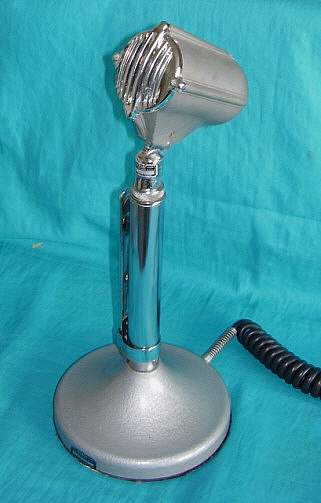
BK-1A  -  MI-11007  -  Pressure Microphone

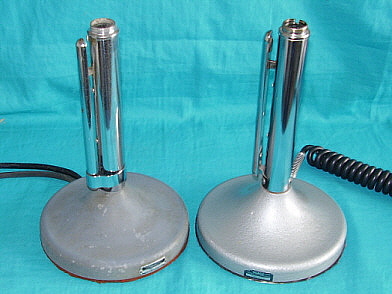
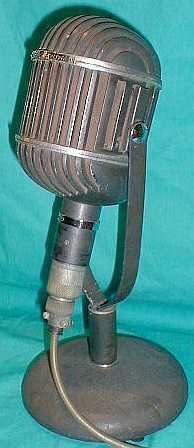
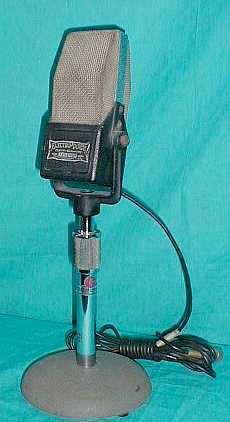
RCA introduced the BK-1A Pressure Microphone around 1950. It was a high fidelity, semi-directional dynamic microphone that was especially designed for announcing and remote pickup. It had a smooth response from 60 to 10,000 Hz and it was considered suitable for reproducing both music or speech. It was non-directional when in the vertical position and became semi-directional when used horizontally. The BK-1A was supplied with the output impedance set at 250 ohm Z but the user could change the connections on the internal terminal board and select either 30 ohms Z or 150 ohms Z also. The standard RCA desk stand was the MI-11008 but the BK-1A shown in the photo is mounted on an Atlas stand. This RCA microphone was used at radio station KSL located in Salt Lake City, Utah. The base is marked "KSL Radio Engineering."


Shure Brothers, Inc.

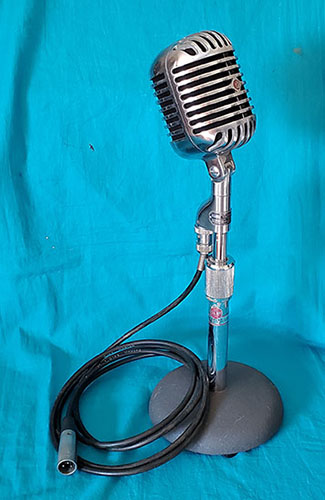
"Voice Unidyne" Dynamic Microphone

Model 55CV


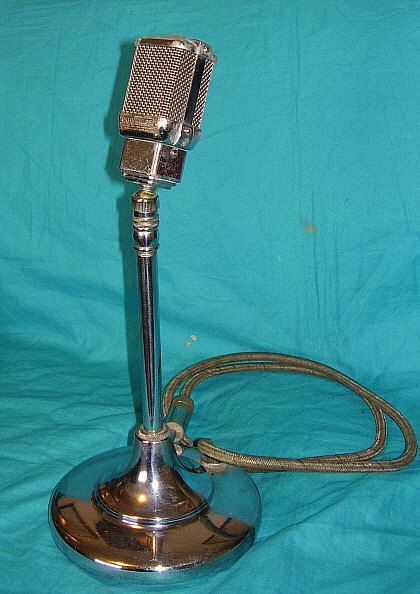
The Shure 55CV is a unidirectional, dynamic microphone designed for high quality public address and broadcasting and recording of voice. "Voice Unidynes" were not intended for high fidelity reproduction of music. They were particularly satisfactory as a soloist's microphone, however. The 55 Voice Unidyne was available as early as 1942 and came in three different impedances, the 55AV was 35-50 ohms, the 55BV was 200-250 ohms and the 55CV was high impedance. Frequency response was generally 40Hz to 10KHz, varying  at the low end with distance from the microphone.


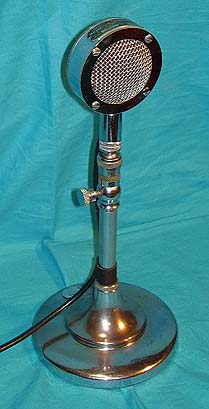
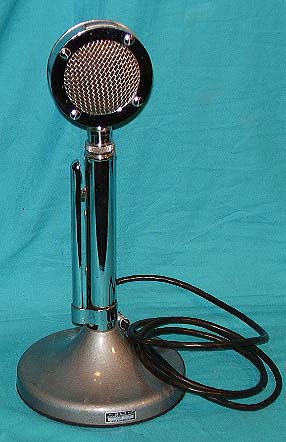
 Pre-1937 Style - 1" thick case and large ID tag

Non-Astatic Stand & Base

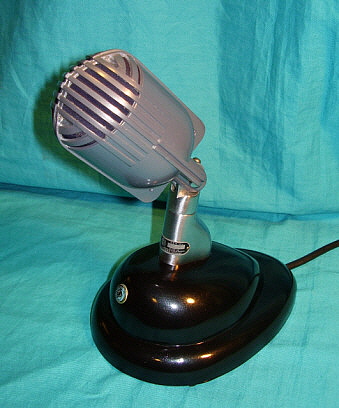
Astatic Microphone Laboratory, Inc.

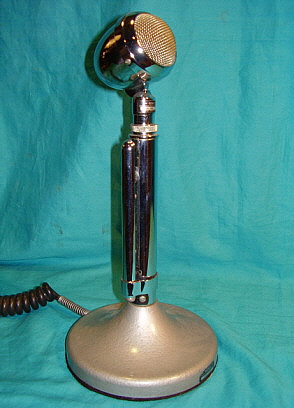
Model D-104

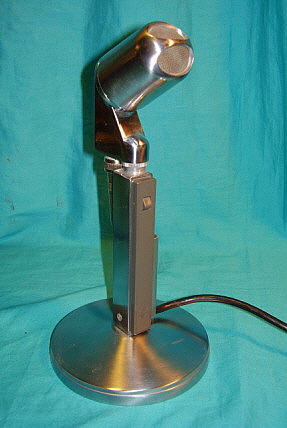
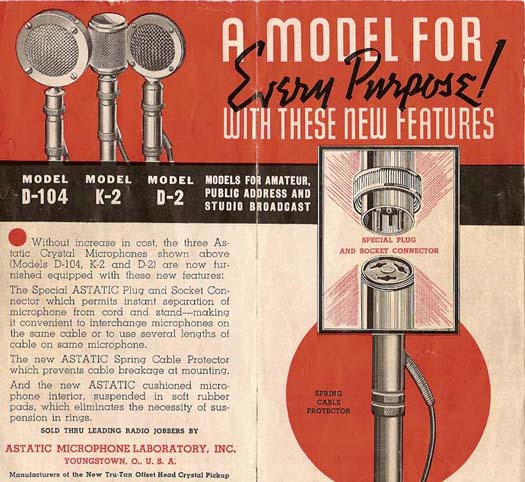
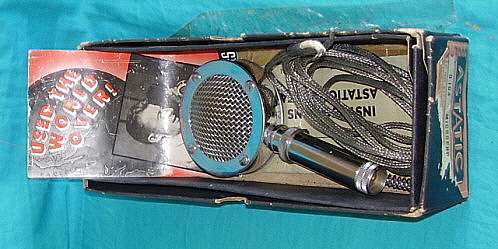
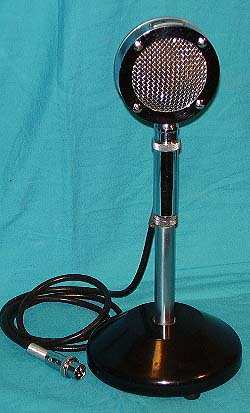
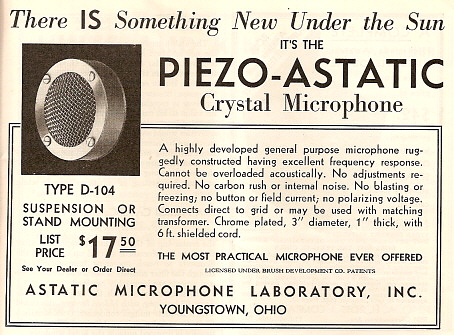
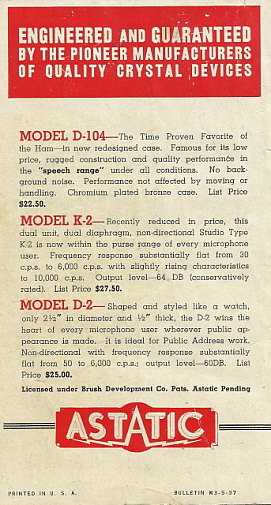
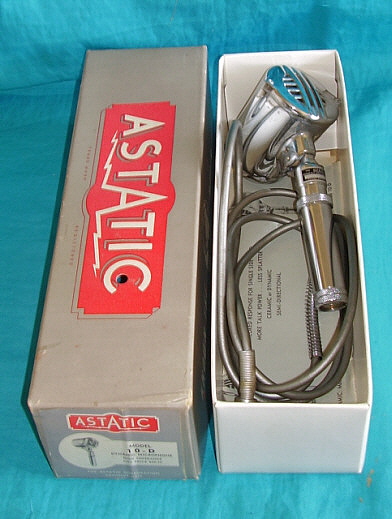
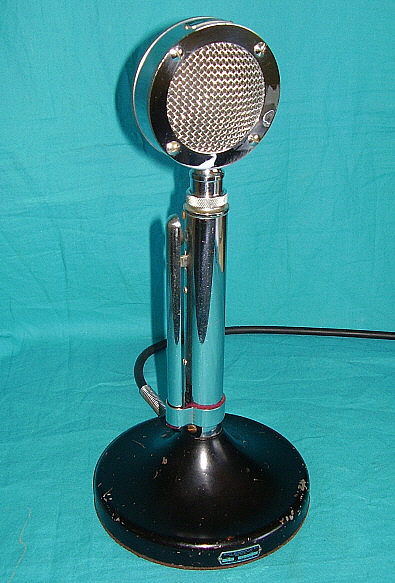
Astatic Microphone Laboratory, Inc. was founded in 1933 by two hams, C.M. Chorpening, W8WR (later W8MJM) and F.H. Woodworth, W8AHW. The two hams experimented with different types of microphones for their AM ham stations beginning in 1930. Their mutual friend, Charles Semple, worked for Brush Development Co. where he had been experimenting with Rochelle Salts crystals. Semple demonstrated some crystal pick-ups that Brush was working with and Chorpening and Woodworth recognized that a crystal microphone would provide excellent service in their AM ham transmitters. When Astatic was incorporated, in 1933, Semple was brought into the company as general manager. The D-104 Crystal Microphone was introduced in November 1933 for $17.50. Almost instantly, the D-104 became a favorite of AM ham operators for its high frequency response which resulted in very intelligible audio. Its high output voltage was characteristic of crystal elements and its high impedance allowed for direct grid input. The early D-104 mikes use a 1" thick case and have a large ID tag along with tapped holes for "ring & spring" mounts. The case thickness was reduced in April 1937 and smaller tags were then used and the ring holes eliminated. The "grip" switch stand ("G" Stand) was introduced in January 1938 but didn't become popular until much later. The early "G" stand bases are gloss black with metal ID tag. Astatic was originally located in Youngstown, OH but moved during WWII (late 1944) to Conneaut, OH. After WWII, Astatic Microphone Laboratory became The Astatic Corporation. In the fifties an optional piezo-ceramic element was introduced as the D-104C. This model was more durable at the price of lower output voltage. The D-104 continued in production with little change until the 1960s when a solid-state amplifier was added to the "G" stand. In 1976, an eagle and shield was added to the rear cover to commemorate the US bi-centennial. Other variations appeared from time to time until 2001, when production ceased - an incredible 68 years after the first D-104 was offered.

1937-1944 Style - Thin case, small metal ID tag, Youngstown, OH location

Non-Astatic Stand & Base

Above: The first ad for the D-104 - Nov 1933, QST magazine


Far right: Astatic flyer for their microphones in the late thirties


The D-104 with "G" grip stand, ca: 1960


Shure Brothers, Inc.

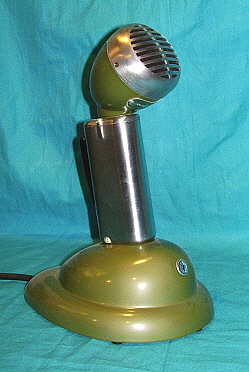
The "Dispatcher"

Model 520-SL

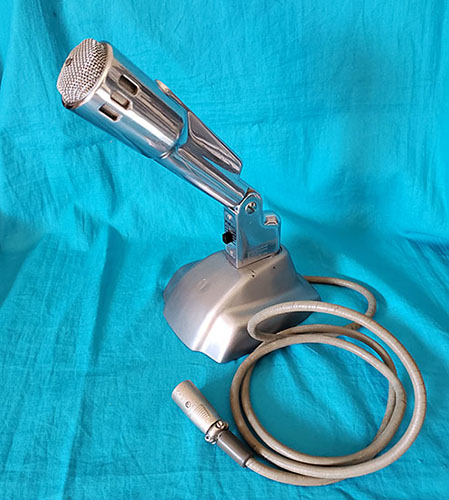
The "Dispatcher" was a rugged, controlled reluctance microphone that was designed for severe field requirements found in amateur radio service, paging use or, as its name suggests, dispatching. Supposedly, the microphone was immune to extreme conditions of temperature or humidity and also provided high output and high speech intelligibility. The green base and mike body are standard as is the robust grip for the push-to-talk function. Selling price was $32.00 in 1950.


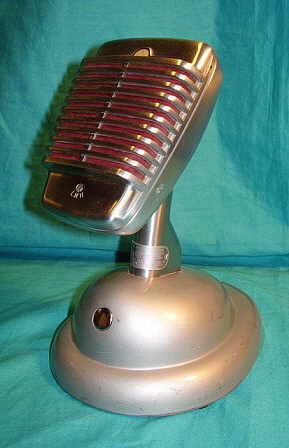
Electro-Voice

Cardioid Directional Dynamic Microphone

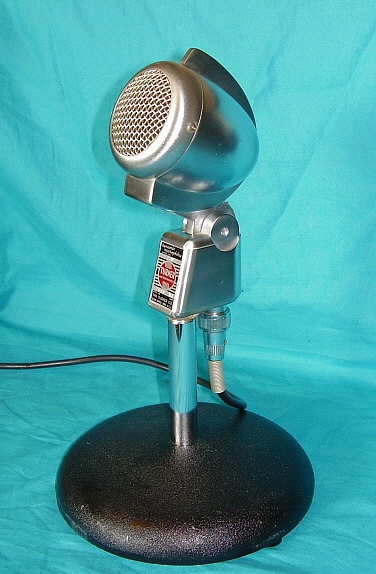
Type 664

The EV-664 was primarily a communications microphone with highly directional characteristics. Utilizing what EV called "Variable D", which was comprised of three sound canceling entrances into cavities at different fixed distances behind the diaphragm providing a front to back spacing that varied in distance (from the diaphragm) inversely with the frequency, the 664 demonstrated a highly directional cardioid pattern. The cavities provided the necessary amplitude and phase conditions to result in a pattern that was constant over a wide frequency range. The directional characteristics of 50% exclusion of side noises and 90% exclusion of rear noises allowed for large distances from the microphone to the source without stray pickup. Dual output impedances of 150 Ohms or Hi-Z and an output of -55db. The 664 sold for $51.00 in 1962 and the optional EV-419 base (shown) was available for $6.00.


Radio Broadcasting Equipment


Gates Radio Company

AM Broadcast Transmitter  BC-250L 

KOWL - 1490 KC - Lake Tahoe 

This is the original, first transmitter used at station KOWL 1490 KC located at Lake Tahoe. KOWL went on the air in 1956 with this Gates BC-250L "Hi-Watter" AM transmitter running 250 watts. The original studios for KOWL were located at Harrah's Club at Stateline, Nevada although the transmitter shack and antenna were located about two miles south in the city of South Lake Tahoe, California. With the Harrah's location, many of the major entertainers that played Harrah's in the fifties and sixties ended up being interviewed on KOWL, their voices going out over the airwaves via this transmitter. The transmitter was in continuous operation from 1956 until the late-sixties, 24 hours a day, seven days a week. It was placed as a stand-by unit in the late sixties and the last time it was powered at KOWL was in 1993. We removed the BC-250L from the original transmitter shack on August 8, 2007. It had resided in that same building for the past 51 years. The BC-250L uses two 810 tubes as RF amplifiers and two more 810 tubes as modulators. It is a high-level plate modulated transmitter that weighs in at around 800 lbs. The dimensions are 78" tall by 42" wide and 31" deep.

The rack to the right of the transmitter contains the monitoring equipment that was used with the KOWL BC-250L. Below are close-up photos of the monitoring equipment. The Gates MO-2639 AM Modulation Monitor is from 1956 and, like all "mod monitors," it is designed to comply with FCC regulations for modulation monitoring. The large "PEAK INDICATOR" would flash anytime the preset modulation percentage was exceeded. The upper meter gave a visual indication of the modulation level and the lower meter was a carrier level indicator. High Quality Audio monitoring was also provided at the rear. The 1956 Gates MO-2890 Frequency Monitor was used to accurately monitor the transmitter's carrier frequency and show any deviation from 1490 KC. The frequency accuracy had to be maintained to 20 cycles or less. The "freq monitor" was crystal controlled and temperature compensated. Additional monitoring was provided by the lower meter and the phone jack on the front panel. Also mounted in the rack is the Conalert alarm-receiver from KOWL.

Photo left: The BC-250L is "ON" in the photo, output of 250W into the dummy load in the rack. Note the lamps, the meter readings and the tube filaments.

Above: Gates MO-2639 AM Modulation Monitor from KOWL.

Right: Gates MO-2890 Frequency Monitor from KOWL


Earle C. Anthony, Inc. - KFI

KAIH - Portable 25W Transmitter

Earle C. Anthony was a well known automobile dealer in Los Angeles, California and owner of radio station, KFI. This is the 25 Watt Portable Transmitter licensed as, KAIH. It was used in 1941 to provide "live", two-way wireless communication between KAIH (at a remote location) and KFI. The listener would hear the KFI broadcast with short, live inserts from the remote site. June 9, 1941 was its first use, operating from the roof of the Turf Club in Inglewood, CA, reporting on an aviation strike. The KAIH transmitter ran on batteries, operated on the 2.0-3.5Mhz band (crystal controlled and selectable from five different xtal frequencies.) and used a 30 foot portable antenna. The circuit uses an 807 modulated by 6L6s. Designed and built at the KFI shop.


M5693.jpg (15592 bytes)

Gates Radio Company

AM Modulation Monitor   -  Model M-5693

The Gates M-5693 Modulation Monitor uses a plug-in coil to set the input frequency range for the Carrier Meter circuit. The Carrier Meter would be set to 100 (with no transmitter modulation and after peaking the monitor frequency control) then the Modulation Meter (right) would readout the transmitter modulation level and relative db level. A selector switch allowed either negative or positive peaks to be read. The Neg Peaks lamp would flash if negative cutoff was detected, depending upon what modulation percentage level was selected (with 100% being maximum.) Audio output (for headphones) and quality output monitoring (for distortion analyzers) were also provided. RF input was usually from a small pick-up coil near the tank circuit in the transmitter or near the antenna. The M-5693 dates from about 1959.


GR731A.jpg (21241 bytes)

General Radio Co.

Modulation Monitor - Model 731-A

AM Radio Broadcast stations were required to monitor the percent of modulation of their transmitter. Most modulation monitors were designed to comply with specific FCC regulations which stated the necessary requirements. The General Radio 731-A Modulation Monitor dates from about 1938. A variable capacitor tunes a pick-up inductor mounted near the tank coil of the broadcast transmitter. This input is then detected to drive the Carrier Meter. Regulated power supplies deliver reference voltages that compare the detected signal/lp filter output and give a percentage of modulation readout. Another circuit allows a variable setting of an Over Modulation warning lamp. Outputs for monitoring are accessed via a Jones Plug on the rear panel. The operator can select Positive or Negative Peaks for readout on the modulation meter.


U.S. Army Signal Corps
(Contractor: Federal Television Corp.)

AM-864/U  Audio Limiter/Amplifier

The AM-864/U is a peak-limiting audio frequency amplifier for use in either AM or FM broadcast system installations where it can automatically control the maximum level of amplification while retaining the audio quality of the program source. The AM-864/U could also be used in recording or in sound systems where automatic level regulation was going to be a requirement. The input Z is 600 ohms balanced and the output is also 600 ohms Z balanced, which is normal for most broadcast audio routing. Five tubes are used in the circuit that is powered by 115vac. The rear chassis adjustments control the point at which limiting is started and also how much limiting is allowed. The large control on the front panel controls the amplifier gain. The panel switch on the left selects if the meter is going to monitor the attenuation level or the amplifier output. The AM-864/U is a high quality device that had multiple uses and apparently the U.S. Army did use them in many different applications. Dates from the mid-1950s.


RCA

70-D Transcription Turntable

This is the RCA Type 70-D, Model MI-11801,  Transcription Turntable with RCA Type 72-D, Model MI-11852 Recording Attachment. This piece of equipment was used in broadcast stations for playing records and for recording onto transcription discs for future playback. Speeds available were 78RPM and 33.3RPM. Also included inside the base is a MI-4975 Reproducing Filter network. The recording attachment allows the user to select groove density and direction (outside-in or inside-out.) There is a scale showing remaining time on a particular recording disc. Ample storage in the base which also houses the large motor and flywheel. This turntable dates from the late forties and was one time used at station KRON-TV (though this might just be somekind of property tag.)


cb11nu.jpg (7696 bytes)

Gates Radio Co.

Transcription Turntable - Model MO-2705A, Type CB-11

Parker Gates' father, Henry Gates, started Gates Radio Company in 1922 but when son, Parker, started building radio broadcasting equipment the company began to flourish. Initially, the CB-11 was a standard, two-speed machine (78RPM and 33.3RPM) but as 45RPM records became more popular the new models had the platter modified with two large holes. These provided access to the capstan and allowed the user to install an internally slotted sleeve over the 33.3RPM part of the capstan, which was now also slotted on top, thus locking the sleeve and increasing the capstan diameter which increased the turntable speed to 45RPM. This CB-11 is fitted with a Gray Research Tone Arm with a GE VR cartridge with 3mil stylus for 78RPM records.


RCA - "ON AIR" Warning Light from KNEV

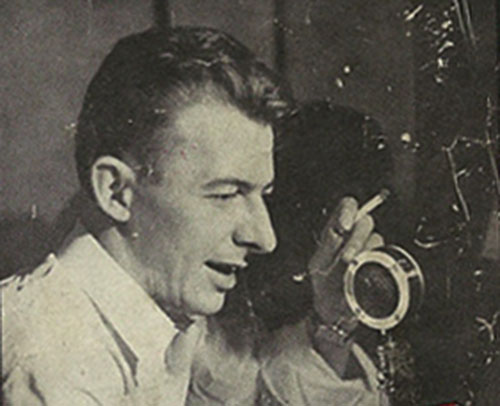
This light was part of the original station equipment at Nevada's first "successful" FM station, KNEV, owned by Jerry Cobb (shown in photo with KNEV microphone.)  Actually, the first FM station in Nevada was KWRN, which was partially owned by the Reno Gazette newspaper. Spending $250,000 for the transmitter, antenna, a modern studio and control room, KWRN went on the air on November 27, 1947. The transmitter was moved to a building that had been built on Peavine Mountain in 1948. The Gazette really never promoted FM's advantages and merely rebroadcast what was already on the local AM stations. The Reno listeners had no reason to switch to FM. With little revenue coming in, it was decided to shut down operation of KWRN on April 15, 1950. The equipment was sold to the Bell Telephone Co. of Nevada. Jerry Cobb purchased the equipment from the telephone company while it was still up on Peavine Mountain. The windows of the transmitter building had been broken and the door left open. Most of the equipment had been vandalized. Salvaging everything, Jerry and his son, Neal, moved the equipment to their home at 1260 Ridgeway Ct., in Reno. Jerry actually had to locate the final RF amp tubes, which had made their way to a fireplace mantel in Central California. By 1951, Jerry had rebuilt the station and had it operational in his garage, however the neighbors were concerned that the FM signal would be "picked-up" by their appliances. Jerry moved the station to 538 So. Virginia St., obtained the license and, with the call KNEV, went "on the air" on Christmas Day, 1953. Jerry Cobb enthusiastically promoted FM by giving away "FM only" receivers to all of the "big shots" in Reno. Additionally, by featuring fine music and hosting several creative programs with man-on-the-street interviews (which he had developed when working at KOH), Cobb got the public's attention and they started buying FM radios, making KNEV and FM a success in Nevada.


we45a.jpg (17001 bytes)

Western Electric

45-A  Amplifier

This input/output transformer coupled, single-ended amplifier uses two WE 205-D triodes, one as an audio amplifier and the second as a B+ voltage rectifier. The 45-A dates from about 1930 and this particular one was used by the Bell Telephone Company of Nevada (later Nevada Bell) for an in-line amplifier when remote site broadcasts required using the telephone lines to send the audio signal to the radio broadcast station transmitter. The amplifier also provides various B+ voltages to operate auxiliary equipment. Powered by 110vac.


Capitol Records

45RPM  Cue Disc

This 12 inch in diameter disc was used to adapt a 45RPM single to a transcription turntable and allow the DJ to "cue-up" the record. The cue disc is made of the same kind of material used for 78RPM records. The edge is embossed with ridges for the DJ to grip the cue disc and allow it to "slip" on the felt of the rotating turntable. Releasing the cue disc let the 45RPM single come up to speed fast and begin playing quickly. When finished, the finger-sized depression made for easy removal of the 45RPM record. Dates from the 1950s.


 ____________________________________________________________________

Donations to the Western Historic Radio Museum and the Museum's Website

If you enjoy using the Western Historic Radio Museum's website as an information resource and have found our photos and hard to find information helpful, please consider a donation to the WHRM. A small donation, such as our normal Museum admission fee of $5.00, will help the expenses of website operation and also help keep the Western Historic Radio Museum open to the public. The WHRM has been an "Open-to-the-Public" museum since 1994 and has provided an on-line information source in its website operation since 1997.

You can use PayPal for sending a donation by clicking on the "Donate" Button below


 If you prefer sending a check, MO or cash donation, please make the check or MO payable to "Henry Rogers" and send to:

Western Historic Radio Museum
P.O. Box 73
Virginia City, NV  89440  USA
_________________________________________________________


Website Navigation Index

- Museum Information - Nevada Radio History - Parish House - (Full Length Articles with Photos) - Items For Sale -

Home-Index

Museum Hours, Contact & Other Information

History of the Parish House (1876)
Lots of Vintage Photos and Information

Nevada Radio History - 1906 to 1930
Father of Wireless, Early BC Stations & More

Radios & Electronics Gear For Sale
NEW!


- Wireless Apparatus & 1920s Communications Equipment  ~  Full Length Articles with Photos -

M.H. Dodd's 1912 Wireless Station
10th Anniversary Edition with New Photos
   SE-1420, IP-501 & IP-501A
"The Classic Shipboard Wireless Receivers"

  THE COLIN B. KENNEDY COMPANY
"
RADIO APPARATUS OF QUALITY"


- Vintage Communications & Amateur Radio Equipment  ~  Full Length Articles with Photos -

Hallicrafters SX-28
"A Pre-war Masterpiece"

Comprehensive History & More

Hallicrafters DD-1 "Skyrider Diversity"
Comprehensive History & Restoration

RCA's Amazing AR-88 Receivers
Comprehensive History, Restoration, Sweep Alignments & More   NEW!

Hammarlund Mfg.Co.,Inc
The Incredible Pre-War 'Super-Pro'

Comprehensive History & Restoration Info

National Co. - HRO Receiver
"The Cream of the Crop" 

BC-348 Receiver - How to Return to Original Dynamotor Operation 

Rebuilding the Hammarlund SP-600
Detailed Info with Lots of Photos

 Vintage Long Wave Receivers
Receiver Profiles, Loop Antennas, NDBs

Building an Authentic 1937 Ham Station


- Radio Photo Galleries ~ with Text -

Entertainment Radios

Roaring 20s Radios 1922 to 1929

Vintage Table Radios 1930 to 1950

Floor Model Radios (Consoles) 1924 to 1940

Only Zenith Radios 1925 to 1940

Communications, Amateur & Broadcast Equipment

 Early Ham Gear & Commercial Wireless - 1910 to 1927

Classic Pre-WWII Ham Gear  - 1928 to 1941

WWII Equipment & Commercial-Military Gear  - 1942 to 1955

Post-WWII Ham Gear - 1946 to 1957

Other Radio Related Articles

Vintage Microphones, BC Gear  - 1930 to 1950s

Radio Teletype - RTTY - with Real Machines

Telegraph Keys - "From Straight Keys to Bugs" - 1900 to 1955

Gates BC-250L BC Transmitter Moving and Restoration 


Western Historic Radio Museum

Vintage Radio Equipment and Memorabilia

from 1910 through the 1950s

P.O. Box 73 - Virginia City, Nevada 89440 USA

Owners/Operators:

Henry Rogers - WA7YBS

Sharon Rogers - KK7EI

This website created by: Henry Rogers-Western Historic Radio Museum © 2000/2010