|
Radio Boulevard WHRM Radio Photo Gallery Radio Teletype - RTTY - with Real Machines Teletype Corporation Machines WA7YBS RTTY Station RTTY Terminal Units by: Henry Rogers WA7YBS/WHRM |
![]() |
Teletype Machines
![]() |
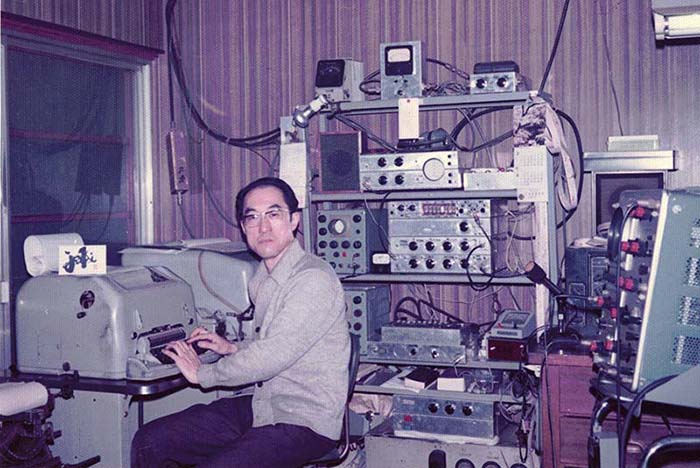
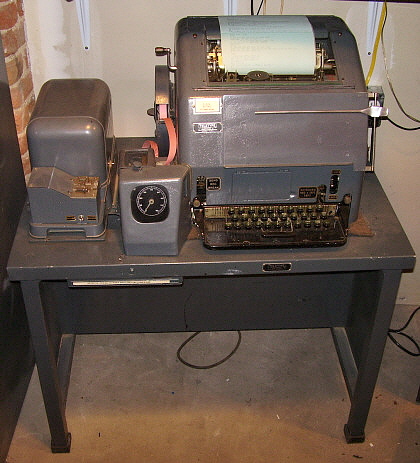
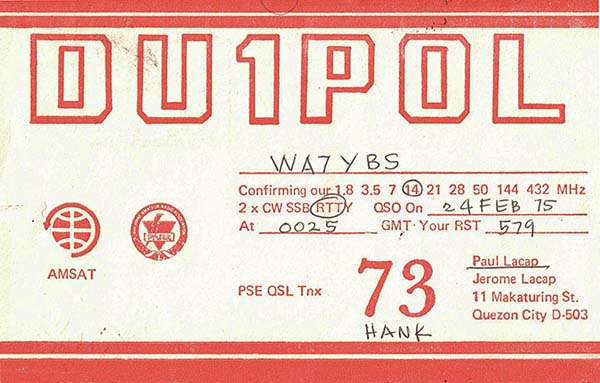
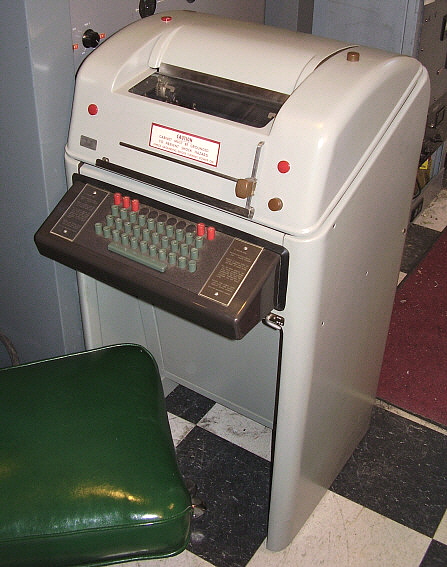
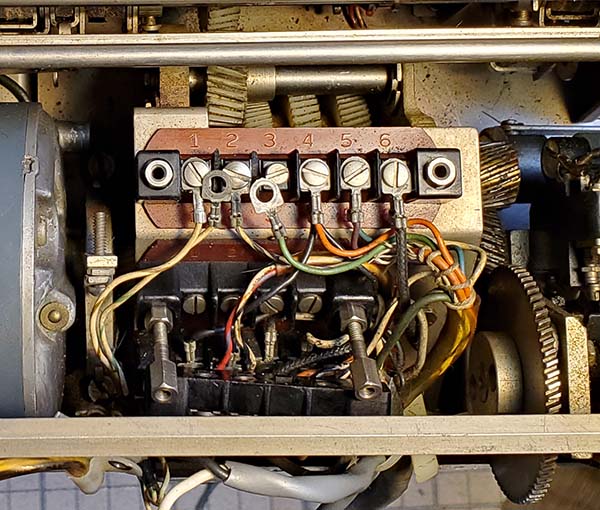
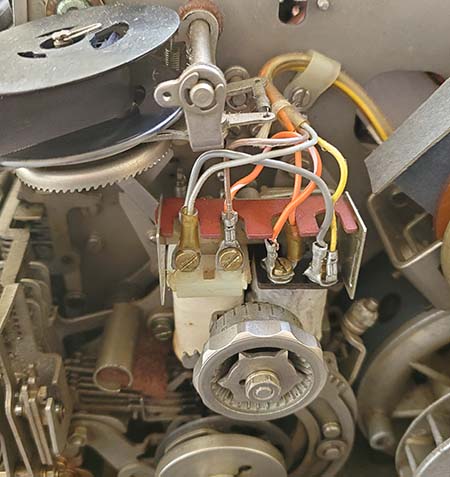
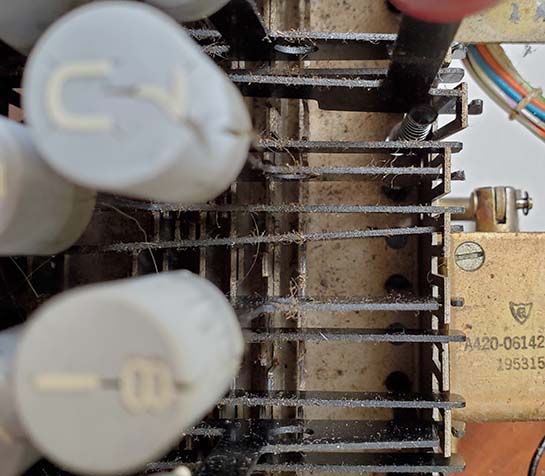
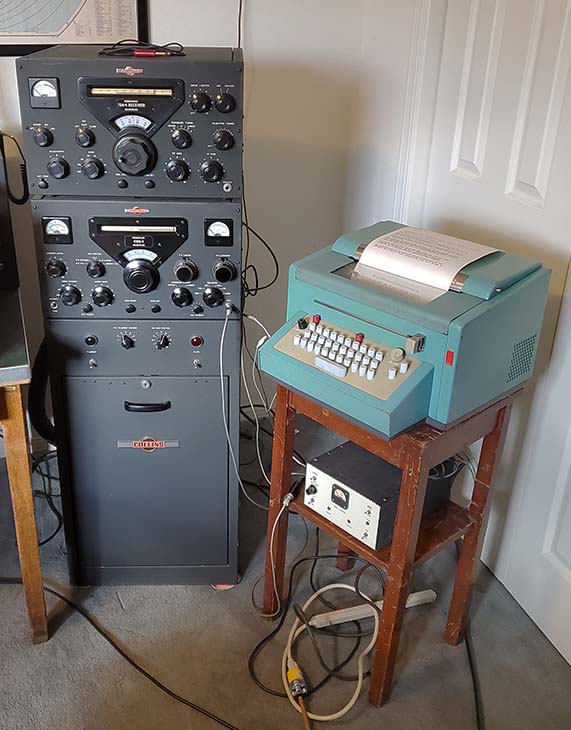
Teletype Corporation Model 19 - USN A/N TT-7/FG I've owned this particular Model 19 since 1975. I purchased it from a company called RTTY Electronics in the California SF Bay Area. RTTY Electronics is still in business in El Sobrante, CA and its owner, Paul Cembura, has been rebuilding TTY machines since 1966. In 1975, Paul was rebuilding teletypes in the basement of his house. What a basement,... full of different kinds of teletype machines and parts. He had a washing system that used solvent (kerosine) to degrease the printers and a metal wash tub basin to capture the run-off. It was an experience just to go there and see all of the machines in various states of assembly and disassembly. Needless to say, this Model 19 has always been in great condition - almost like new inside, probably because thirty-some-odd years ago, new parts were still easily available. I paid $125 for it and hauled it back up to Nevada in the bed of a 1969 Datsun pick-up (pulling Luther Summit was quite a load for the little 1200cc engine.) I used the machine actively on 20 meters from 1975 up to about 1980, working several DX RTTYers like DU1POL, Paul Lacap, who was the chief of police in Quezon City in the Phillipines, or JA1DI, Isao Yamaguchi in Tokyo, Japan (see header photo.) Many stateside RTTYers were also worked with this old Model 19. In 1980, I moved from Gardnerville, Nevada to Minden, Nevada and had no room for the RTTY station at the new QTH, so I stored the TTY from 1980 until 1993, when we moved to Virginia City, Nevada. In 1995, I went through the machine, lubing and adjusting, in order to have it as a working exhibit in our radio museum. The only problem was I couldn't find any RTTY signals on 20 meters at that time,....at least 45 baud Baudot signals (except for one lone XE1 station that was copied.) I assumed that real machine RTTY was dead. In 2007, I again resurrected this Model 19. I had to replace the 323B grid-controlled thyratrons in the REC-30 loop supply in order to get the tape perforator working but otherwise the machine was still in fine operational condition. This time many 45 baud Baudot signals were copied especially during contests. It was great to again find that the Model 19 along with an old HAL ST-6 would print out solid copy with that fabulous electro-mechanical cacophony that is real machine RTTY. This Model 19 is the later version with the tape perforator counter mounted to the left of the keyboard inside the perforator housing. This mounting made the mechanism less likely to sustain damage compared to the earlier right side mount. The machine is military in origin and has holding magnets in the printer (connected in parallel for 60ma operation.) Military designation was TT-7/FG. The gray color is a later addition courtesy of RTTY Electronics. |
![]() |
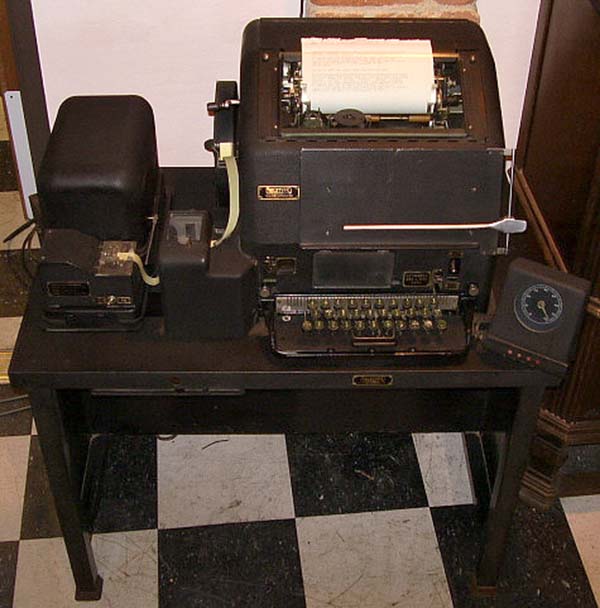
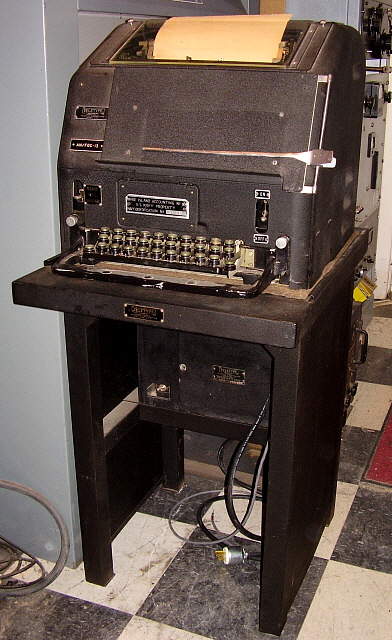
Teletype Corporation Model 15 - USN Mare Island Naval Shipyard This Model 15 machine was owned by well-known Reno ham, Al Chin. Al worked on most of the radio gear for the Reno PD. He became an SK in the mid-1970s. This Model 15 was removed from Chin's backyard metal storage shed around 2003. It is in very good condition considering how it was stored. The metal tag on the front is an property asset tag and indicates that this machine was used at USN Mare Island Naval Shipyard located in the San Francisco Bay Area by Vallejo, California. The Model 15 is a KSR machine, that is, Keyboard Send-Receive. The indestructible Model 15 was found everywhere including radio stations, weather stations, police departments, newspapers. Many times the keyboards were not needed in a "receive only" installation and there was blanking plate installed to cover the opening. If a Model 15 was well-maintained, it will run forever. |
![]() |
Teletype Corporation Model 28KSR - U.S. Navy
This 28KSR TTY was discovered by KB6SCO in a warehouse in Carson City, Nevada where it had been stored since 1997. It had apparently been purchased as part of a military surplus lot since the warehouse was literally filled with various kinds of equipment that had come from these kinds of "lot" purchases over several decades. KB6SCO, knowing that I'm an avid TTY fan, obtained the TTY from the warehouse specifically for our collection. As can be seen in the photo, this 28KSR is in mint condition and has never been put into service since it was rebuilt by San Diego Navelex in 1987.
|
Model 28ASR - Western Union ... This is an unusual Model 28ASR as it is loaded with a lot of special Western Union equipment inside for routing of incoming and outgoing signals. Photo coming as soon as I can clear away the "junk" in the garage that is piled up around the machine.
![]() |
RTTY Station WA7YBS
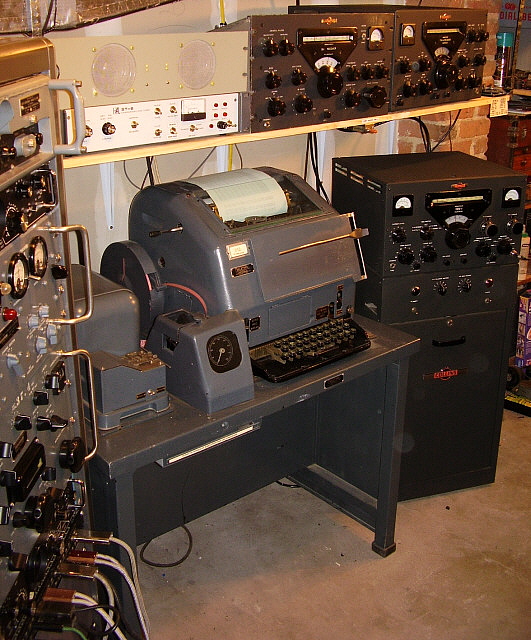
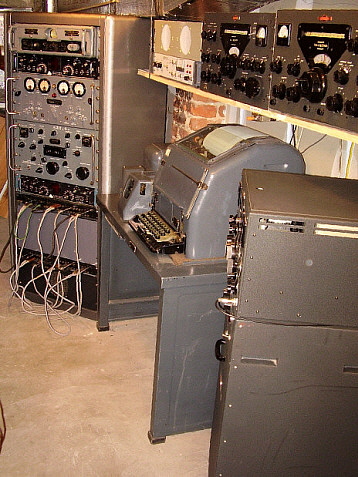
This is a photo of my old RTTY station that I had set up a few years ago. In the rack from top to bottom, CV-89A RTTY TU, Dovetron Tempest RTTY TU, CV-116/URR RTTY Diversity TU, Collins R-390A/URR receiver, Dovetron Multipath RTTY TU, Patch Panel, Keying Loop Supply and at the bottom an 8" PM speaker with 600 ohm Z matching transformer. On the shelf left to right, Dual Speaker Panel on top of a HAL ST-6 RTTY TU, Collins 51J-2 receiver and a Collins 75A-4 receiver. Center floor is the AN/TT-7 FG (Model 19) TTY machine and next to it the Collins KWS-1 transmitter. Although all of the gear in the rack does work, I normally used the 75A-4 and KWS-1 as the receiver and transmitter and then demodulated the RTTY with the HAL ST-6. This set-up with the Model 19 TTY worked quite well. The KWS-1 had to be run at reduced power due to the 100% duty-cycle of RTTY but still 200W output provided a decent signal. Unfortunately, this station is no longer set-up but I still have all of the gear shown and if some extra space ever can be created around here, I would like to set this station back up.
|
RTTY Terminal Units
![]() |
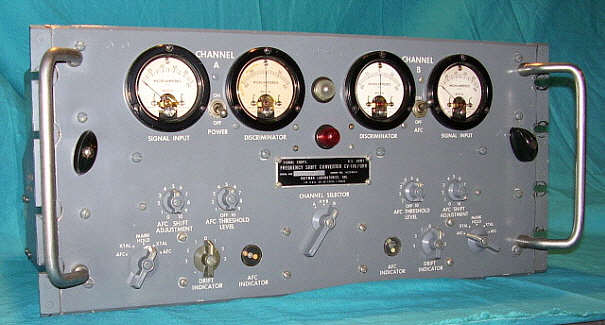
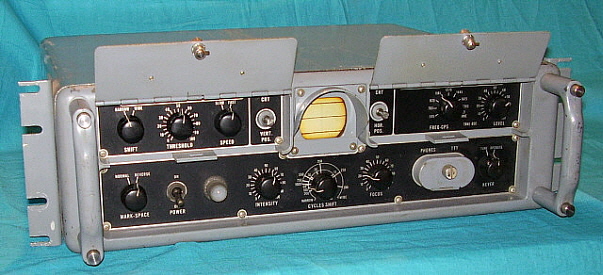
Hoffman Laboratories Inc. U.S. Army Signal Corps - CV-116/URR The CV-116 is a diversity RTTY FSK TU that was designed for the Signal Corps to be used with two R-390 receivers for space or frequency diversity RTTY. Using 45 tubes and weighing in at nearly 70 lbs., the CV-116 uses the 455kc IF output from one or two receivers for its signal input to each channel. The input stages are similar to a receiver's input in that an RF amplifier, oscillator and mixer are used in each channel. Channel A operates at 50kc and Channel B operates at 29.3kc into their respective discriminators. Although crystal control can be used, AFC is also available to compensate for receiver (or signal) drifting. There are two, motor driven AFC controls that use amplifier circuits in feedback loops to drive motors that gear drive a tuning condenser that keeps the oscillator tuned for each channel. The red lamp is an addition that provides a visual alarm indication that the driven AFC condensers are near the end of travel. Normally, the internal bell gave a warning alarm but if several CV-116s were in use with several TTY machines, it would have been difficult to find which CV-116 was giving the bell alarm, thus this addition which provides both alarms. The second from the left meter (M4) can be switched to monitor several areas of the circuit including the built-in, adjustable loop supply. The CV-116 is designed to drive the TTY printer magnets directly (cable interface required) and will drive resistive loads from 125 to 500 ohms. This Cadillac of military TUs was built in 1953. It is fully functional and in use with a R-390A receiver to copy RTTY on the Model 19 TTY. |
![]() |
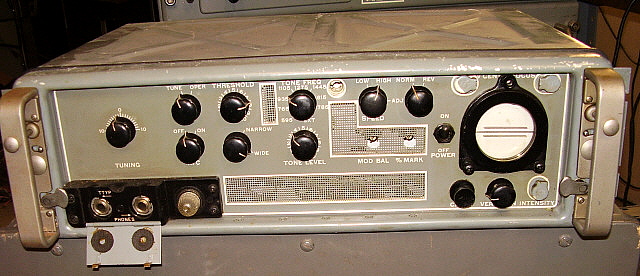
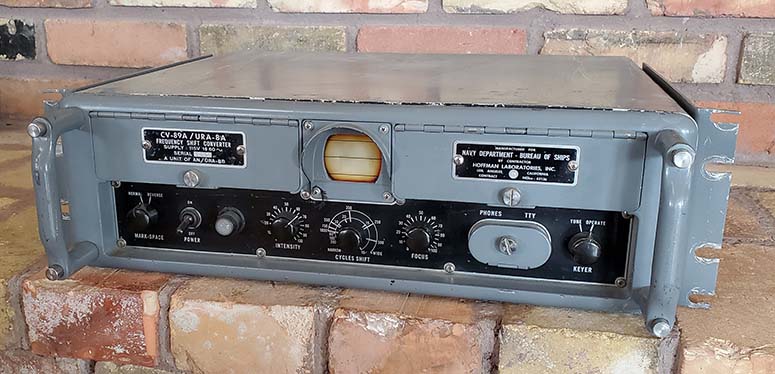
Hoffman Radio Co. U.S. Navy - CV-89A The CV-89A was part of the URA-8 diversity RTTY system that was built for the Navy by Hoffman Radio Company. Two CV-89A units were used with a combiner unit to achieve space diversity and reduce fading signals to improve RTTY copy accuracy. Using 15 tubes, the CV-89A is modular in construction. Five modules make up the unit - four are mounted in the chassis and one is mounted in the back of the case. Being an audio discriminator device, the operator has to tune the RTTY signal so the mark and space frequencies straddle the center frequency of the filter selected. Narrow shift center frequency is 1000hz and wide shift is 2000hz. The CV-89A features a built-in oscilloscope display to aid in tuning and determining FSK shift. The oscilloscope display will shift vertical positions with mark and space frequencies and by adjusting the shift knob so the display spreads between the three graduations on the display scale, frequency shift can be measured. The CV-89A requires a separate loop supply in series with the printer magnets. The magnets and loop supply can be connected to the rear A/N MIL connector (14S-9P) or if the TTY/loop is set-up with a single .25" phone plug, it can be inserted into the jack on the front panel behind the small door in the lower right panel. An excellent, easy to use military TU. Built in 1953, this CV-89A is fully functional and provides great copy with any receiver that has a 600 audio line out. |
![]() |
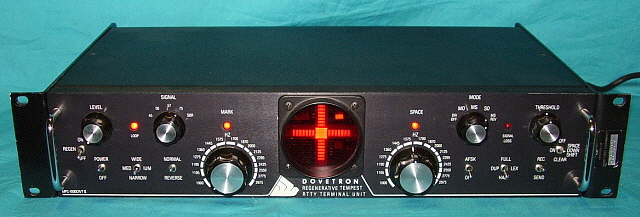
Dovetron MPC-1000CR/T "Regenerative Tempest" MIL-SPEC RTTY TU Possibly the most electronically elaborate RTTY TU ever built for use with real machines. Though the Dovetron "Tempest" looks very similar to the civilian MSR-1000RC (below), it is the military/government version of the TU and MIL-SPEC is used throughout the unit. The Tempest units will have BNC connectors for inputs and outputs on the rear and a 14S-7P power input connector. Speed conversion, diversity capability, duplex afsk and tunable mark and space filters are the standard features but the Tempest versions do not have an auto-start feature or the keyed TTY loop supply of the civilian models. FSK polar outputs are provided to drive a loop keyer for machine RTTY or whatever else you might want to use. Both +/-6vdc and +/-12vdc FSK polar outputs are provided. The MPC-1000CR/T shown is in the "self-test" mode to show the SSD "Cross-fire" LED display operating. The horizontal line indicates mark and the vertical line indicates space. A fantastic TU that really has the great performance to go along with its great looks. Built in the early 1980s. |
![]() |
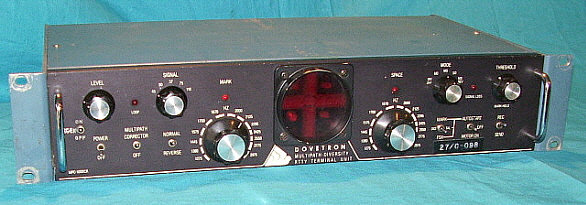
Dovetron MPC-1000RC - Multipath Diversity RTTY TU The MPC-1000RC is a commercial/civilian RTTY TU that can do speed conversion, multipath correction, auto-start, AFSK and has a multitude of other abilities depending on the users requirements and the TU's options. The MPC-1000RC features front panel tunable filters for Mark and Space from which shift can be determined. Originally, the early Dovetrons used a CRT display but later a SSD "Cross-fire" LED display could be installed to replace the CRT. The Dovetron shown has the LED display option installed. Mostly op-amp technology but a considerable amount of digital CMOS in the UART board which does the speed conversions. The MPC-1000RC provides an adjustable built-in loop supply to directly drive the printer magnets. Built in 1976. |
![]() |
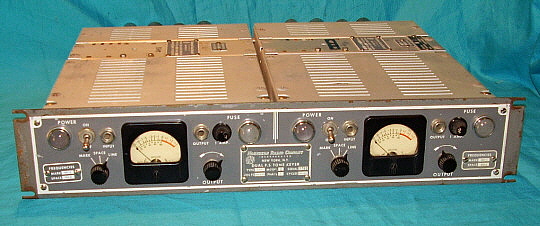
Northern Radio Company Type 153 Model 2 This is a Tone Frequency Shift Keyer built by Northern Radio Company. It is a dual channel unit and both units are completely independent of each other. Fixed tuned filters are used and are set for 85 Hz shift. The tones also use a Mark frequency that is higher than the space frequency. This suggests that this TU may have been used in the VLF wavelengths. It has also been reported that the government state department used the 153 in their RTTY feeds to the VOA stations.12 tubes total are used, six in each unit. I have never used this TU since it is such an odd, apparently special function unit. Mid-fifties vintage. |
![]() |
HAL Communications Co. ST-5 The ST-5 was one of the first TU's to use op-amp technology utilizing the 709C op amp. It came out in 1970 and was available as a kit. Build quality varies considerably. The circuit uses toroid based filters and features a built-in loop supply that is keyed for direct connection to the printer magnets. Later models featured auto-start. |
![]() |
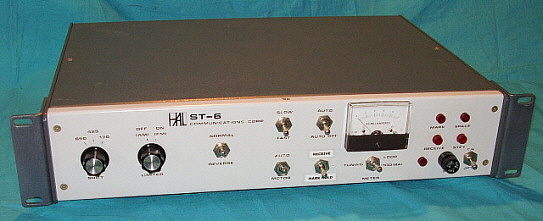
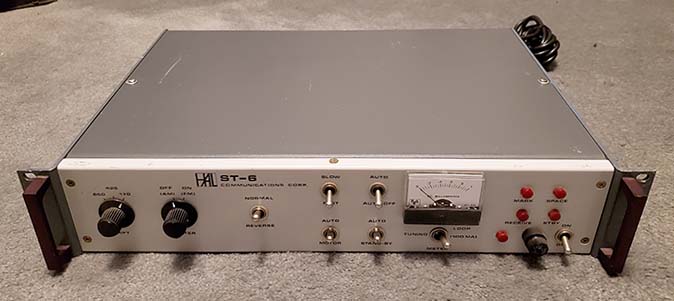
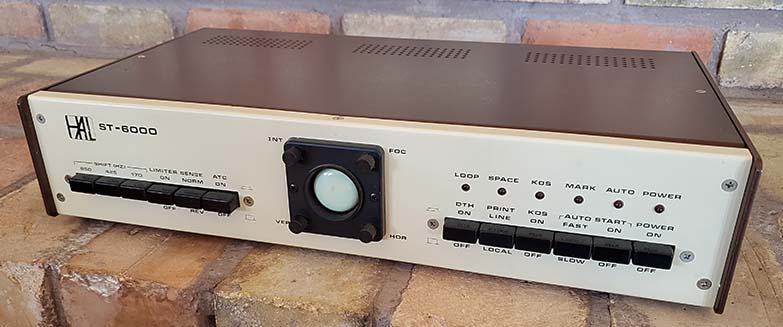
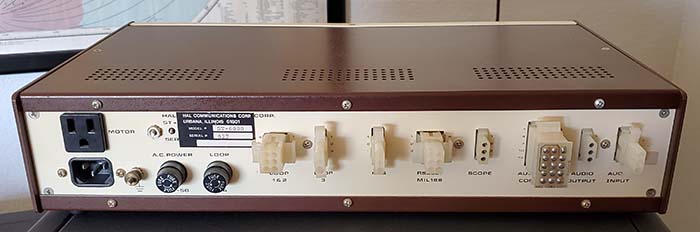
HAL Communications Co. ST-6 The old stand-by,...the reliable ST-6 was (and is) the work horse for real machine RTTY. Using toroid based filters and op-amp technology, the HAL ST-6 is easy to operate and it is easy to tune in stations. The ST-6 is built on eight circuit boards which plug into sockets that are mounted vertically. The meter is cheap and rarely accurate. Some meters are illuminated but most aren't. Early versions of the ST-6 use .25" phone jacks for TTY outputs and RCA phono jacks for inputs. The later versions will have Molex connectors for the TTY outputs. Many ST-6s were sold as kits and therefore the build quality can vary dramatically. When well built, the ST-6 is indestructible and always reliable. Even if you do have to work on the ST-6, it is well laid out and easy to troubleshoot and repair. Too bad it doesn't have the "Dovetron" looks. Built in the mid-1970s. |
![]() |
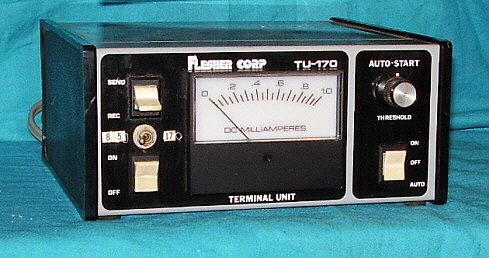
Flesher Corp. Model TU-170 This small TU is mostly op-amp technology and uses active filters for mark and space tuned circuits. It has a built-in loop supply and also has auto-start capabilities. The plastic and metal case is small for the amount of circuitry inside. Dates from the mid-1970s. |
![]() |
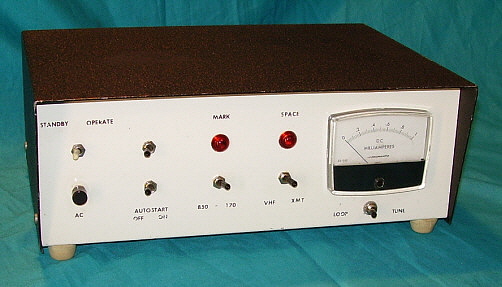
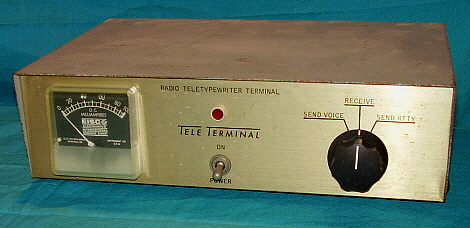
Electronics International Service Corp. (EISC) Model TV1-C "TELE TERMINAL" This TU is a basic unit that provides only TTY decoding with a built-in loop supply. Discrete transistor technology and toroid based filters make this a very simple unit to work on. Normally the AFSK oscillator output would be connected to the microphone input of a SSB transmitter which resulted in FSK signals - at least that was how it was done in the seventies. This TU provided a mic input on the back and then the operator could select RTTY or Voice from the switch and not have to disconnect cables. The TU itself does not have AFSK capabilites. The meter is dated February 1971. |
![]() |
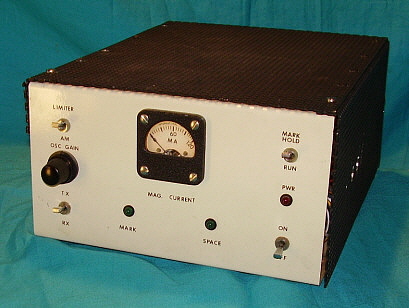
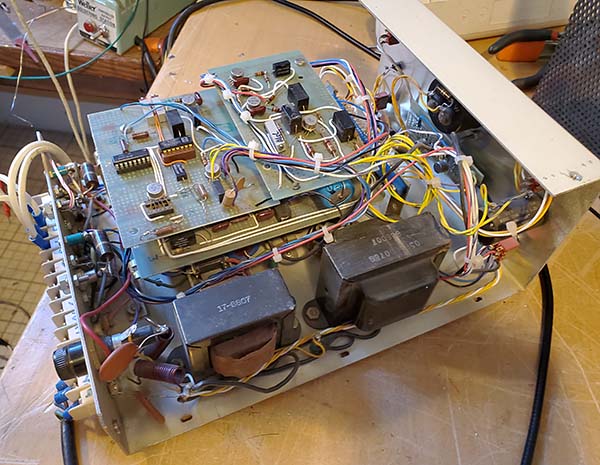
WA7YBS Homebrew TU I designed and built this op-amp based TU in 1975. I decided to use active filters as they were the current "buzz word" at the time. Unfortunately, active filters require a sine wave input and the square wave output of a standard RTTY TU limiter wouldn't work correctly. I used an op-amp based AGC IC (LM-380) for the input so the filters would always "see" a sine wave regardless of the input signal level. At first I had the Q so high on the filters tuning in a signal was next to impossible. The filters have to overlap somewhat for ease of tuning and good copy and this was accomplished with a lower Q in the filters (RC component change.) My AFSK circuit used an Intel "Function Generator on a Chip" (you used to be able to get them from PolyPacks - remember them?) I switched between two fixed 1% MF resistors using a DG-200 micro relay and the system worked quite well. For local copy, I split the output of the AFSK buffer to also drive the input of the TU during transmit. This resulted in an actual received copy on the printer and not the local copy that results from breaking the local loop. It all worked pretty good and I used this TU from 1975 until 1980. Ugly, isn't it? NOTE: I also built one of the W2PAT tube-type TUs in 1975. It used neon lamps indicators and had TV-type adjustable coils in the filters. I later changed the filters to toroid based filters and the whole thing worked much better. I wish I still had it but I torn it up years ago for parts for some other project. |
Henry Rogers WA7YBS © November 2007, new info and photos added December 2009, July 2011
____________________________________________________________________
Donations to Radio Boulevard - Western Historic Radio Museum's Website
If you enjoy using Radio Boulevard - Western Historic Radio Museum's website as an information resource and have found our photos, our hard to find information or our restoration articles helpful, then please consider a donation to the WHRM website. A small donation will help with the expenses of website operation, which includes research, photographing and composition. WHRM was a real museum that was "Open-to-the-Public" from 1994 to 2012 - eighteen years of operation. WHRM will continue to provide its on-line information source with this website, which has been in operation since 1997.
Please use PayPal for sending a donation by clicking on the "Donate" Button below
Website Navigation Index
|
- WHRM History ~ Nevada Radio History ~ The KOWL XMTR ~ Full Length Articles with Photos - |
|
Western
Historic Radio Museum - Information |
Nevada Radio History - 1906 to 1930 |
|
- Wireless Apparatus, 1920s Radio and Communications Equipment ~ Full Length Articles with Photos - |
|
M.H. Dodd's 1912 Wireless Station |
THE
COLIN B. KENNEDY COMPANY |
A.H. GREBE & CO., INC. |
|
|
SE-1420, IP-501
& IP-501A |
Vintage
Long Wave Receivers |
|
- Vintage Communications & Amateur Radio Equipment ~ Full Length Articles with Photos - |
|
National Co. - HRO Receiver |
National Co. -
NC-100 Series |
Hallicrafters SX-28 |
Hallicrafters DD-1 "Skyrider Diversity" |
|
- Rebuilding Communications Equipment ~ Full Length Articles with Photos - |
|
Rebuilding the R-390A Receiver |
Rebuilding the Hammarlund SP-600 |
Rebuilding the
ART-13 Transmitter |
|
Rebuilding the BC-348 Receiver |
Successfully
Operating the BC-375 on the Ham Bands Today |
Building
an Authentic 1937 Ham Station |
|
|
- WHRM Radio Photo Galleries with Text - |
|
Entertainment Radios from 1922 to 1950 |
|
Communications Equipment from 1909 to 1959 - Commercial, Military & Amateur |
|
WWII Communications Equipment |
Commercial & Military |
|
Vintage Broadcast Equipment, RTTY & Telegraph Keys |
|
Radio
Teletype - RTTY - with Real Machines |
Telegraph Keys - 1900 to 1955 |
|
Radio Boulevard
Western Historic Radio Museum
Vintage Radio Communication Equipment Rebuilding & Restoration Articles,
Vintage Radio History and WHRM Radio Photo Galleries
1909 - 1959
This website created and maintained by: Henry Rogers - Radio Boulevard, Western Historic Radio Museum © 1997/2013