|
Radio
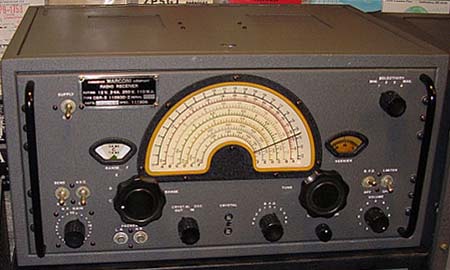
Boulevard CANADIAN MARCONI COMPANY CSR-5, CSR-5A Receivers Receiver No.1 - Type CSR-5 110930-Z - Table Cabinet Version - SN: 394/682 Receiver No. 2 - Type CSR-5 110480 - Rack Mount for CM-11 - Chassis SN: G0 H50 CMC History, Receiver Circuit
Design and Construction, |
|
|
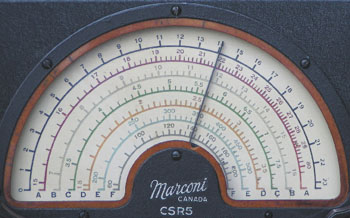
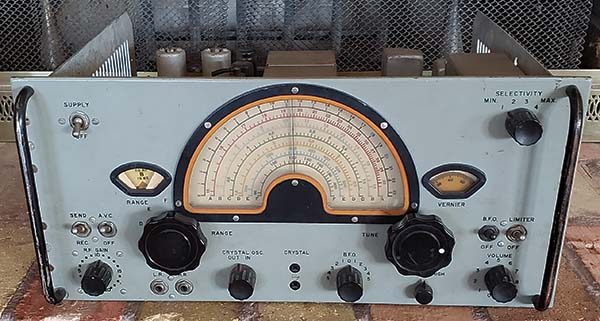
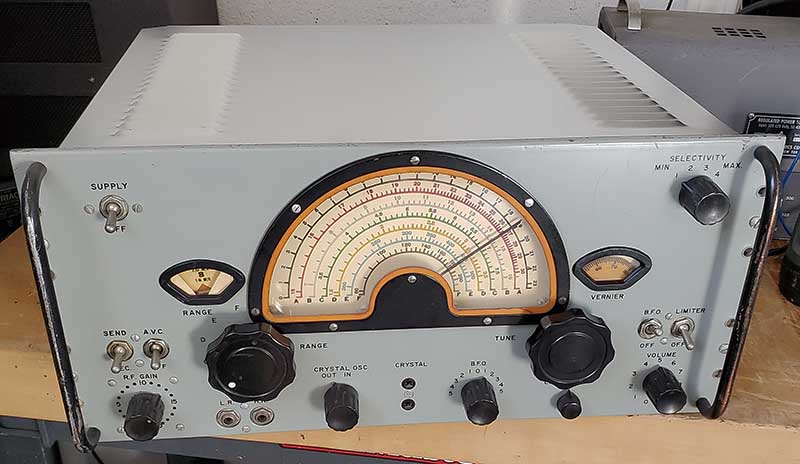
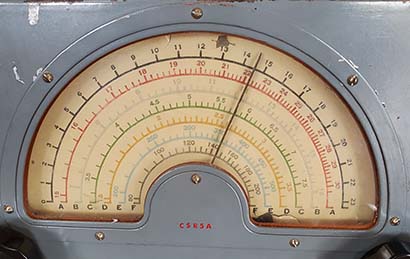
The visually stunning Canadian Marconi CSR-5 receiver is just about as good-looking as a WWII receiver can get. If you're impressed with the appearance of the Marconi/RAF R1155 receiver's semi-circular, multi-colored but non-illuminated tuning dial, you'll become instantly infatuated with the CSR-5's spectacularly illuminated version of the semi-circular, multi-color dial. But what about performance? Is the CSR-5 all looks with nothing behind the dial? The Canadian Marconi CSR-5 receiver's performance and ergonomics are simply superior in every comparison to its British airborne cousin, the R1155 (though that's really not much of a comparison.) The CSR-5 is a first-class, WWII communications receiver that can be successfully used in any amateur vintage military radio station and it's an excellent band cruiser with audio that isn't too bad either. Although many of its CSR-5 sisters may now be shelf-queens, it's more than just a pretty face. The CSR-5 can easily become a favorite of just about any fan of WWII radio equipment by providing superior performance and impressive bench-presence combined with the robust construction demanded by the Royal Canadian Navy. |
|
CANADIAN MARCONI COMPANY A Brief History of the Company - The Canadian Marconi Company started out in 1903 as The Marconi Wireless Telegraph Company of Canada (MWT/C.) At first, the company was part of British Marconi, officially known as Marconi's Wireless Telegraph Company, Ltd., but soon, with Canadian government encouragement, MWT/C became an independent company. By 1919, after the WWI wireless ban was lifted, MWT/C created Scientific Experimenter Ltd, in order to sell wireless ham equipment. By 1922, they were selling broadcast radios. By 1925, MWT/C had changed their name to Canadian Marconi Company (CMC) and entered into a cross-licensing agreement with Canadian General Electric Co., Ltd, Canadian Westinghouse Co., Ltd and Northern Electric Co., Ltd to "protect" their manufacturing patents to the exclusion of other Canadian radio companies. At the same time in the USA the so-called "Radio Group" operated a similar "cross-licensing" arrangement headed by General Electric with Westinghouse, AT&T and RCA as the members (United Fruit Company had been an earlier member of the "Radio Group" but their radio company, Wireless Specialty Apparatus, was purchased by RCA around 1924 and became Radiomarine Corporation of America in 1927.) CMC became involved in radio broadcasting in 1925. During WWII, CMC grew as a company and produced communication equipment for the war effort. In 1953, the English Electric Co., Ltd. purchased a controlling interest in CMC (50.6%.) Sometime later, GEC (General Electric Company - UK) owned controlling interest in CMC. Since that time, CMC has had a multitude of different controlling companies, different owners and many name changes. CMC is still in business making mostly aircraft electronic equipment as "CMC Electronics." |
|
CSR-5, CSR-5A Receivers |
|
|
The CSR-5 Receiver - Brief History - In 1943, Canadian Marconi was contracted by the Royal Canadian Navy (RCN) to build a high quality receiver for their use onboard RCN ships. The RCA AR-88 had been approved for the Canadian military as the general purpose receiver but it wasn't specifically designed for use at sea, although it could easily perform duty at sea. The RCN wanted a "designed for sea use" receiver and wanted to do business with Canadian Marconi even though RCA-Montreal built all of the AR-88LF receivers at that time. The CSR-5 receivers were supposed to be ready mid-1943 but delays pushed initial delivery to either the end of 1943 or early 1944. Around 700 receivers had been ordered and New Zealand wanted another 100 sent to them so these receivers comprised the first of the CSR-5 receivers. Sometime in 1944, the CSR-5A was introduced. This version had several small changes inside and also a few minor changes to the exterior but basically the "A" was very similar to the earlier CSR-5. The most obvious exterior difference is the SUPPLY switch and the SELECTIVITY control locations that are spaced vertically from the top of the front panel down 1.5" for the CSR-5 and down 2" for the CSR-5A. Internally, the CSR-5A replaced two of the 6SK7 tubes in the receiver with 6SG7 tubes. The table model cabinets were slightly different for the CSR-5A using rear chassis guide posts that the CSR-5 didn't employ along with different venting screens. The CSR-5A was built up to 1945 with most of production occurring in 1944. The total production quantity of CSR-5 and CSR-5A receivers wasn't particularly a large number,...CSR-5 authority Jerry Proc estimates that possibly 700 CSR-5 receivers were built and perhaps 1000 CSR-5A receivers were built. But he cautions that this is just an estimate based on known serial numbers and that the exact method of CSR-5/A serial number assignment is not really known.
|
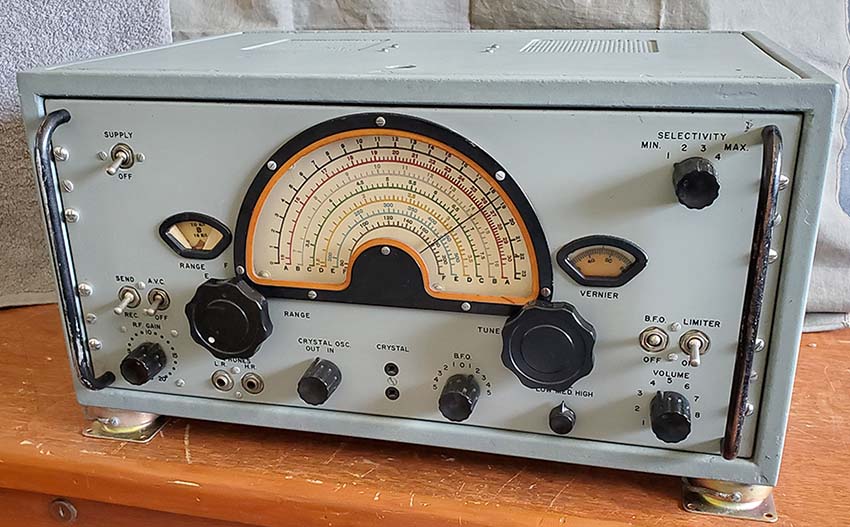
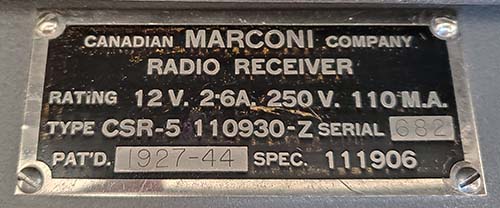
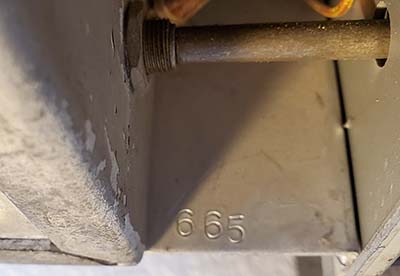
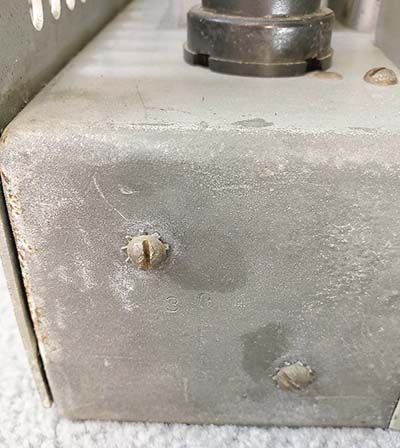
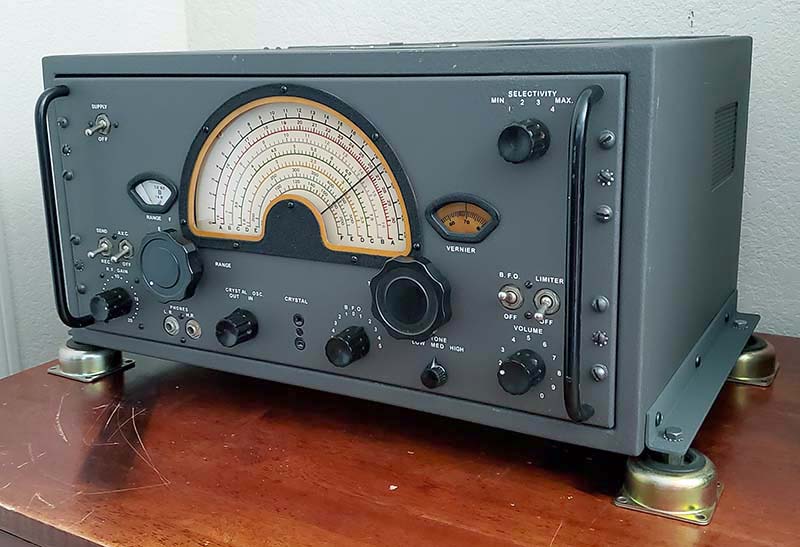
| CSR-5 Receiver No.1 is shown in the photo to the above-left. It's a Type CSR-5 110930-Z (table cabinet type) with the serial number "394" (on receiver chassis - photo further down this page) or "682" (on cabinet data plate shown in photo to the right.) It was rebuilt cosmetically and electronically several decades ago with no regard for originality whatsoever. The panel and cabinet color are a much darker color (other than black) than was normally used on CSR-5 receivers and the white silk-screened nomenclature on the panel uses a font that isn't like the original lettering and the size is too small. I went through this receiver electronically about six years ago and now, functionally, this CSR-5 receiver works very well. The CSR-5 data plate shows the 110930-Z identification as a table model receiver. The serial number of 682 doesn't match the serial number on the receiver chassis, 394. There are several possibilities for how this mismatch could have occurred. |
|
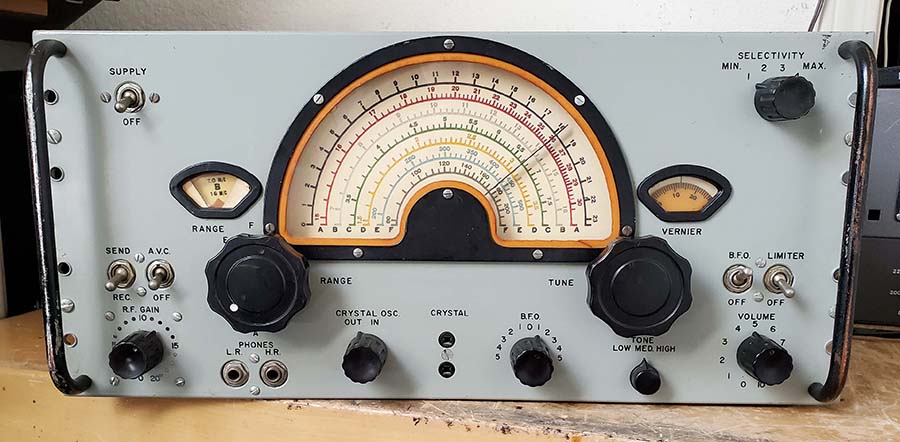
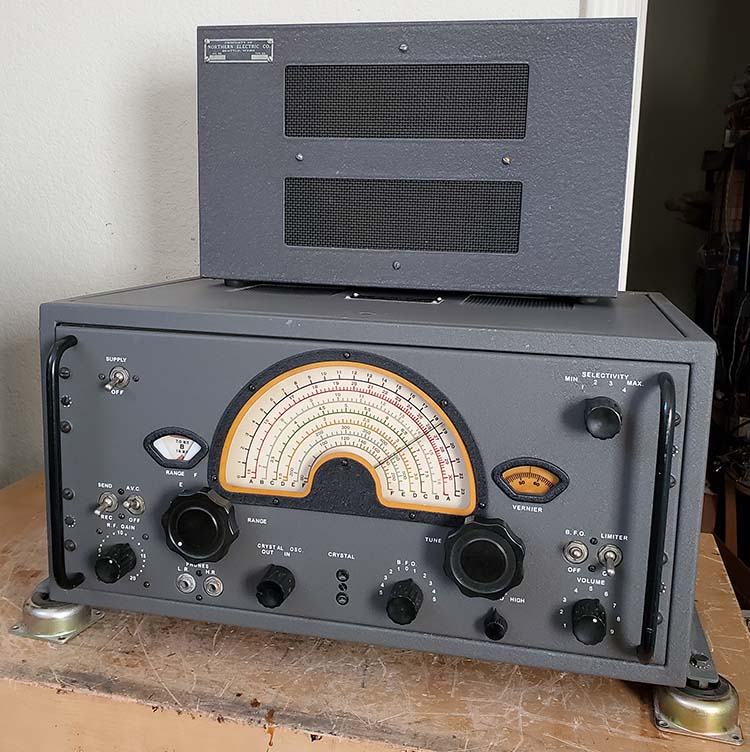
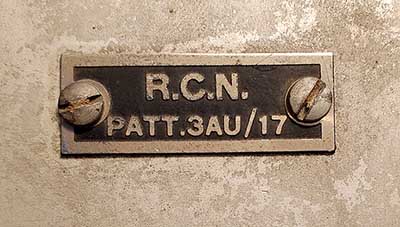
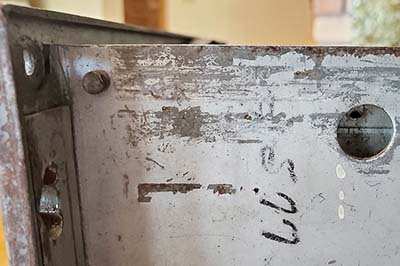
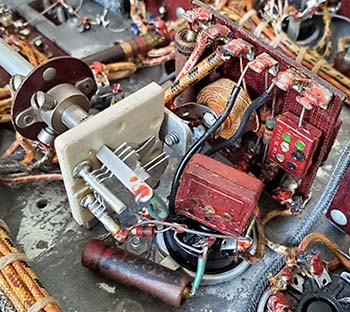
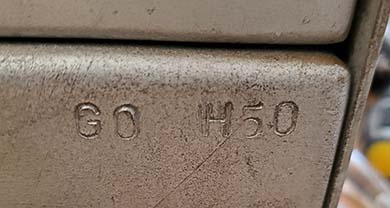
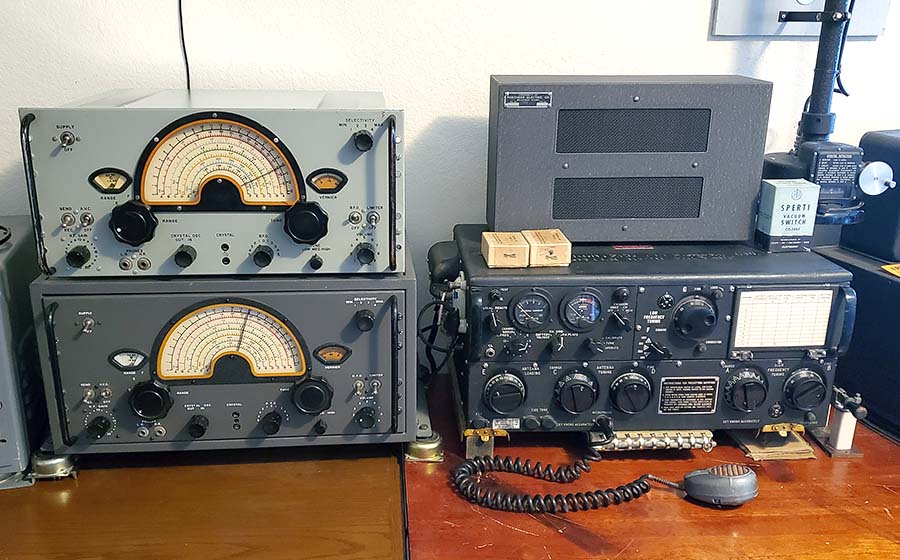
| CSR-5 Receiver No.2 is a rack mount version shown in the header photo above. Its chassis serial number is "G0 H50" and that's punch-stamped on the rear chassis.The data plate was normally mounted to the rear of the top cover and, since the top cover is now gone, the actual serial number is unknown. A metal tag indicating "R.C.N. PATT. 3AU/17" mounted on the left side panel. If the CSR-5 was used as part of the CM-11 receiver-transmitter combination, it would have a smooth semi-gloss light gray panel and the R.C.N. PATT.3AU/17 tag mounted on the side panel (see photographs to the right.) This receiver is virtually all-original,...well, original if the RCN depot reworking and refurbishing from WWII up to the 1950s or 60s is still considered "original." |
|
|
|
|
Where Used - The CSR-5 was used for several purposes, even though its intended primary use was supposed to be aboard ship. Shipboard use required extensive shielding in the receiver to allow its operation along side other equipment without causing interference or radiating the LO from the antenna and for the receiver's reception to not be interfered with by the operation of other shipboard equipment. The CSR-5 apparently met the <400pW LO to antenna requirement. But, the RCN found other uses for the CSR-5 such as surveillance and enemy signal intercept monitoring during WWII. Canada's DOT had a very small quantity of CSR-5 receivers in use at some airports and for some marine port use. These CDOT CSR-5s were painted black crackle or black wrinkle finish with stenciled nomenclature and were probably delivered directly to the Canada DOT from CMC. Most CSR-5 receivers weren't installed onboard ships until the early 1950s. The later version CSR-5A was mostly built after the initial contract of CSR-5 receivers although it's possible that the production overlapped somewhat (probably mid-1944.) It's also possible that some CSR-5A receivers were built up into 1945 but the majority of receivers were built in 1944. |
|
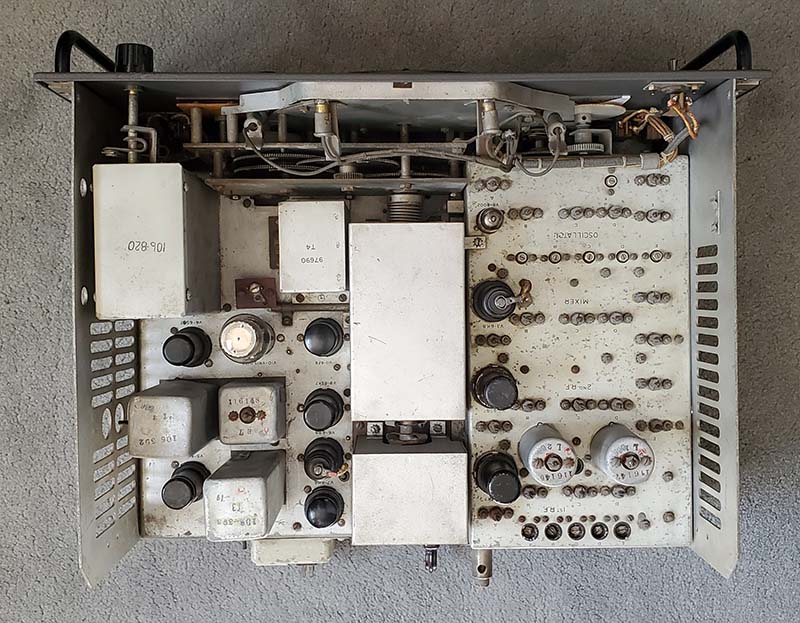
Design and Circuit Details - The CSR-5 receiver's frequency coverage was in two sections, 75kc to 530kc and 1.5mc to 30mc, in six bands. Each scale on the large illuminated dial was color coded. There are two known variations that swap the colors assigned to Bands B and A and that might coincide with the CSR-5A introduction. Also, on most dials the Mauve color, light purple, usually assigned to Band B, is actually gray. Also, later dial scales, probably "As" only, have double lines with indexes while the earlier dial use a single scale line. The CSR-5A replaced two of the 6SK7 tubes with 6SG7 tubes in the 2nd RF and 2nd IF as the major change, however there were many other minor changes in the cabinet vents style, power connector orientation, dial scale index style, etc. Many of the earlier CSR-5 receivers were retrofitted with the 6SG7 tubes which may cause confusion as to the receiver's original designation. Additionally, the manufacturing silk-screen was not changed for the chassis, so many CSR-5A receivers will have hand-modified 6SK7 to 6SG7 tube identification. Rubber stamped ink was normally used but sometimes hand-written will be encountered. When installed onboard ships, a dual shock mount system attached to each side of the cabinet. The two shock feet on each side were mounted to an angle bracket that was bolted to the lower part of each side of the cabinet. To save bench space sometimes the shock feet were mounted directly under the cabinet. The CSR-5 has eleven tubes in the receiver with two RF amplifiers, Mixer (also provides Xtal Osc function,) LO (9002 miniature tube,) two 575kc IF amplifiers (dual wave traps are in-circuit to prevent IF interference,) Crystal Filter (Selectivity positions 3 and 4) AVC/NL, Det/1AF, AF output and Voltage Regulator. The RF Gain control is a stepped attenuator type with 4db steps on the low end and 20db steps on the high end. AF output is 2 watts into a 10K Z load for loudspeaker, both Hi-Z (5000Z+) and Lo-Z 'phones (up to 1000Z) and a 500 ohms Z line audio with a separated winding with link provided for grounding the center-tap. The "Crystal" socket and "Crystal-IN" allowed drift-free operation through a crystal-controlled local oscillator function but the receiver still had to be tuned to the intended receive frequency for the RF and Mixer stages to be "in tune." The CSR-5 Crystal socket only allowed using the large style crystal but the CSR-5A used a different socket that had three receptacles that allowed using either the large crystal types or the standard FT-243 with 0.5" pin spacing. |
|
|
|
Panadapters - There was a Panoramic Adaptor connection provided on the
chassis using a screw terminal connection. Since a panoramic adaptor
could be used with the receiver, a carrier level meter wasn't
required. The panoramic adaptor had to have an input frequency
range that would accept 575kc but the manual never specified
where to find a manufactured panoramic adaptor with that input
frequency capability. Most panoramic adaptors had adjustable inputs that
ranged from 400kc up to 500kc since most receivers used the
standard 455kc IF. More specifically, the US Navy receivers RBB, RBC used a 400kc IF
(required panadapters designed for 400kc input,) the
Signal Corps Hammarlund Super Pro used a 465kc IF, the US Navy-National HRO
and RBJ used a 456kc IF and the USN-National RAO-6, 7 and 9 receivers
used 455kc. Although the CSR-5 has
the capability to allow panoramic adaptor use, it's unlikely it was ever
historically set-up that way. Jerry Proc's website has a concept method
that uses an AM-BC receiver modified to act as a frequency
converter. It's an interesting idea if you really want to use a
455kc input panadapter with the CSR-5. Be aware that the
panadapter connection on the CSR-5, and on almost all vacuum tube
receivers, is a direct connection to the Mixer plate and has B+
present when the receiver is in operation. Most panadaptor input
connections used a very high resistance value in series for isolation. Also, be aware that connecting
a panadaptor to the Mixer stage will generally have a
detrimental effect on the received signal. For that reason, some
receivers had a vacuum tube buffer stage between the receiver's
Mixer stage and the panadapter input, the USN RBB and RBC, for
example, used a panadapter buffer that was an official USN
upgrade kit found installed in many RBB and RBC receivers. Front Panel Color Variations - The CSR-5 and 5A front panels are found in a variety of different paint colors with the most common original color being a wrinkle finish, very light greenish-creamy-grayish color with black nomenclature. Smooth finish semi-gloss light gray is found when the receiver was rack mounted and part of the CM-11 transmitter-receiver rack system. Beige or a light tan wrinkle finish was a common paint color in the stand-alone receivers. Many different shades of gray are often encountered and occasionally black wrinkle finish might be seen. Black Crackle, aka "alligator" finish, along with black wrinkle finish with white stenciled nomenclature was used on the Canadian DOT receivers. These CDOT receivers also had a chrome "Marconi" badge mounted just below the dial escutcheon. There are some examples that were apparently painted dark blue. Along with the different colors, shades and texture variations will be found both black or white nomenclature depending on the panel color used. Most of the unusual color variations might be from post-WWII RNC repaint jobs but, could also be from recent amateur restoration attempts where authenticity wasn't a primary consideration. Restorations nowadays that involve a complete repainting have to deal with the silk-screened nomenclature that will usually significantly complicate any refinishing plans. It's possible that stencils could be used since there are a few apparently original (well,...vintage) examples using this approach. Getting stencils made is certainly possible although somewhat expensive and then doing the actual application and having it look professional would require some experience working with stencils. The same caveat can be applied to rub-on dry-transfers. Unless one has considerable experience in applying this type of lettering, the results will be disappointingly obvious. |
|
|
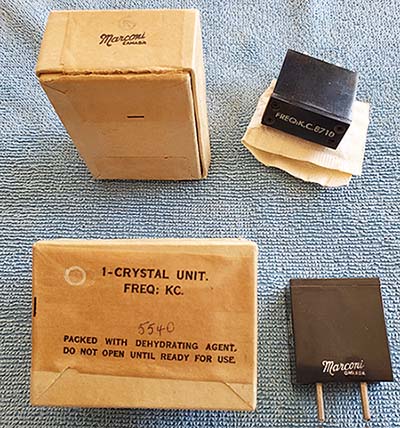
Crystals - Shown in the photo right are two CSR-5 Crystals with their original boxes and desiccant packet. One crystal frequency is 5540kc and the other crystal frequency is 8710kc. The design of these crystal resonators utilizes an air gap meaning that the crystal holder also has ground glass spacers to maintain the proper air gap and the quartz crystal can move slightly within the holder. National Co. crystals in the 1930s HRO crystal filters also used an air gap type quartz crystal of similar design. If "CRYSTAL OSC - IN" is selected, then the CRYSTAL UNIT installed in the front panel socket is connected into the Crystal Oscillator circuit that uses part of the 6K8 tube for the oscillator function. Although the crystal installed determines the frequency of the oscillator, the receiver has to be tuned to the desired frequency of operation so that the RF sections and the Mixer section are also tuned to work with the crystal oscillator frequency that will actually be 575kc higher than the operating frequency. When calculating the desired crystal oscillator frequency, the IF has to be added to the desired frequency. With the crystals shown, for example, 8710kc would provide 8135kc reception and 5540kc would provide 4970kc reception. If the crystal is to be used on a harmonic for operation on Band A one has to remember that the oscillator-Mixer circuit on that tuning range has the oscillator as the higher frequency instead of the lower frequency as on the frequency tuning ranges, B through F. CSR-5 or CSR-5A - Easy Identification - The easiest way to identify whether a receiver is a CSR-5 or a CSR-5A when viewed from the front of the receiver is to observe the position of the POWER switch and the SELECTIVITY control. On a CSR-5, the spacing from the top edge of the panel down to the switch or control is 1.5" but, the CSR-5A receiver spaces these two controls from the top edge of the front panel 2.0" down. Also, the CSR-5 receiver CRYSTAL socket is a two-pin for large crystals and the CSR-5A uses a three-pin crystal socket (for large crystals and FT-243 crystals.) Once you know these differences, the receivers are easy to identify, even from photographs. |
Loudspeakers - Two types of loudspeakers were available for the CSR-5. A table cabinet speaker and a dual rack mount speaker. The table speaker was an eight inch diameter speaker with a 10,000Z ohm to 8Z ohm matching transformer. The dual rack mount speaker is virtually unknown although it is pictured in the manual. It's not specified in the manual if the two speakers had individual inputs (most probable) or if the speakers were connected in parallel with a single input (unlikely, but in the photo on Jerry Proc's website, the CDOT set up shown has one dual speaker panel per receiver implying that perhaps the speakers were connected in parallel.) The photo to the right shows two CSR-5A receivers installed onboard the RCN ship Athabaskan in the early 1950s. Note that it appears the receiver on the left has the "block" lettering on the escutcheon implying it was repainted at a RCN depot. Note the Marconi loudspeakers mounted on the bulkhead above the receivers. These are the standard Marconi table speakers that were available for the CSR-5/5A receivers. Other RCN Mods - The RCN usually added a SO-239 coaxial cable receptacle to the receiver to the chassis just to the right of the antenna terminal board. Original CSR-5 cabinets had to be modified to have a clearance hole added for access to the SO-239. Also, note in this installation on the Athabaskan how the shock mount feet are mounted directly to the underneath of the cabinet on the receivers. This certainly simplifies the shock mount installation and significantly reduced the width of the receiver when compared to the width if the standard shock mount brackets were installed (added about 3" to the cabinet's total width.) The receiver in the center of the equipment is a version of the RAK made by RCA-Montreal, the TE236, that was used to monitor 500kc (although it tunes 15kc to 600kc.) There was an RCN mod that changed the alignment for the lowest tuned frequency on Band F to around 69kc to allow reception of 73.6kc, a RNC Marine Command Broadcast station frequency. |
|
|
|
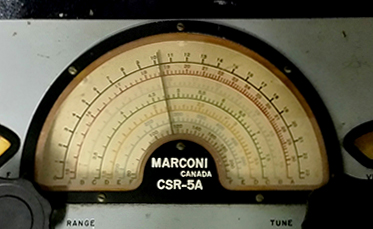
The Dial Escutcheon
- Originally,
the CSR-5 had Marconi
CANADA CSR-5 silk-screened lettering on the
dial escutcheon but, when receivers were refinished by RCN
depots in the 1950s and 60s, many escutcheons were repainted
and only block-letters were used. Many different fonts and
letter sizes were used but, if the silk-screening was done
at a depot, whether the receiver was a CSR-5 or a CSR-5A,
the escutcheon was (always?) screened as "CSR-5A." Some
escutcheons were repainted by the RCN and no lettering was
applied. Both photos are from Jerry Proc's website, www.jproc.ca |
|
|
The VP-3 Power Supply |
|
|
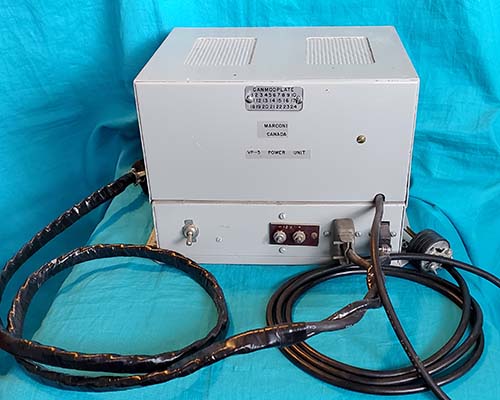
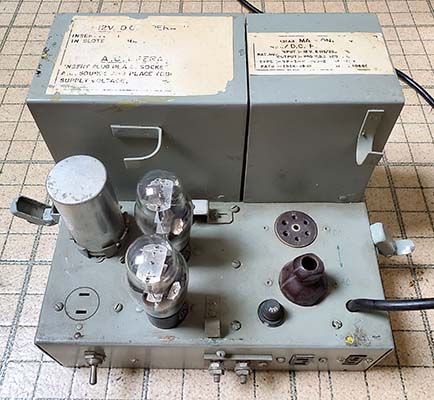
The CSR-5 requires a separate power supply. There was a rack mount AC operated power supply, the WE-11 that was specifically for the CSR-5. The other power supply was the VP-3 that was specifically for the CSR-5A but, since the voltage outputs are the same, it can also be used for the CSR-5. The VP-3 provided 12vac 3A Filament for the series/parallel connections for all 6.3vac tubes, except the BFO and LO that use series resistive loads, that were used in the CSR-5 and +250vdc 110mA B+ with an input requirement of either 12vdc for the vibrator PS or 115/230vac. Two 6X5GT rectifiers are used in the VP-3 bringing the receiver's total tube count to 13 tubes. The two terminals with hex nuts installed are for the 12vdc input if the vibrator supply is desired. Internally, to change from AC operation to DC operation, first the AC plug on the AC cable has to be inserted into the dual slotted opening on the chassis next to the rectifier tube. This actuates a switch under the chassis, S-2. Then the six-pin "option plug - PL-1" is removed from the "AC" socket and installed into the "DC" socket on the chassis. Then the toggle switch on top of the chassis is flipped to "DC." This toggle switch usually has a guard that has to be removed to actuate the toggle switch. Next, connect 12vdc to the + and - terminals and make sure a 12 volt four-pin vibrator is in the socket. |
|
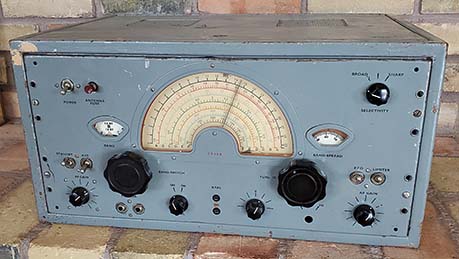
| When operating on DC, the vibrator creates an interrupted DC that is connected the power transformer primary winding that is specifically for the +12vdc vibrator output. This works with the power transformer secondary winding to provide HV to the 6X5GT rectifiers for B+ and another secondary winding provides the 12vac for tube heaters. Only a pi-network is used for B+ filtering. Originally, a spare vibrator could be stowed in clips located on the underside of the top cover. My VP-3 is set up for AC operation. A separate power transformer primary winding is provided for either 110vac or 220vac input. In AC operation, the VP-3 power supply is a very basic power supply with a pi-network filter. The outputs to the receiver are two cables with Cinch-Jones plug connectors. I've wrapped the two cables so as to handle like a single large cable. At the receiver-end, the cable has a non-original single C-J female plug that mates with the non-original 10-pin C-J male plug on the rear apron of the receiver chassis. This is a post-RNC, amateur modification from the original dual C-J connectors to a single larger 10 pin C-J connector. Originally, the CSR-5 used two C-J receptacles similar to the connectors the VP-3 power supply had except the receiver C-J connectors are male. The two pin C-J connector is routed through the cable and to the receiver and then to the SUPPLY switch on the receiver's front panel allowing the operator to switch "on" the VP-3 from the receiver. The three pin C-J connector has 12vac filaments, chassis ground and +250vdc B+. Unfortunately, the clips that help to retain the two-pin C-J plug were removed, probably to allow using the mil-grade AC plug (that does fit into the original C-J receptacle.) Changing this mil-grade AC plug back to the original type of C-J connector would be an easy task (and I do have the proper C-J plug and I did do the change.) Another non-original problem is the AC power cable that is a three-conductor grounded type with a three-pin AC plug. Of course, this AC plug can't be installed into the chassis AC receptacle to switch the VP-3 to DC operation. Replacing the AC power cable with a two-conductor cable and installing a proper AC plug will be necessary if DC operation is to be used. Of course, a dummy plug could be used to actuate the switch. Inserting the AC plug/cable into the chassis socket was a safety feature for DC operation preventing inadvertent or accidental "plugging in" the AC line during DC operation (if both power sources were available.) |
|
|
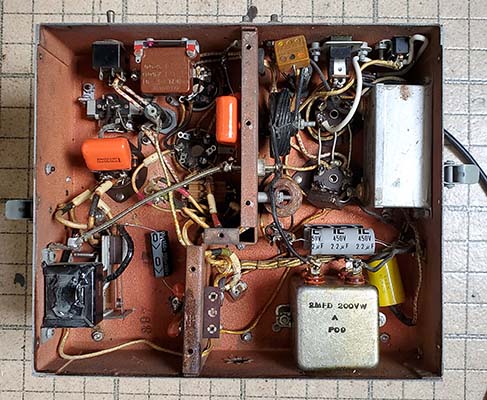
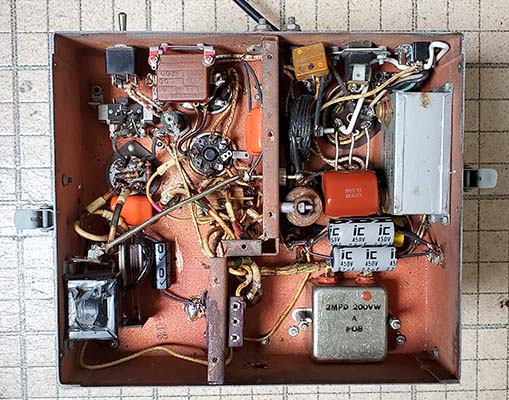
VP-3 Inspection and Repair - Apr 11, 2026 - I've owned this VP-3 since 2010 but I don't think I ever pulled the bottom cover off. If I had, I would have immediately seen the two 2uf oil-filled tub capacitors that were leaking oil. The oil was all over the bottom cover. The terminal seals were the red rubber type that are also found on the tub capacitors used in the WWII AR-88 that also are very prone to leaking oil (these seals are over 80 years old so oil leakage is a common problem.) Additionally, some of the capacitors had been replaced with orange drops and IR electrolytic capacitors. The two 22uf electrolytic capacitors for the B+ filter weren't soldered at the ground connection,...I guess there must have been enough contact to allow filtering since I never experienced hum in the CSR-5. The capacitor replacement workmanship was the worst I've seen in a while and looked like everything was done in a "rush" with components installed with hook-splices and glop-soldering. All of the replacement parts needed to be removed, the mounting terminals cleaned of the excess solder, then remounting the component using insulating sleeving on the leads and a proper soldering technique employed for the reinstallation. |
|
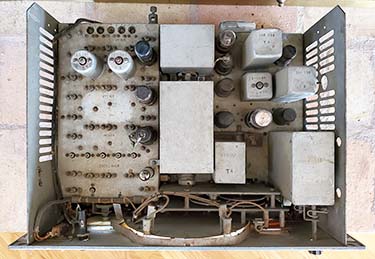
| I removed the top 2uf tub cap because that was the one that was leaking oil. I left the other tub cap installed since it wasn't leaking oil (yet) but disconnected from the circuit. I electronically replaced tubs with a 4uf 400vdc non-polarized capacitor just in case I want to try DC operation sometime. I dismounted all of the newer components and added sleeving to the leads. Then the components were remounted neatly and soldered correctly with real SnPb solder. A 16-2 AC power cable with mil-grade 2-pin plug was installed. Although the VP-3 seemed to be working fine before the clean-up operation, it sure didn't look like it would have worked very well at all. Now, with the underside looking better it's surprising that there doesn't seem to be any change in how the VP-3 operates. |
|
CSR-5 SN:394 Re-Restoration |
|
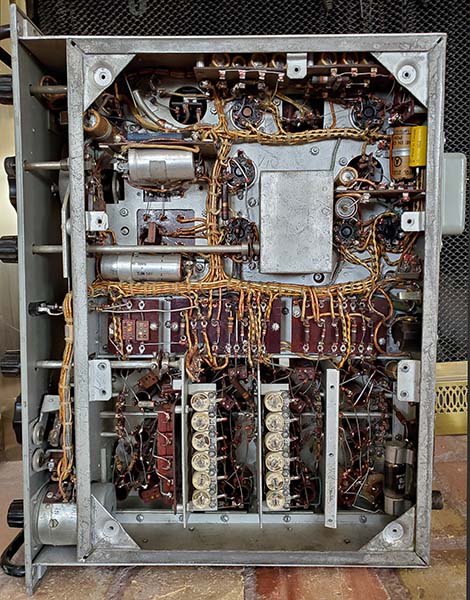
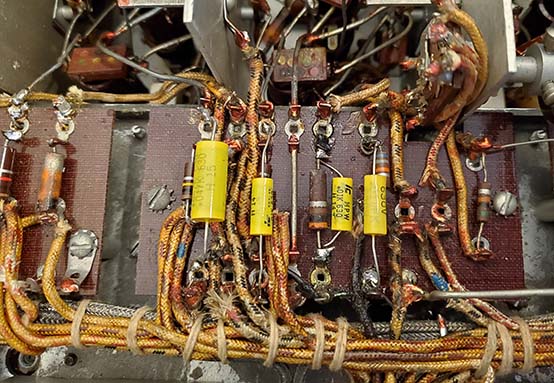
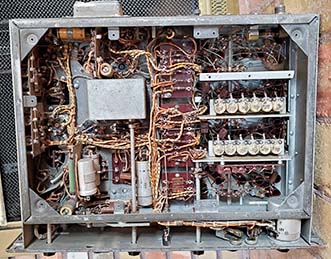
Earlier Restoration Dissatisfaction - I obtained CSR-5 SN:394 around 2010 from a fellow collector that brought it to the Western Historic Radio Museum in Virginia City, Nevada. The receiver had been cosmetically restored earlier by another collector-restorer. This earlier owner had the cabinet and panel powder-coated in a grayish-brown color that was substantially darker than the light greenish-gray or beige wrinkle that has been found on most of stand-alone CSR-5 receivers. The collector that was selling the CSR-5 to me had obtained the receiver in "unfinished" condition and needing some electronic work. Electronic Work - A "re-cap" job had been performed that wasn't particularly sympathetic using "yellow jackets" (poly-film caps) and IC electrolytics. When installing replacement capacitors, many were mounted over the resistors on the component boards rather than going through the extra work to mount all of the capacitors on the backside of the component board as original. Most of the capacitors were connected using "hook joints" that were soldered rather than dismounting the old component completely and installing the replacement component directly to the terminals. Some components were left "hanging in the air" rather than using the correct lead dress as original. Although the receiver did function (and that was probably all that was desired,) underneath looked amateurish and sloppy. Cosmetic Work - Besides the mayhem under the chassis, I had always been disappointed at the color choice for the powder-coat paint job. Although it certainly could be argued that the CSR-5 receivers are found in quite a variety of color schemes, many of which are vintage, meaning that some color variations do have RCN provenance. However, the dark brownish-gray color does nothing to compliment the great CSR-5 aesthetics, though I suppose that's just my subjective opinion. Then there's the silk-screening that at first glance appears to be not centered at the control locations. For quite a while I thought the silk-screening had been carelessly done and that accounted for the "off-center" look. However, when I acquired an original CSR-5 SN:G0H50, I was able to compare the original silk-screening and I saw that the "off-center" nature of the nomenclature is original and, therefore, the silk-screener of SN:394 had been accurate in the locations of the nomenclature. But, the size of all of the nomenclature is too small and not the original style font. Also, the nomenclature color had to be white because of the dark panel. The smaller size and the white color of the nomenclature actually enhances the "off-center" appearance making it look more apparent. Once I had obtained the receiver, I repainted the dial escutcheon black wrinkle finish because it had been flat black with white dry-transfer rub-on "block" letters that weren't original and were obviously an amateur application. I also made new cables for the power supply to receiver hook-up since the cables that had been used were made from very small gauge wires that didn't look sufficient to provide the power supply connections without a substantial voltage drop on the 12vac line. I didn't do anything else to the receiver except use it for a couple of test-listening sessions and then put it on display in the Western Historic Radio Museum in Virginia City, Nevada. Unfortunately, although a repaint would certainly be possible, the silk-screened nomenclature is virtually impossible to duplicate and have the results be close to the original and appearing professional. However, when looking at many of the CSR-5 and CSR-5A receiver photos on the Internet, there are examples with much worse paint-jobs and much worse nomenclature reproduction attempts. At least, homely as it is, this cosmetic restoration is in excellent condition. Correcting Some of the Electronic Mayhem - Fast-forward to 2020,...I had closed WHRM in 2012 and moved to Dayton Valley, Nevada. The CSR-5 had been stored for the past seven and a half years in my "cool room" in the shop in Dayton Valley, a well-insulated and very dry storage room where the temp extremes are from 30F to maybe 75F and it's always dark,...unless I turn the lights on. I had just recently gone through a Marconi/RAF R1155 and its impressive multi-colored, semi-circular dial got me interested in that large multi-colored "half-circle" dial on the Canadian Marconi receiver. I had to extract it from the "cool room" and bring it into the house and upstairs to the radio repair lab to take a better look at it and reacquaint myself with how it performed. As far as performance, the CSR-5 still worked as it had before,...okay, but seeming like it could do much better. The tubes tested okay but the band switch was very erratic and needed cleaning with DeOxit and a small paint brush. All controls were given the DeOxit treatment. The split-gears in the tuning gear box were stuck together so a flush with WD-40 loosened them and that eliminated the backlash. The BFO and NL toggle switches seemed non-functional but a "spray down the barrel" with DeOxit cleared up the problem-causing internal oxidation. I was positive that neither of the former owners I knew about had performed an alignment. If a full IF/RF alignment hasn't been performed, doing one will certainly improve performance significantly. The IF adjustments and RF L adjustments all have lock-nuts so be sure to loosen them when adjusting. When snugging-up the lock nut be sure to kept an eye on the receiver output to verify that the adjustment doesn't change with the lock-nut tightening. With this CSR-5, all of the alignment adjustments were far enough out that quite a bit of improvement was gained by the procedure, especially the tracking which now easily meets the 0.5% accuracy tolerance specification (marker stations are right-on frequency but the dial resolution is very limited.) |
I checked the "problem C123" location since
this receiver was a CSR-5 with a serial number lower than 816.
C123 was entirely missing. It's not a critical component but
it should be present to take care of high frequency transients and
protect the output transformer primary. NOTE: On early CSR-5
receivers, C123 was connected to the wrong terminal on T4 and
required correction. It's likely that by now all CSR-5
C123 connections have been corrected. C123 should be a 2200pf
capacitor (square mica-type) connected to pins 4 and 5 on the audio output
transformer T4. Also noted were two of
the connections to T4 output xmfr weren't soldered and several
others were "tack soldered" connections. All connections to T4
had to be completely redone. I checked over all of the "new" solder joints
under the chassis and corrected those that looked questionable
(a lot of 'em.) The RF
Gain control connection to chassis needed to be redone. I
shunted the series "re-radiation resistor" in the antenna
connection (it had been changed from original 1K to a 10 ohm
carbon composition resistor, but I shunted it anyway.)
|
|
| It's worth noting that on the data plate, while it's for a
CSR-5 Type 110930Z, it has the SN:682 stamped and yet stamped on
each side and on the rear chassis apron of the receiver is "394"
which I assume is the actual receiver's serial number. Cabinet
swapping during RCN depot repair might account for the
discrepancy. The RNC depot scene was probably comparable to the U.S.
Army Signal Corps depot repairs of BC-348 receivers where it was very
common to find the receiver installed into a non-matching
cabinet, e.g., a BC-348-Q installed in a BC-348-R cabinet. It's also possible that maybe there never was any
attempt at CMC to assure that the receiver chassis serial number
matched the data plate serial number on the cabinet. One note is
that the CSR-5 receiver chassis will not fit into a CSR-5A
cabinet due to the rear chassis locating pins inside the "A" cabinet. All of the front panel screws were new, non-original type, black Phillips head screws. This was another example of using non-authentic hardware just because it's easy to find and looks new. The original screws used on this receiver were round head slotted machine screws although some CSR-5 receivers will have binder head slotted screws installed. As long as all screw types match, it's an indication of original hardware or a careful restoration. I replaced all of the screws with the vintage correct types that were "raven finish". The external tooth locking washers were used to match the other locking washers used in the receiver. I wanted to set up the CSR-5 with the shock mounts. I found a set of Barry shock mount feet on eBay and purchased the 1"x 1" mild steel angle locally. The angle brackets were built and then painted wrinkle finish using VHT Gray Wrinkle Finish. The VHT Gray has a lot of brown in the mix and it was a close match,...well, maybe one shade more towards gray but close enough. I've set CSR-5 SN:394 up as the station receiver with an ART-13A transmitter. Maybe not an original combination but both pieces are WWII veterans and work together nicely. |
|
|
Performance - Overall, CSR-5 SN:394 is a good performer that is fully capable of operating as a station receiver in an amateur vintage military radio set up (providing the particular Mil-Rad Net is operating AM on 75M.) The receiver is robustly-built and that provides excellent stability which is helped by the VR tube and filament loads on the LO and BFO tubes resulting in very little drift after a short warm-up. Sensitivity is competitive, especially if the receiver has been "gone through" and has had a complete IF/RF alignment and is used with a full-size, resonant (or tuned) antenna. Selectivity is very good if the crystal filter is operating correctly. It's a minor negative point that there's no front panel Phasing control for the crystal filter. The IF alignment instructions have C-64, the phasing trimmer, set to minimum bandwidth and that's generally the desired function for a Crystal Filter. This CSR-5 has some very slight heterodyne distortion on frequencies above 10mc that's more noticeable when using the VP-3 power supply. The distortion is also present when using a Lambda bench power supply indicating the problem isn't in the power supplies used. It's probably due to the "hamster" rebuild workmanship in the recapping of this CSR-5,...and that hasn't been corrected,...yet. Marker frequency stations, such as WWV, are "right on" the correct index indication on the dial. On the down side, the dial resolution is vague at best, especially on SW. This is due to the wide frequency coverage of each tuning range and is typical and expected of any WWII vintage receiver. The logging dial and logging scale on the dial will provide an accurate method of frequency reset ability. I'm using an eight inch Jensen speaker mounted in a Northern Electric Co. loudspeaker housing that looks a lot like an old RME speaker housing with a Northern Electric data plate installed. But, it matches the CSR-5 quite well. To match the 10K output impedance, I'm using an 8K ohm to 8 ohm matching transformer spare that originally was for the Signal Corps LS-3 loudspeaker. |
T-R function is accomplished using the Send-Rec "AC receptacle" on the back of the chassis apron or one can use the SEND-REC toggle switch on the front panel and then utilizing the remote standby contacts on the T-R relay inside the ART-13 transmitter. The ART-13 also has a vacuum receive antenna switch for receiver isolation during transmit. The CSR-5 is a "heavy-weight" and when installed in the cabinet with the shock mounts weight is up around 75 pounds. The receiver chassis weighs about 45 pounds. The all-steel cabinet is very heavy, weighing in at about 30 pounds. Then add the VP-3 power supply at about 25 pounds but my cables are long enough so the VP-3 sets on the floor. It all adds up to a formidable weight experience unless the pieces are disconnected and moved separately including removing the CSR-5 chassis from the cabinet. Update - Oct. 12, 2020 - I've been using the CSR-5 in combination with the ART-13A for a few of months now. It has proven to be one of my favorite WWII receivers to use. I've found it to be sensitive enough for 100% solid copy on all military radio net operations on 75M. Selectivity is good enough for dealing with adjacent frequency activity on all occasions. Audio quality is good and allows for excellent voice reproduction. I use the logging dial for accurate frequency reset. Minor points might be the AVC action which has a very slow "release time" which for CW is fine but for Voice could be a bit faster - very minor. Also, no antenna trimmer on the front panel (matched to the antenna during alignment.) A great receiver to use with fabulous bench presence. 630M Operation? - I've been using the CSR-5 on 75M for several months now. It's set up with the ART-13A from SAAMA. It's the same ART-13A and CU-32 combo that I used on 630M a couple of years ago. I had a 630M hiatus due to an ART-13A power supply modification that involved using a separate linear 25A power supply for the 28vdc supply. It turned out that in CW, this 25A power supply would "kick out" its breaker immediately with the first "dit." Voice operation was better but still random "kick outs" did happen. In November 2020, I purchased a used Lambda SWS600-24 switching supply that was rated at 25A and could be adjusted to over +30vdc. This power supply has solved all of the issues I had with using the linear supply. So, now 630M CW operation is possible again. A couple of years ago, I was using the Hammarlund SP-600VLF as the receiver and the receiving antenna was a homebrew 6' remotely-tuned loop. However, the SP-600VLF has been moved downstairs and I now have the CSR-5 as the station receiver. I needed to do a test of the CSR-5's MW reception performance. Also, the homebrew loop is history and I've been using a Pixel Shielded Magnetic Loop for MW reception. So, the test was to see what I'd receive using the CSR-5 and the Pixel Loop. Actually, performance was a real surprise. I tuned through the 300kc to 420kc part of the MW band to see what NDBs were present. Quite a few, with LLD 352kc in Hawaii and YXL 390kc in Ontario, Canada being noticed as pretty good DX. The "blowtorch" NDBs like MOG 404kc or QQ 400kc were extremely strong. Several of the 25W NDBs were received out to the midwest. So, this indicated that the CSR-5 was a capable receiver when using the Pixel Loop. How about what was on 630M? From 472kc up to 479kc was occupied by about five JT9 data signals, one of which was very strong. I did hear some very slow CW around 473kc but the signal wasn't on but a few seconds. What the test indicated was that 630M CW using the CSR-5 with the ART-13A and operating with a scheduled QSO is very possible. Due to the JT9 data users occupying most of the 630M band, calling CQ on CW is usually a futile effort. Setting up a "sked" is the best method to assure a 2X QSO on CW. UPDATE: Heterodyne Distortion above 10mc - Apr 14, 2026 - I've been running comparisons between the SN:394 and SN:G0H50 using both the Lambda 25/12vac transformer power supply and then using the Canadian Marconi VP-3. When testing SN:G0H50 with either power supply, the operation is identical. Heterodynes on the higher frequencies are clean with no modulation distortion. Not so with SN:394. Using the Lambda 25/12vac transformer power supply, there is a noticeable modulated distortion of heterodynes on 20M CW signals. SSB signals also have a slight modulated distortion on 20M. Lower frequencies are less affected,...in fact, the modulation distortion is not noticed at all below 10mc. Using the VP-3 enhances the higher frequency modulation distortion of the heterodynes a bit more. It's certainly more apparent and makes tuning in 20M SSB signals difficult. The interesting aspect of this problem is that SN:394 was completely recapped while SN:G0H50 is all original except for vintage RNC repairs. On SN:394, due to the careless recap job I suspect that lead dress, that is, the way components are mounted and the way wiring is routed, might be causing the problem. Many of the capacitors were mounted over resistors rather than under the component board. ALL of the polyfilm capacitors used in the "recap job" were mounted with "hook-splices" utilizing "clipped and then bent" leads with "glopped-on" solder joints resulting in much longer leads than were originally used in assembly. This is a very poor method of rebuilding that almost always results in minor anomalies that will annoy some users or go completely unnoticed by others. Sloppy rebuilding and changing the original lead dress will almost always cause minor issues in RF and IF circuits and in Oscillator circuits. I think the solution to this problem would require a substantial amount of rework. In fact, I would probably "strip-out" the all of the "rebuild" capacitors and start over using new capacitors mounted "as original" in a professional technique that would assure the component is in the correct physical location and is mounted and soldered as original. But,...I have to consider this plan for awhile,...it would be a formidable project and I might be just a little bit OCD (an issue with perfectionism) about a minor problem. The CSR-5 does work fine, especially on AM on 75M (where and how it's primarily used.) |
|
|
CANADIAN
MARCONI COMPANY
|
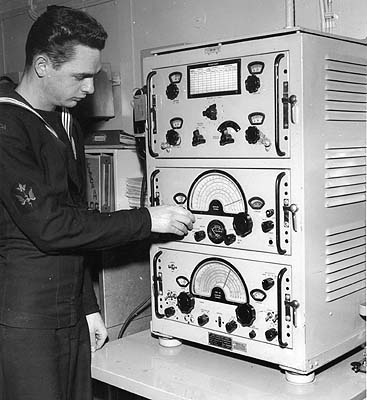
| Data Plates, Serial Numbers and R.C.N. Tags - SN:G0 H50 has a small metal tag mounted on the right side panel of the receiver with "R.N.C. PATT.3AU/17" on the tag. The CM-11 transmitter had a similar tag installed on its side panel with "R.C.N. PATT.3AU/18" on its tag. The presence of the 3AU/17 tag on this CSR-5 is confirmation that the receiver was part of a CM-11 Transmitter-Receiver combination. This receiver was originally rack-mounted but someone removed the top cover and also removed the two D-zus mounts on each side panel at the back. This top cover removal was very common with rack-mounted equipment and a result of the misplaced belief that the top cover retained heat and caused failures. It's very seldom that rack-mount receivers, especially when going through maintenance facilities several times over many years, were able to retain their original top covers. Unfortunately, the data plate was mounted on the rear of the top cover and the data plate had the actual serial number stamped on it. See photo below-right showing the complete CM-11 Transmitter-Receiver,...well, complete except for the ZM-11 power supply that mounted underneath the operating table. The bottom unit is a CSR-5A receiver, the middle unit is the CM-11 transmitter (a potent 100W CW transmitter using an 813 PA, less output power in MCW or Voice) and the top unit is the Antenna Tuner. |
| Initial Inspection: Problems Found
1. Yellow power cable exiting
the rectangular hole that originally had the two pin Jones connector.
This was a fairly modern three conductor cord that had the black and
white wires connected to the Power switch wires using crimp splices.
Removed. |
|
| 6. BFO toggle switch is a replacement that is "raven finish" and doesn't
match the other toggle switches. I'll change to the correct type of
switch. (switched the switch. Installed a matching A-H nickel toggle
switch.) 7. Right side grab handle slightly bent inwards. Will have to remove to straighten. 8. All of the 12 volt 1 C.P. had blackened glass bulbs. They all had good filaments but I replaced them with NOS #53 bulbs since some of the black deposits were quite dark. 9. Range E color on dial is light blue but color on indicator is light green. Range E on SN:394 is a bluish-gray color on dial and gray on the indicator. Faded colors? 10. Four of the five small knobs are missing their white index "dot." Looking at vintage photos it's difficult to tell on CSR-5 receivers if the "dots" were filled or not. 11. Tested all tubes on the TV-7 tube tester. All tubes tested >50% above minimum acceptable. Several of the tubes are Marconi brand or they have "Made for Canadian Marconi" stamped in red on the tube (metal octal type.) |
|
|
Front Panel and Dial Cleaning -
Mar 29, 2026 - Removed all of the knobs. Dismounted the all
of the toggle switches, phone jacks, crystal holder and the RF Gain pot.
Four 8-32 BH slotted screws mount the front panel which was then
removed. Cleaning is much easier with the front panel separated from the
receiver. The front panel was very dirty, although it really didn't look
like it was. I used Glass Plus, WD-40 and finally Isopropyl Alcohol to
remove all of the different kinds of crud that was on the front panel.
None of these cleaners had any effect on the nomenclature
silk-screening. Cleaned the dial with Glass Plus. The dial was also very dirty and required several cleanings to remove all of the dirt. Some dirt deposits were also in the colored scales and that required Glass Plus and a soft small paint brush to clean out of the engraving. Cleaned the logging dial carefully but the silk-screen ink wasn't affected by the Glass Plus. Cleaned with white plastic index plate. Cleaned the tuning range indicator. Cleaned the front part of the chassis and lubricated the range switch dent and the gear bearings for the range indicator. Lubed the control shafts. Remounted the front panel to see how things looked now,...big improvement. Front panel color went from a greenish-grayish color to very light gray. |
|
|
Cleaning Disaster,...well,...a mini-disaster - Mar 30, 2026 - I cleaned the knobs and reinstalled them. I started cleaning the chassis, beginning with the RF deck. This appeared to have a coating that was applied over dirt, maybe. Nothing seemed to remove the dirt, except Isopropyl Alcohol applied with a Q-tip. Then I applied more alcohol using a small paint brush and in a few seconds the coating wrinkled and lifted. It appeared that the coating was silicone-based due to the way it "balled up" in clumps as it was removed. It didn't appear to be from WWII but maybe some later application that was over the entire RF deck, including ALL of the alignment adjustments. Originally, a thin coating (probably lacquer) was only on the silk-screened nomenclature. Since the alcohol didn't seem to affect the silk-screen nomenclature, I started to remove the silicone coating. Well,...I thought the silk-screening wasn't affected. Actually, if the alcohol was left on the silk-screen lettering long enough, it did dissolve the lettering too. It takes longer,...but it will happen. So,...don't try to clean the chassis with anything other than WD-40 or Glass Plus. This now absent nomenclature on the RF deck doesn't really affect anything electronically,...just visually. The alignment instructions show where the adjustments are located and I have the other CSR-5 receiver as a reference. |
|
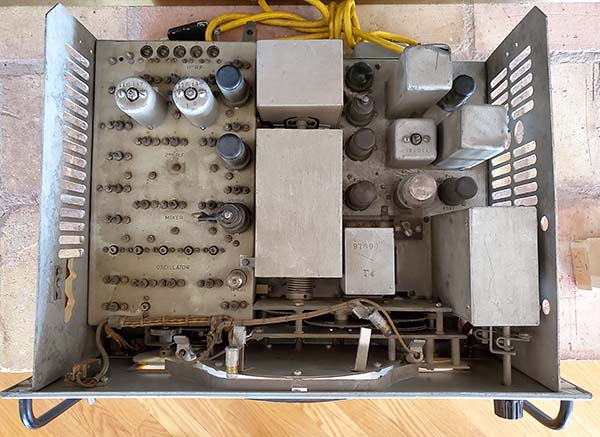
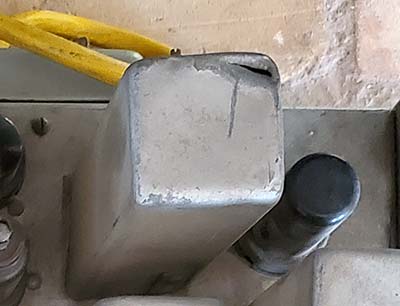
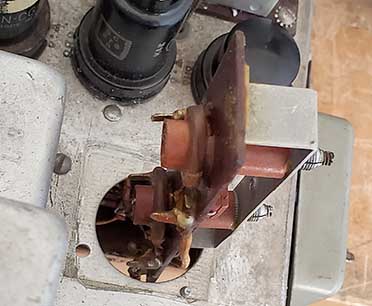
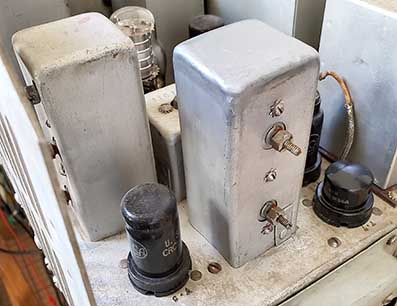
Still,...it's too bad I didn't test the Isopropyl alcohol more thoroughly before applying massive quantities on the RF deck but this type of "rubbing alcohol" is so mild you can rub it on your skin for a "rub down" so I didn't think it would have the effect that it did. And, as mentioned, this was some later silicone spray applied over everything on the RF deck, dirt, alignment adjustments and all,...not an original coating. Power ON Test - Mar 31, 2026 - I used a 12vdc 2.5A power supply and clip-lead connected the positive to the Cinch-Jones bottom pin of the power connector. Negative was connected to the center pin. I used another clip-lead to short the POWER wires (simulates the POWER switch being ON.) I switched on the +12vdc and the dial lamps slowly illuminated and I could see the tube heater in the 9002 tube. I put the Lambda 25 on the bench and connected +200vdc to the top pin of the Cinch-Jones connector and switched on the Lambda. The CSR-5 had a loudspeaker connected and a ten foot long test wire for the antenna. Background noise and no hum since I was using the Lambda. The controls were scratching and dirty but I was able to tune in 15mc WWV coming in strong. Tuned a few 20M CW hams. I tuned down to 40M but since it was about 0830hrs, nobody was on,...but then, I was only using a 10 foot wire for the antenna. Not bad for an initial power-on test. Later I connected the Collinear Array for the antenna. Copied hams on 40M and on 20M. I had to reset the BFO knob. I also had to spray some DeOxit down the barrel of the AVC switch to get it working. NOTE: I based my decision to not recap this CSR-5 on the experiences of Gerry O'Hara VE7GUH and his restoration of a CSR-5 that he wrote up in a SPARC article "Restoring a Marconi CSR-5 - A Canadian WWII Classic." In his write-up Gerry related that he tested the original capacitors that he pulled while doing the recap of the receiver. He found that all but one capacitor tested good. It's comparable to the USN RAO-7 receivers that seem to operate quite well on all original parts. Of course, this applies only to receivers that have been well-taken-care-of and were stored indoors their entire existence. It certainly doesn't apply to receivers that have been stored for decades in an unheated shed with a leaky roof and a voracious rodent population. At any rate, I'll see if any problems develop from this decision, but I doubt they will. SN:G0H50 appears to have always been kept indoors and is in excellent physical condition. I almost never replace capacitors in WWII vintage gear,...well, unless they're Micamold capacitors. The CSR-5 uses most Aerovox capacitors and that's a pretty good brand. Here is a link to Gerry's SPARC article: https://sparcradio.ca/wp-content/uploads/2020/03/Canadian-Marconi-CSR-5-Receiver.pdf Detailing - I pulled the cover on the tuning condenser and used a small paint brush to apply DeOxit to the rotor contacts. The shield over the three gang condenser is easy to remove but the shield over the 1st RF/Ant stage has two screws on top of the chassis and then two nuts under the chassis that need to be removed before the shield can be dismounted. I cleaned the rotor contacts on the RF condenser also. Afterwards both shields were remounted. I used a small paint brush to apply DeOxit to all of the band switch segments. Replaced several missing 6-32 BH machine screws for the bottom covers. Tested on 20M, copied several SE USA hams on USB. The Dilemma of the Cinch-Jones Connectors - Luckily, the three-pin male Cinch-Jones (C-J) connector for the B+, Ground-Chassis and the 12vac tube heaters is present. However, the two-pin male C-J connector is missing. This connector is for the two wires that run up to the POWER switch and allow turning on the VP-3 power supply from the receiver. A large yellow power cable had been connected directly to the original wires using crimp splices probably because the original C-J connector had broken. I removed the yellow power cable and have been powering the CSR-5 using a +12vdc 2.5A power supply and the Lambda 25 for the +240vdc B+ that are connected to the 3 pin C-J connector pins using clip-on test leads. Once I have a proper C-J male connector installed then I can use the Canadian Marconi VP-3 power supply to run the CSR-5. So far, it's been difficult to find the proper connector in the size that fits the opening, or L=0.875" x H=0.50" and the connector body has to have a mounting flange that allows mounting in a horizontal opening for the connector with the flange mounting holes being vertical oriented. Once the proper C-J connector is found, the rest is easy. Although, my other CSR-5 receiver uses a non-original (what else?) ten-pin C-J connector with the five wires required connecting to the single connector. The receiver-end of the cable from the VP-3 also has a mating ten-pin C-J connector but the power supply end of the cable does have the original three-pin C-J connector for the VP-3 but the two-wire connector is some sort of mil-grade AC plug that fits into the original C-J receptacle. I could make a second power cable with the correct C-J connectors for SN:G0H50 and then I'd be able to operate either receiver using the VP-3. Maybe later,...I could modify the CSR-5 SN:394 to have the correct C-J connectors and modify the receiver-end of the cable to use the correct C-J connectors. Two sets of two-pin male and female C-J connectors ordered and one three pin female C-J connector ordered - Apr 2, 2026 Tube Heaters now on Hammond Transformer - Apr 1, 2026 - I came across this transformer while out in the shop looking for,...what else?,...Cinch-Jones connectors. It was a Hammond transformer in the original box and was a type 266 with dual primary windings and dual 6.3vac secondary windings. The transformer was rated at 12.6vac at 4 amps. The primary windings had to be connected in parallel for 117vac operation and the two secondary windings had to be connected in series for 12.6vac. I used an AC "zip cord" with molded plug for the primary connection to the house AC line (with "bucking transformer" to lower the AC line from 122vac to 116vac.) I used test clip-leads for the secondary connections to the receiver. For the 3 amp current load, I used two clip leads in parallel for the heater connection and an 18ga. 12" test lead for the ground connection. CSR-5 performance seems a little better, more stable, SSB signals easier to tune in on 20M. Also, solid copy on Trenton Military VOLMET on 15.035mc USB (I know Trenton Mil's operating frequency,...the CSR-5 dial only indicated some frequency slightly above 15mc. Typical of any WWII vintage receiver, if an accurate determination of tuned frequency was necessary then the operator would use a Heterodyne Frequency Meter to make that determination.) NOTE: This combination of the Lambda 25 and the 12vac 4A transformer has provided very clean reception on the higher frequencies. On 20M CW, the heterodyne tones are clean and distortion-free. SSB signals are easy to tune in and sound very good. Verified Reception on all Tuning Ranges - Apr 2, 2026 - I used the HP606B as a signal source but I connected its output to a 10ft wire to act as the radiator rather than connecting the HP606 directly to the CSR-5 antenna input. However, the CSR-5 was connected to the Collinear Array outdoor antenna but I didn't match the antenna to the tuning ranges, except that it was matched to 20M. Signals were received on all tuning ranges. On E and F ranges, the LF and MW part of the spectrum covered, signals were noticeably at a lower level, although still easily heard. These two ranges have reduced sensitivity specs, as indicated in the manual, so the somewhat lower response was expected. I was surprised at the tracking since it appeared to be about as good as my other CSR-5 that I aligned just a few years ago. BFO Switch - Apr 3, 2026 - The BFO toggle switch was a "raven" finish,...a black finish mainly for black wrinkle finish Navy equipment. It was an Arrow-Hart switch, which is correct, but the wrong color. The soldering quality (or lack of it) was an indication that the switch was a replacement but something that was probably accomplished in the 1950s. I looked through the toggle switch bin and found a nickel-plated A-H toggle switch that was SPST, as needed. I decided to pull the front panel since it makes the switch replacement so much easier. I had to recondition the wire ends as would be expected since this is the third switch installed in this position, the original, then the black switch and now this nickel switch. Wiring was simple since there are only two wires going to the switch. While I had the panel off, I adjusted the position of the logging dial because it was just slightly rubbing on the backside against the white plastic index piece. I only moved the logging dial out about 0.060" and that was sufficient to eliminate the rubbing. I reinstalled the front panel and knobs. 3rd IF Transformer Shield-can Gouge Hole - Apr 4, 2026 - Repairing the hole in the 3rd IF transformer shield-can required dismounting it from the chassis. First, the bottom cover was removed that covered the IF section of the receiver to verify that the two mounting nuts for the shield-can were easily accessible. I didn't want to unsolder the IF transformer, so I removed the three, side-mounting screws that hold the IF transformer assembly inside the shield-can. There isn't enough clearance to remove the shield-can unless the iron-core slug adjustments are screwed almost down to the bottom. I measured the length of screw-threads showing before I adjusted the slug-cores so I would know approximately where to reset them when finished. With the mounting nuts removed, the three side screws removed and the slug-core adjustments screwed in, the shield-can was easily dismounted. I used wooden dowels to push the soft aluminum into place to close the hole and remove the dents in the can. I applied epoxy to the crack that had been the hole. After the epoxy cured, I painted the area of the repair with silver paint to match the color of the aluminum. After the paint dried, the IF transformer was then reassembled and mounted. Then the two slug-core adjustments were adjusted out to 0.312" threads showing. The receiver was powered up and the 3rd IF transformer "peak" adjusted. The three photos below show the process.
|
More Band Switch Cleaning - Although the CSR-5 is working fine on all tuning ranges, it's a bit erratic on Band A, the highest frequency tuning range. I was trying to receive some 15M ham signals and noticed that if I "rocked" the band switch knob, I could hear some ham stations. No amount of "rocking" though seemed to be a permanent solution. Since Band A is at the end of the switch rotation (mechanical stop) I can't really get a good "swiping" action to help clean the switch contacts. A little more De-Oxit judiciously applied should help. Cinch-Jones Plugs - Apr 6, 2026 - The C-J three-pin female cable connector arrived today. It was a perfect fit. I wired 12.6vac, Chassis-Ground/B- and +250vdc B+ to three 16 gauge wires about 36" long. At the moment, the wire ends are soldered to the 12.6vac 4A transformer with one transformer secondary lead connected to Chassis-Ground/B-. The other transformer secondary lead is connected to the wire that goes to 12.6vac input. The B+ wire is connected directly to the Lambda 25 B+ binding post. A second wire from the Lambda 25's B- binding post is connected to the transformer's Chassis-Ground/B- wire for the B- return. Tested and the receiver functions correctly. The two-pin C-J male plugs arrived the next day (Apr 7) and these won't fit the rectangular opening on the back of the CSR-5 without a little bit of modification. Of course, I wouldn't modify the CSR-5 opening,...I'd modify the connector to fit. This is actually easy since the embossing of the connector body actually defines the proper size to fit the CSR-5 rectangular opening. I used a hacksaw to remove about 0.060" on all four sides to achieve the proper size. Then the pins are too long and will contact the chassis. I had to bend the pins to have some clearance. Finally, I had to come up with a bracket for mounting the now correct size C-J connector. A strap type of bracket was made from thin aluminum. It was made to wrap around the back of the connector (between the two pins) and was secured to the connector body with epoxy. By having the bracket wrap around the connector its strength is greatly increased since the mating plug has to be pushed in and pulled out with each move of the receiver to a different location. Also, the modification of this C-J connector has to take into consideration that there are two additional components and a tie strip mounted inside the rear connector housing,...clearance is minimal inside. The modified C-J connector fit inside the connector cover with no problems. It was mounted with vintage screws to match those used for the other C-J connector. Since someone had added the yellow power cable with crimp splices, now the original wires were too short to reach inside the connector cover. I had to splice about 3" of wire to reach inside the connector cover and be able to solder the wires to the C-J terminals. Each splice was covered with black sleeving and the wires were pushed against the chassis side wall. I had to chase the chassis threads for the mounting of the connector cover and then use vintage and matching screws for mounting. I tested the fit of the female C-J connector and it was perfect. Finally, I was able to test the operation of the C-J pins to the SUPPLY ON switch. NO Continuity. I sprayed DeOxit down the barrel of the toggle switch and operated it back and forth several times. I then had continuity at the SUPPLY ON switch and also had continuity at the C-J pins. Apr 8, 2026 VP-3 Power Supply Sharing - I only have one VP-3 Power Supply. By alternating compatible cables, either CSR-5 receiver could be operated using the single VP-3. Another possibility would be to build an AC power supply to operate the rack mount CSR-5. I already have a good 12vac 4A transformer. I have all of the parts necessary for building a +250vdc 110mA supply. I also have a nice-size, unused chassis and a NOS Bud cabinet for the project. The only advantage of a second power supply would be if I wanted to set-up both CSR-5 receivers and operate either one without having to exchange receiver power cables. The disadvantage is, of course, having to build a power supply,...the sheet metal work is a PAIN. The cables just "plug-in" so it's not that involved of an operation to swap cables and "share" the single VP-3. It's just that the VP-3 usually sets on the floor under the operating desk so crawling under the desk to swap cables might be considered another type of PAIN. The cable for SN:G0H50 is 4' long. It has two 16 gauge wires for 12vac and chassis-ground. One 18 gauge wire is provided for +250vdc B+. The POWER ON wires are two 16 gauge wires that are actually a heavy-duty AC zip cord. As with the first cable, this second cable has all five wires taped together to be one cable but with two different connectors on each end. All connectors on this cable are the correct C-J types, as original. The CSR-5 SN:394 already has its power cable. I'm not really satisfied with the installation of a 10 pin C-J connector on the receiver. Eventually, I might replace the 10 pin C-J connector although the housing has been severely modified. A butch-plate will be required to use the original housing. When looking at the housing, I think it's actually a power transformer top cover. If I can find a power transformer cover the correct size, that might be an easy solution. Also, on the SN:394 cable, the connector for the POWER ON is a mil-grade AC metal plug. These AC plugs do fit into the C-J connector that is the original receptacle on the VP-3. I have changed the mil-grade AC plug to the correct type of C-J plug (two blade pins and one round locating pin) on this cable. I might consider changing the 10 pin C-J connector to the original type connectors IF the decision is made to redo the entire recap job. |
| Quick and Easy Top Cover - Finding an original top cover for the rack-mount CSR-5 would next to impossible. This is just a quick method to provide some type of top cover for the CSR-5. This is definitely not a permanent cover,...just something that adds a look of "completeness" to the receiver until an original top is found (unlikely that will ever happen.) The R-390A top cover is just about the same size that's required to set on top of the CSR-5 side panels. The only problem is original R-390A covers are needed for R-390A restorations - not for something like this. However, about 15 years ago, Fair Radio was selling reproduction R-390A covers,...cheap. I bought a set back then. These were absolutely terrible reproductions that were made of very thin sheet metal (much thinner than the original covers) and the covers didn't fit without some modification and a lot of bending. I never even used the top cover,...until now. An R-390A top cover can just set on top of a rack-mount CSR-5 and it fits okay "as-is" without any modifications. Just set it on top and it looks pretty good. However, if you have one of these crappy repros, a better fit is easy to accomplish by clipping-out the front hole in each side lip to allow the cover to clear the CSR-5 top cover mounting posts. An even better fit can be accomplished by removing about a six inch section of the top cover's front lip to allow the cover to clear the dial lamp reflector and slide under the front panel lip. This reproduction top cover had a gold iridite dye (not easily removed) so I painted it with silver spray paint for a more appropriate appearance. |
|
|
IMPORTANT NOTE: I would
never, NEVER,
NEVER
have done this modification to an original R-390A top cover,...no
matter how bad of condition the original R-390A cover was in. I only did
this mod because this particular R-390A cover I had was a cheaply-made reproduction that didn't
even fit an
R-390A anyway. But, as mentioned, even without any modifications, an
extra or spare original R-390A
top cover can just set on top of a CSR-5 and it fits pretty well and it will improve the looks of a rack-mount
CSR-5 that's missing its original top cover. It's just a temporary fix until an
original CSR-5 top cover shows up,...as unlikely as that's going to be.
Also, the slight modifications to the repro cover mentioned aren't
visible if or when the cover would be "bent-to-fit" and installed on an R-390A,...well,...other
than the silver paint job. And,...even if the repro cover was used on an
R-390A, it would only be considered a "temporary" installation
anyway,...to be replaced as soon as an original R-390A cover could be found. |
| SN: G0H50 Performance using the VP-3
- Apr 14, 2026 - Up to now I've been running this CSR-5 with the 12vac 4A transformer
and the Lambda 25 bench power supply. Now that I've gone through the
VP-3 and have built a compatible power cable with the correct C-J
connectors, I'm ready to see how the CSR-5 runs with an original-type
Canadian Marconi power supply. When first powered up, the CSR-5 didn't have any BFO. I tuned the BFO control 180º and heard a very weak heterodyne. I switched power supplies going back to the Lambda and the BFO still wasn't operating correctly. I replaced V9 (BFO tube) with a NOS 6SK7 CRC/USN tube and the BFO then operated normally. I retested the old 6SK7 and was surprised that it tested just at "minimum acceptable" when two weeks earlier it had tested good (it's also unexpected that a "minimum acceptable" tube in a BFO circuit would not function,...but tube testers don't catch all types of failures since the "tube under test" isn't operated in the tube tester anything like it is in the receiver.) I switched back to the VP-3 and everything was then operating correctly. I was test-listening on 20M. With the Lambda, heterodynes were very clean with no modulation. The VP-3 also allowed for clean heterodynes on 20M. SSB signals were easily tuned on 20M. If there are any differences in operating the CSR-5 on the Lambda compared to the VP-3, they seem to be insignificant and not really noticeable. I measured the B+ voltage at the output of the VP-3 while it was operating the CSR-5 and the DVM indicated +254.2vdc. I'm running the VP-3 AC input using a bucking transformer so the AC input is 116vac. Later in the afternoon I monitored a SSB station on 20M that was working a variety of other ham stations around the country. I had only let the CSR-5 warm up about five minutes. I didn't have to retune this SSB signal at all and I listened to him work about seven or eight stations for a duration of about 15 minutes. I was surprised at the stability on 20M and especially involving a SSB signal. The amateur station was located in Corpus Christi, TX and was a vehicular mobile that was stationary but parked near the water of the Gulf (he was surrounded by massive amounts of salt water that accounted for his strong signal for only 100 watts to a mobile vertical antenna.) He did try to work a VK (Australia) but he couldn't copy him well enough and I couldn't even hear the VK. |
|
| On the Air with the Rack-Mount CSR-5 and
the ART-13A - Apr 19, 2026
- I used the SAAMA ART-13A with the table
cabinet CSR-5 in 2020 with very good results. I used the combination for
several months which indicates that I liked how the CSR-5 performed with
the ART-13A. Although I've listened quite a bit with the rack-mount
CSR-5, I haven't used it installed in an amateur vintage mil-rad
station until now. With the cabinet version of the CSR-5, I had the
remote standby operational and I now have the remote standby set up for the rack-mount. The most difficult part
(it's not really that difficult) of the remote standby set up is
accessing the NC contacts on the ART-13A sending relay. The U8/U
connector on the ART-13A provides direct connections to the NO-ARM-NC
contacts for receiver remote standby. Pins 23 and 24 are the ARM and NC
contacts and are accessed with 14 gauge "pins" that slide
into the U8/U connector receptacle sockets #23 and #24. These 14 gauge pins are soldered
to a 4 foot long zip cord that has an AC plug on the other end. The AC
plug is installed into the remote relay socket on the rear chassis apron of the receiver. The
receiver has to have the SEND-RECEIVE switch in the SEND position for
remote standby operation. When
the ART-13A PTT is actuated, the CSR-5 instantly goes into standby. The
CSR-5 receiver antenna coax is connected to the REC terminal on the left
side of the ART-13A. This REC terminal uses the internal vacuum switch
to isolate the receiver during transmit. The ART-13A set up was
originally for the BC-348 receivers used in the WWII bombers equipped
with the ARC-8 radio gear. Since the CSR-5 is essentially functioning in
the same manner, the ART-13A can be interconnected with the CSR-5 and
both work together nicely. The use of the ART-13A PTT to control the
remote standby of the CSR-5 allows for quick break-in and that allows me
the ability to use this mil-rad station when I'm operating as net
control for the Nevada Vintage Mil-Rad Net. The ART-13A uses an AC
operated power supply of my own design and it allows the transmitter to
have an output power of 120 watts that is routed through a Viking KW
Matchbox to the Collinear Array antenna. When operating on 75M sensitivity isn't really very important since even the simplest of receivers are sensitive enough for 75M nets. There are two other reception factors that are important though,...how selective is the receiver and how well does it function in an RFI-noisy environment. The selectivity needs are dependent on the time of operation. The Nevada Vintage Mil-Rad Net operates early Sunday morning when activity is fairly low but propagation is adequate for about a 300 mile radius. Usually 6kc bandwidth is enough selectivity to cope with adjacent QRM but finding a WWII receiver with 6kc bandwidth is sometimes a challenge. The CSR-5 has a Crystal Filter that is brought into the IF circuit in SELECTIVITY positions 3 and 4 and these positions are usually adequate for the normal QRM. Also, "off frequency tuning" can be applied for "dodging" minor QRM. Just tune a couple of kc higher or lower to reduce the adjacent frequency QRM. RFI-Noise is a serious problem on 75M that sometimes prevents any reception at all. Metropolitan areas and even some urban areas are becoming an unrelenting noise source that nothing can be done about. Some receivers are better than others in coping with RFI-Noise. Also, antenna types can reduce some types of RF noise. Shielded Magnetic Loop antennas are particularly effective for coping with an RFI-noisy environment. In severe RFI-noise environments, remote reception using SDR-Internet accessible receiver stations may be necessary. Any WWII vintage receiver that has a Noise Limiter circuit, that NL circuit was designed to reduce auto ignition noise. A pulsing, repetitive noise "spike" that was easy to remove with a clipper-type NL circuit. Most NL circuits for that time period work fine on auto ignition noise,...but, of course, there hasn't been any auto ignition noise produced in decades. The roar of SCRs, grow lamps, switcher power supplies, dimmer switches, neon pilot lamps are all RFI noises that the Clipper NL doesn't respond to. When I used the cabinet version CSR-5 in 2020, I didn't have any problems with either QRM or with RFI-Noise. |
For More CSR-5 and CSR-5A Info - go the Jerry Proc's fabulous webpage located on his extensive website on Canadian Radio History and Royal Canadian Navy ships. URL is www.jproc.ca for the extensive website and www.jproc.ca/marconi/csr5a.html for the webpage specifically for the CSR-5 and CSR-5A. Much of the information presented in this article about the CSR-5 was found on Jerry Proc's website. Also, an excellent article on restoring the CSR-5
receiver was written by Gerry O'Hara VE7GUH "Restoring a Marconi CSR-5 - A Canadian WWII
Classic." Gerry's write-up has a
lot of detail about the formidable task of replacing the capacitors by "restuffing"
the original cardboard tubes with new polyfilm caps and then using brown
hot melt glue to seal the cardboard tubes. Also, the correct method of
dismounting the component boards to do the capacitor replacement. Gerry
also built-up vintage-looking electrolytic capacitors for a believable
under-chassis appearance. If you're contemplating rebuilding a CSR-5,
reading Gerry's write-up will be extremely helpful. |
|
|
Radio Boulevard
Western Historic Radio Museum
Vintage Radio Communication Equipment Rebuilding & Restoration Articles,
Vintage Radio History and WHRM Radio Photo Galleries
1909 - 1969
- 60 years of Radio Technology -
This website created and maintained by: Henry Rogers - Radio Boulevard, Western Historic Radio Museum © 1997/2026