|
Radio
Boulevard COLLINS RADIO
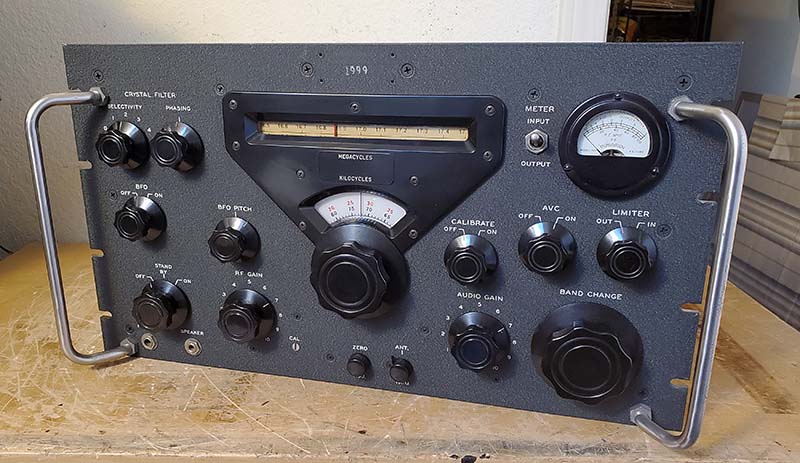
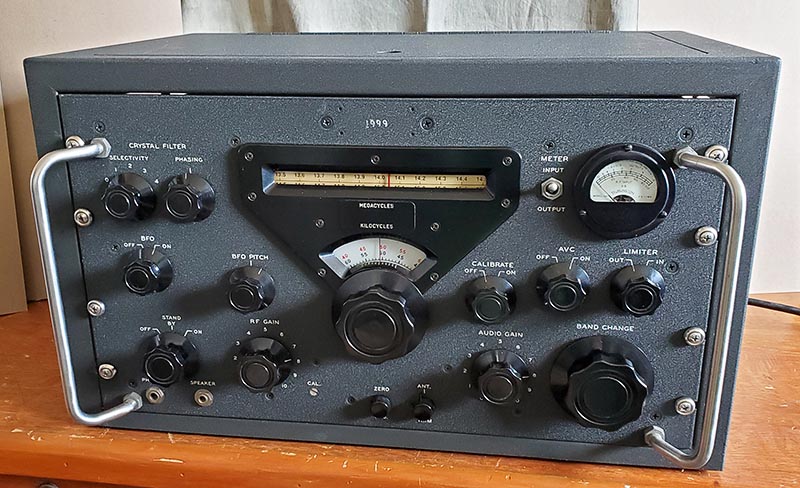
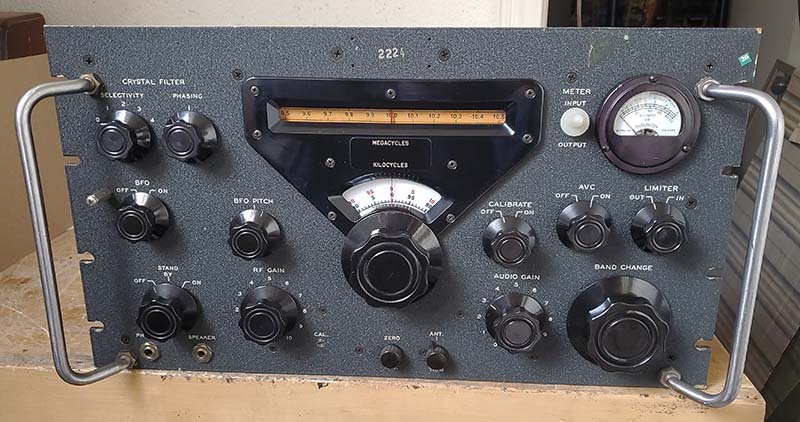
COMPANY Part 4 51J-4 Light Gray
Panel - Collins Laboratory Version
|
|
|
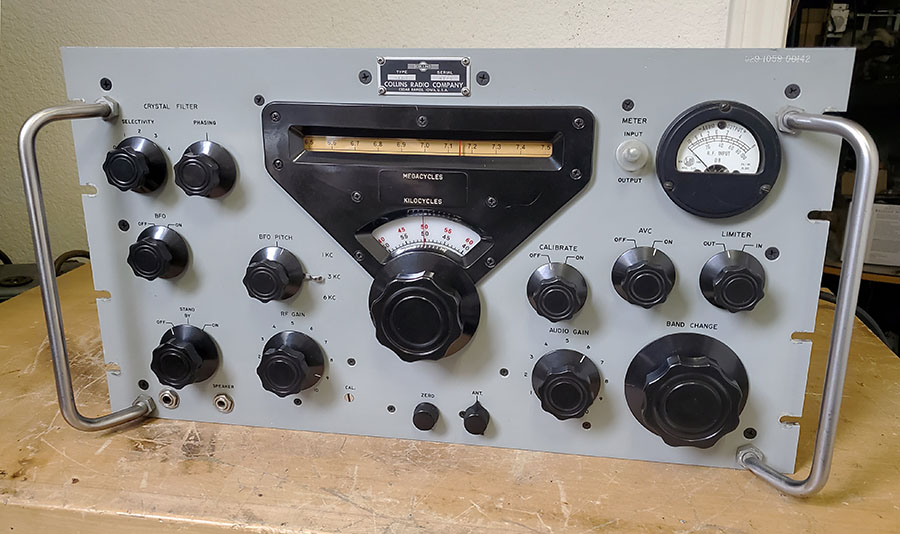
51J-4 - Collins Lab Receiver - SN:4723
Some Servicing,
Some Restoration and a Performance Evaluation As the final version of the 51J Series one would expect the best performance to be from the 51J-4. The original market consisted of the commercial communications or laboratories users who had specific requirements with stability, dial accuracy and selectivity being at the forefront. Great audio wasn't a consideration since the bandwidth selectivity had to be kept narrow. The users today are all either hams, SWLs or collectors and this group definitely have different performance desires than the original purchasers had. |
| 51J-4 Stock
Performance -
For dial accuracy, stability and selectivity, it's hard to beat the
51J-4. Mechanical filters provide a superior selective ability to all
but eliminate most QRM and the Crystal Filter can take care of
heterodyne interference. Sensitivity is very good or at least
competitive. Where the 51J-4 has problems is in its audio reproduction
when listening to an AM signal.
To say the receiver sounds awful on AM wouldn't be too much of an
exaggeration for an audio purist (I'm not one but the stock J-4 audio
still sounds pretty bad on AM, AM-BC or SW-BC.) I've owned two stock
51J-4 receivers and have recently found a 51J-3 with the 354A-1 mechanical filter
conversion and all of them sounded (or sound) pretty much the same on AM. The
AM signals would normally be tuned with the 6.0 kc mechanical filter selected. What is
noticed is that on either side of the passband center the audio range is
pretty good but at passband center the audio is "muffled." This is
because the 6.0 kc filter is limiting the audio response to 3.0 kc at
the highest. On either side of passband center you are tuning to one
sideband or the other of the AM signal and the audio response can go up
to 6kc or so and thus the audio highs sound better. This is normal AM
reception for
the 51J-4. In fact, Collins recommended that when tuning an AM signal to
always use one
sideband or the other depending on receiving conditions. Collins later
also recommended reducing the RF Gain as needed to improve AM audio
reproduction.
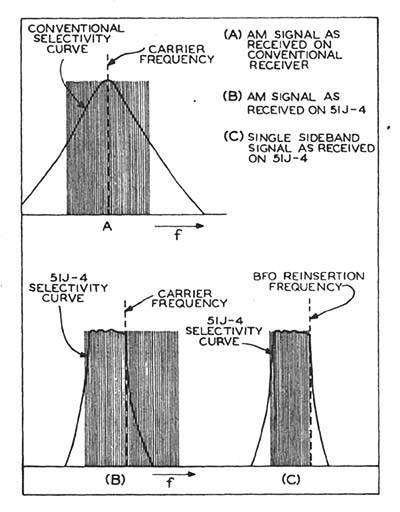
The drawing shown to the right is from the 51J-4 manual. Drawing (A) shows how in a typical "bell-curve" type of IF the AM signal has the carrier placed at the center of the passband and both upper and lower sideband information is detected and reproduced. If one tries to tune "off frequency" to recover more audio highs it can be seen that the carrier would be reduced as the signal is tuned further from the passband center and eventually distortion will develop. Drawing (B) shows the 6kc mechanical filter's "flat top" passband curve and how it allows tuning one sideband and the carrier without loss of carrier strength. This allows better reproduction of the sideband information plus the carrier because the ratio of carrier to audio modulation is preserved. It all looks good on paper and certainly works fine with strong, constant-level AM signals. But, that's not how 90% of the AM signals are - except for local AM-BC stations (most strong local AM-BC stations sound pretty nice on the 6kc MF tuned to either the USB or the LSB. Too bad the programming is so dismal.) Typical SW-BC stations fade, sometimes producing phase distortion, ratios of carrier to modulation change and cause distortion, sometimes there are heterodynes from other SW-BC stations. With ham AM signals the same problems can exist in addition to QRM, carrier frequency drift and low modulation levels. In the real world, tuning the 51J-4 for an AM signal using the 6kc mechanical filter as described in the manual will work well sometimes, especially on the AM-BC band, but with SW-BC or ham AM signals, much of time distortion and restricted audio are very noticeable. If you get used to tuning AM signals in this one sideband plus carrier manner (and conditions allow for it) the audio will have more highs and will generally sound like decent communications-grade audio,...most of the time. |
|
|
|
On SSB, drawing (C) shows how the sideband information should fit
within the 3.1kc passband without any losses. The stock 51J-4 works
quite well on SSB if it's operated as a typical early fifties receiver
without a product detector. The same goes for CW reception. Of course,
the 3.1 kc and the 1.4 kc filters can be used in those modes for greater
selectivity. You can get away with using the 3.1 kc filter for an AM
signal if QRM is particularly bad by selecting one sideband or the other
depending on where the QRM is. Those who are 75A-4 users probably wonder
why the Crystal Filter continued to be used when MFs are provided. The
Crystal Filter is actually better for certain kinds of QRM, especially
heterodynes or adjacent frequency SSB signals. The Crystal Filter
Phasing can eliminate that kind of interference where the MFs can't.
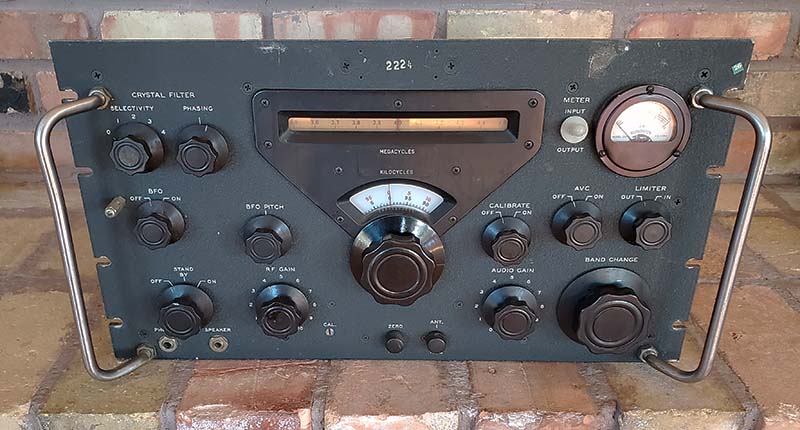
As for the stock 51J-4, it was primarily for communications, not for aural-pleasure derived from band cruising using an ultra-wide bandwidth for high fidelity reproduction of idiomatic music transmitted by high-quality SW-BC stations (like China's Firedrake!) The basic 51J design was for data reception, not particularly for voice and certainly not for music reproduction. It's also important to remember that AM signals on the 51J-4 should be tuned to one sideband or the other. If you center the AM signal within the 6.0 kc MF passband then the audio will be restricted to 3kc and the audio will sound "muffled." The 51J-4 dial accuracy meant laboratories didn't have to have frequency meters anymore. Same with many of the military installations. Dial accuracy, frequency stability and excellent selectivity were what most users were interested in when purchasing a 51J-4. Great audio reproduction was not even considered since the passband had to be kept narrow for communications selectivity. Having sold or traded off at different times formerly owned stock 51J-4 receivers, I swore I'd never buy another one,...ever! All it took to change my mind was seeing a light-gray panel laboratory version 51J-4. This receiver has a strikingly different appearance that stands out in the station landscape. And,...it's turned out to be a very interesting receiver since it has a Collins-installed "audio fix" for the 6kc MF position that allows decent AM reception. |
|
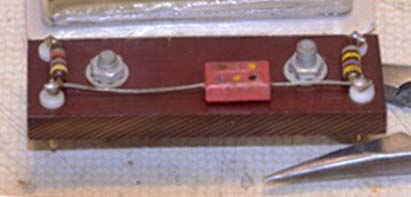
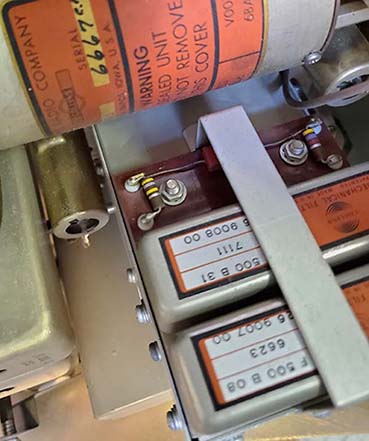
| Modification Caveat - I wouldn't normally advocate this RC coupler as a "ham mod" except this seems to be a Collins "fix" and it does a good job in a very simple, "no holes drilled" manner. And, most importantly, it can easily be unplugged and the 6kc MF reinstalled, if desired. Well, I don't have that option but I already know how the J4 sounds with a 6kc MF! UPDATE: Now, I have a 51J-3 with the 354A-1 installation, so I can compare the 6kc MF reception on that receiver with the RC coupler in this receiver and the RC coupler improvement is very obvious. I can say this Collins "fix" gives the user a noticeable improvement in the quality of audio for AM signals. But, although the audio highs are improved there's still that 200hz roll-off in the bass, so don't expect miracles, but the AM audio has better intelligibility and that's a big help. Besides, there's still the 3.1kc MF for good SSB performance given that there's still the stock AM envelope detector and BFO injection level. Additionally, the 3.1kc MF can be used on AM by just tuning to one sideband or the other to avoid severe QRM. NOTE: I do most listening with the 3.1kc MF selected and only switch to the RC coupler if the AM signal is relatively strong and has good modulation levels. With the 1.4kc MF, a very narrow CW bandwidth is available (also works fine for 170hz shift RTTY.) Underneath, the receiver still appears totally stock (except for the new AC power cable installation with super-long wire lengths - I did a correct reinstallation of the AC power cable using the correct-type vintage strain relief and much shorter wire runs.) I have to say that sn:4723 has proven to be a very interesting 51J-4. I'm glad I didn't adhere to my stance of "I'll never buy another one." |
|
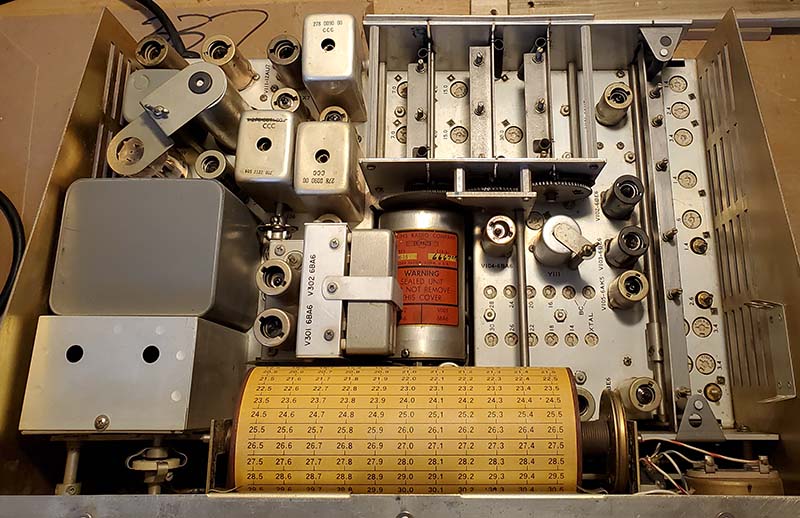
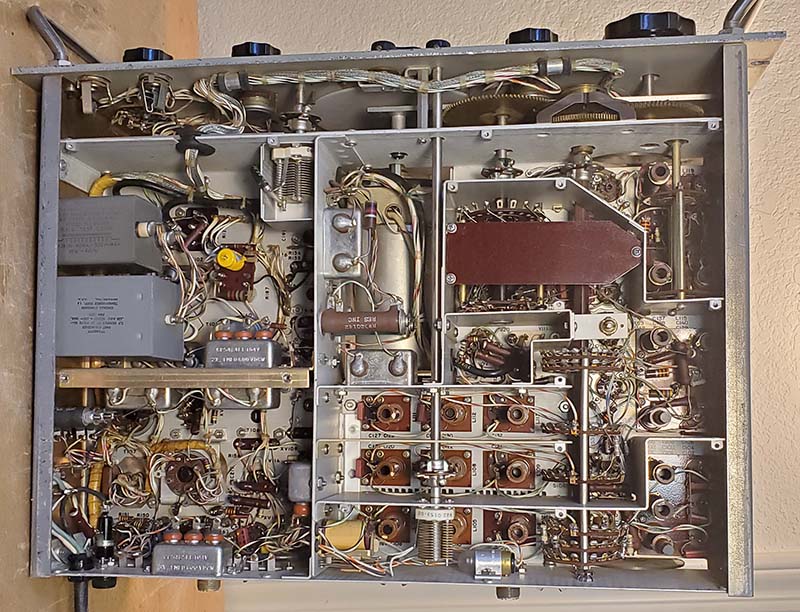
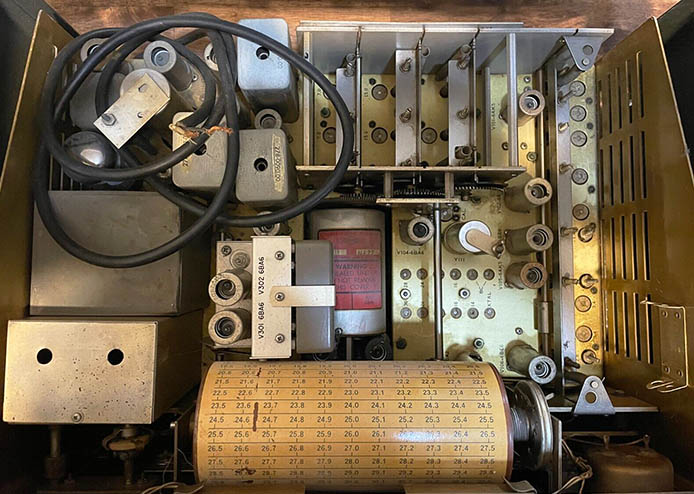
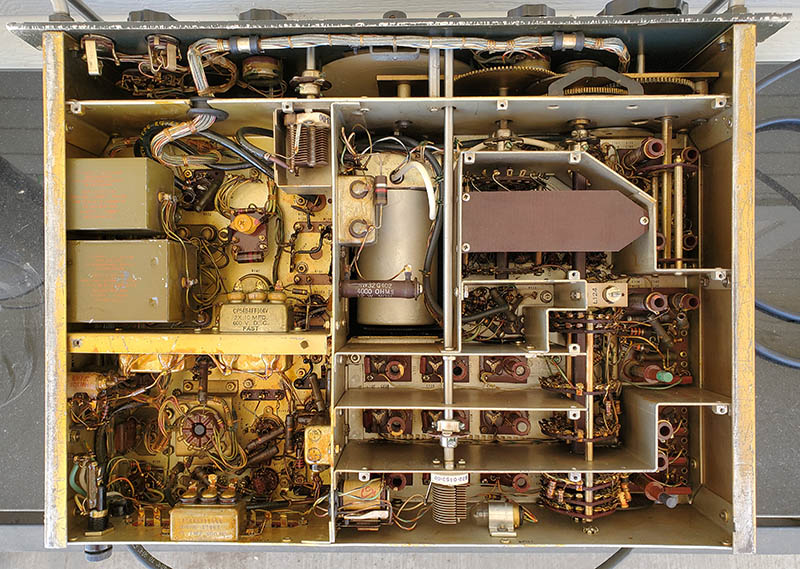
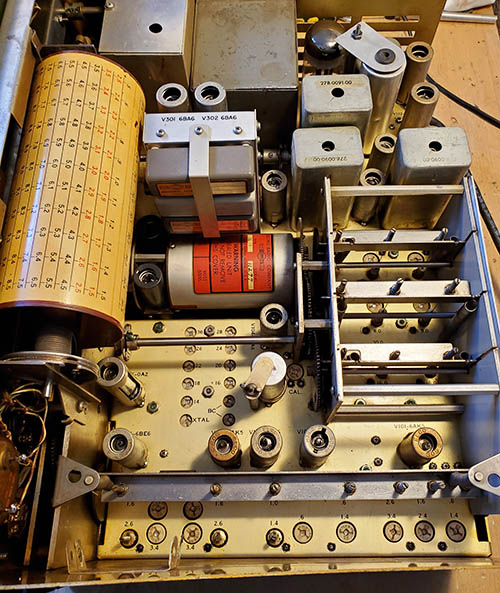
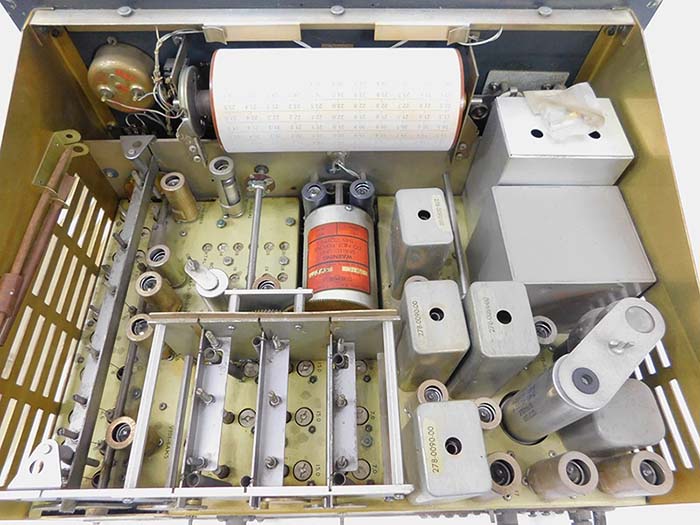
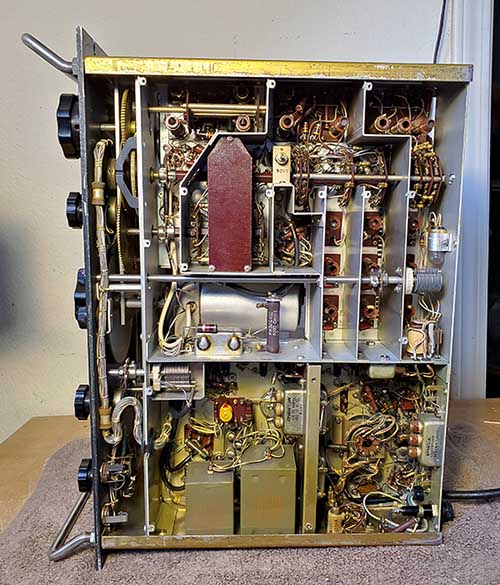
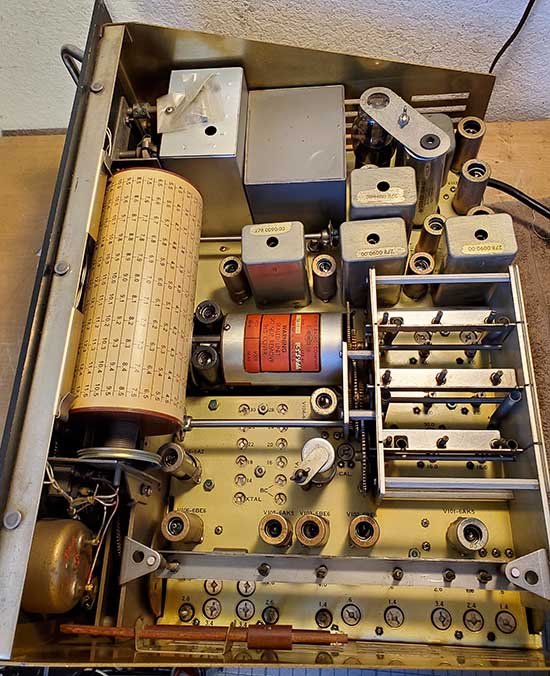
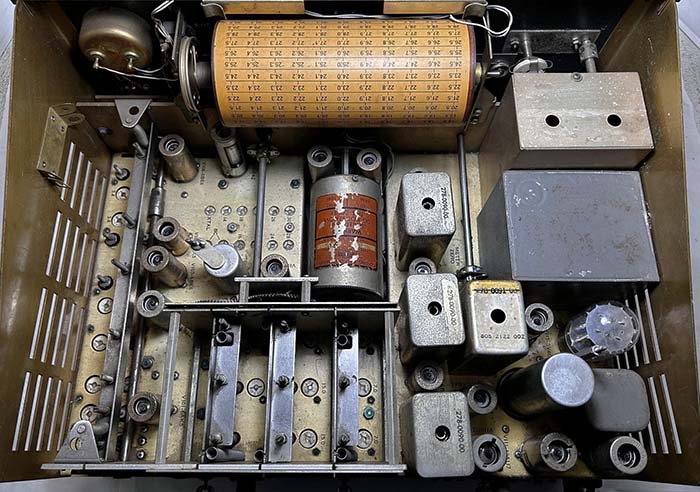
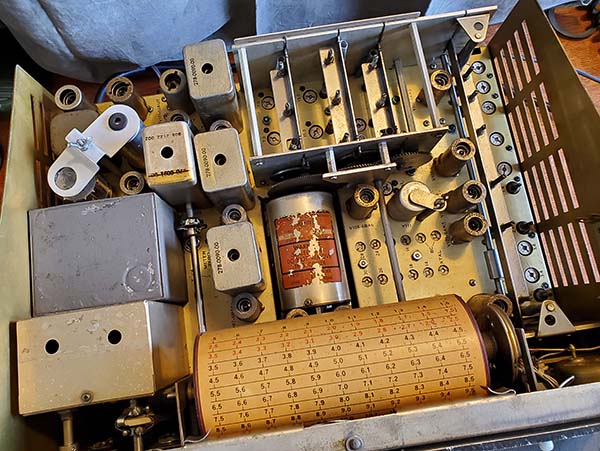
51J-4 sn:4723 showing the top chassis and underneath. |
|
| Servicing SN: 4723 - Jan
5, 2023 - This 51J-4 did function but it was obvious that
it hadn't been thoroughly checked out in a very long time and that the sensitivity and
gain were down quite a bit. The seller had indicated that he had tested
the receiver before listing it and it picked up WWV at 5, 10, 15 and
20mc. So, since it had been very recently operated, I didn't really need to
do a "pre-power-up" test. I could just go right to seeing how well the
receiver worked. When operating, I could pick up many signals but the receiver didn't
seem very sensitive, the CL meter wasn't moving and the receiver took a
very, very, very long time to "warm-up."
Usually, a long warm-up time indicates a few to many weak tubes so the first thing to do was to test all of the tubes. All of the tubes tested very good BUT in the Mechanical Filter assembly one 6BA6 position actually had a 12BA6 installed. No wonder it took a long time to warm up. I momentarily thought the 12BA6 in the MF IF amplifier might have been some type of mod. Something like "install a low gain tube for reduced distortion" but I think it's more likely that was the closest "BA6" tube a former owner could find. With all good condition tubes, SN:4723 had much better sensitivity. I set the zero on the CL meter and could just get about a 10db increase by tuning in WWV, so sensitivity is not up to spec, yet. But, the Calibrator signal will drive the CL meter up to +60db so the problem might be the limitations of using a Pixel Loop antenna indoors (heavy wet snow took down my 135' Inv-vee Tuned antenna.) There wasn't any change in the audio quality, so I'm pretty sure the 12BA6 was installed because that was the only "BA6" easily available (out of the junk box?) >>> |
>>> I did a quick end-point check on the PTO and got 4.5kc change over
1.0mc span. That's not too bad considering most 70E-15 PTOs have EPEs
that are >10kc and they're so far out they probably aren't even adjustable. 4.5kc should be able to
be adjusted down to <1kc EPE using the compensation adjustment on the
front of the PTO (unless it has already been adjusted and 4.5kc EPE is a
good as it gets.)
There was a lot of "crackling" in the audio output that seemed to originate in the MF assembly caused by a dirty tube socket (the one that had the 12BA6 installed.) Cleaned the tube socket with DeOxit to correct the problem. The MF selector switch shaft slips a little and it must have been a long-term problem because the bristol screw that tightens the bell-crank lever to shaft clamp was virtually stripped of its splines so the clamp couldn't be fully tightened. Easy to replace, so I installed a good condition spline-head screw but, when tightened, the apparent "slipping" still occurred. The problem was in the bell-crank lever on the MF assembly switch shaft was slipping on that shaft because the set-screws weren't tight. After tightening the set screws the MF selector switch level worked like it should. I'll run SN:4723 for a few more days to get some hours on the tubes before I do an alignment. The ink-stamped number on the back of the chassis is "2" - that's all, just a single digit. Of course, the Collins tag has 4723 for the serial number. Navy-radio.com has a listing of several 51J-4 numbers and it looks like with the early production, serial numbers and the rear chassis ink-stamped numbers usually matched. By about SN:1000, this is no longer the case and the ink-stamped numbers become very low numbers while the SNs are four digit. There are a couple of exceptions, one as high as a SN in the 6000 block, but on most of the later 51J-4 receivers the SN and the ink-stamp number don't match but there are always exceptions. |
| Detailing - Jan 8, 2023 - Although this 51J-4 didn't really look it, it was pretty dirty. I was amazed at how much gunk came off with Glass Plus. Someone in the past had polished the panel with something that left a white power residue. It couldn't have been too abrasive since the silk-screened nomenclature looks fine. Also, the index lines on the knobs were crudely redone as were the index marks and nomenclature on the bezel. I dismounted the knobs, cleaned the panel and then individually cleaned each knob. I had to carefully use a razor blade to shave off the excess white paint on the index lines before reinstalling. I removed the bezel and cleaned it with Glass Plus and then polished it lightly with Wenol's. The two glass windows were very dirty but cleaned easily with Glass Plus. The bezel and windows were then reinstalled. I had to clean and darken the bezel screws as they had lightened somewhat. I use "real paint" pens with black paint to darken the screw heads. Once the screw head has been painted and before the paint dries, blot the paint with a dry cotton cloth to "dull down" the paint gloss. The screw heads look original after that. The panel is in very good shape. The paint has a semi-gloss sheen to it when clean. | Jan 12, 2023 - AC Power Cable
- I really didn't like the way the AC power cable had been installed. It
might have been part of some Collins rework but I doubt it. The power
cable was just stuck through the chassis hole (not even a grommet) and a
plastic wrap-around clamp was installed on the inside (and that was
after a new hole was drilled for the 6-32 mounting screw for the clamp.)
The proper and original method of installation required using a molded
black plastic strain-relief that will clamp the AC cable and mount into
the chassis "double-D" hole. I looked at new strain-reliefs at the
hardware store and they are pretty cheap looking. Back home, I checked
all of the parts bins and managed to find a vintage strain-relief that
was the correct size. These are difficult to install unless you have the
correct tool. I haven't seen one of the proper strain-relief
installation tools in over 30 years. But, I used 16 gauge wire wrapped
and twisted to
compress the strain-relief to get it into the chassis hole. Then the
wire was cut after which small
channel-locks can achieve the right angle to compress and push the
strain-relief into position with the cable inside. I had to cut and then
remove the original connections by unsoldering and also had to clean the joints
with Solder Wick
for new soldering. I then trimmed and routed the three AC wires
correctly, stripped and tinned, then mounted and soldered the AC
connections to finish the installation,...correctly. The photo of the
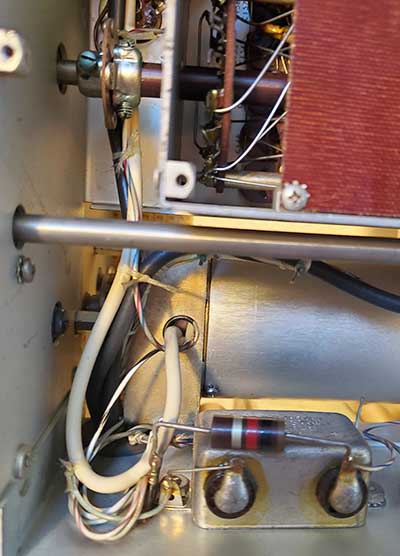
underside of SN:4723 above shows the new AC power cable installation. Missing Screws - A pet-peeve, I guess. I bought all new 4-40 x .375" pan head, Phillips, SS machine screws along with flat washers and locking washers to correctly mount the bottom cover with all the same type of screws (19 screws are required for the bottom cover.) Bought three 6-32 wing-nuts and flat washers for securing the top cover correctly. |
| IF Alignment
with Mechanical Filters - The manual indicates the IF adjustments
should be performed with the 3.1kc MF selected. Monitor the
Diode Load output with an analog VTVM and keep the signal generator
output at a level that produces about -3.0vdc on the Diode
Load. Connect the signal generator through a .01uf capacitor to the grid
of the last Mixer V-107. The manual indicates that a RC load consisting
of a .01uf cap in series with a 4.7K resistor needs to be connected to
the IF transformers as they are adjusted (a simple shunt-LP filter that keeps the IF from mixing with
the crystal oscillator and PTO since you have the bottom cover shield removed.) Peak all of the IF transformers top
and bottom while moving the shunt load as directed in the procedure.
There's also the adjustment on the mechanical filter assembly.
Recheck to be sure that all adjustments are at peak at the correct input
frequency. Disconnect the signal generator and the VTVM. Test the IF alignment by tuning through a broad AM signal with the 6.0kc MC filter selected. Carefully listen to the signal as you tune from one end to the other. You should hear the AVC quickly attack at the low end of the passband, then the signal will quickly clear up and as you tune through about 2 to 3kc or so, the signal should stay constant and clean with fairly high audio frequency response. You will hear the AM signal narrow in audio bandwidth at the center of the 6.0kc filter but the signal level should remain constant with no distortion although with reduced higher frequency audio response. As you tune out of the high end of the passband, the audio frequency highs will increase for 2 to 3kc and then the AVC will react to the noise as the signal is quickly reduced by the steep slope of the mechanical filter. This should be repeated for the 3.1kc filter and the 1.4kc filter also. IF Gain Adjustment - One other thing though, if you have a later version 51J-4, it should be equipped with an IF Gain adjustment. This should be set last after the completed IF/RF alignment. The proper IF Gain setting was first accomplished at the factory, but that was over 50 years ago! Different tubes and component aging requires that the setting should at least be checked. The Collins procedure requires injecting 3uv into the antenna input at 2.1mc and then setting the IF gain pot for 270mv output on the IF OUT coax connector on the rear chassis. At the time this procedure was written measuring a RF level was commonly accomplished using a VTVM with RF probe and measuring the RMS voltage value specified. The manual assumes the alignment tech knows how to measure RF levels since nothing is mentioned in the procedure. NOTE: This IF Alignment section is general information on how I align 51J-4 receiver fixed IF sections, not specifically for SN:4723 (until about two years later.) Unneeded Alignment of SN:4723 - Jan 20, 2023 - After using SN:4723 for a few weeks, I felt the receiver was already pretty close in alignment. The fixed-IF was especially nicely adjusted because the Crystal Filter seemed to function just as it should. The date in 2013 that was written on a paper stick-on label stuck on the multi-section plug-in filter capacitor was probably when the receiver was last serviced and probably aligned at that time. There were a couple of checks that I performed however. First, I pulled all of the crystals in the Crystal Oscillator to check the sockets and pins for any corrosion and none was found. I then measured the Crystal Oscillator output and adjusted all of the trimmers for just under 2 volts. All of the trimmers had been set a bit lower in voltage but that was probably okay. Next, I aligned the Variable IF. Again, nothing was very far off from being in alignment and only needed slight peaking. Then the RF section was adjusted. This was only slightly off on a few adjustments. Last was the .5 to 1.5mc band and, again, nothing too far off, just a slight peaking of the adjustments. There weren't any problems with stuck trimmers or slugs, everything adjusted easily. A quick test using a ten foot wire "test" antenna on the AM-BC band and KOH 780kc pushed the CL meter to +80db. On the Pixel Loop, WWV 15mc pushed the CL meter to +40db (even WWV 20mc pushed the CL meter to +40db!) So, I've done alignments like this before. It's where you turn an adjustment only to put the adjustment back where it was. There were one or two slight adjustments needed but most were just "move and return" types. About two years later, Dec. 2025, I did perform a full IF/RF alignment. All the details are further down in "PTO Calibration for 51J-4 SN: 4723." |
| UPDATE: Feb 9, 2023 -
Finally, I've been able to repair the devastating antenna damage
sustained during the Dec 31, 2022 mammoth, wet-heavy snow storm that took down
both of my large wire antennas. My two half-waves in-phase antenna (Collinear
array on 75M) is now rebuilt and functioning correctly with the feedline
now running 108 feet to the upstairs ham shack (it had been a "shop"
antenna only, with 77ft of feedline.) The antenna itself is now a
center-fed tuned 234ft dipole (it had been 270ft) that operates as a Collinear
array on 75M (~1.9db gain) but can be "tuned to operate" on almost any
frequency above 3.8mc although as the frequency is increased the gain
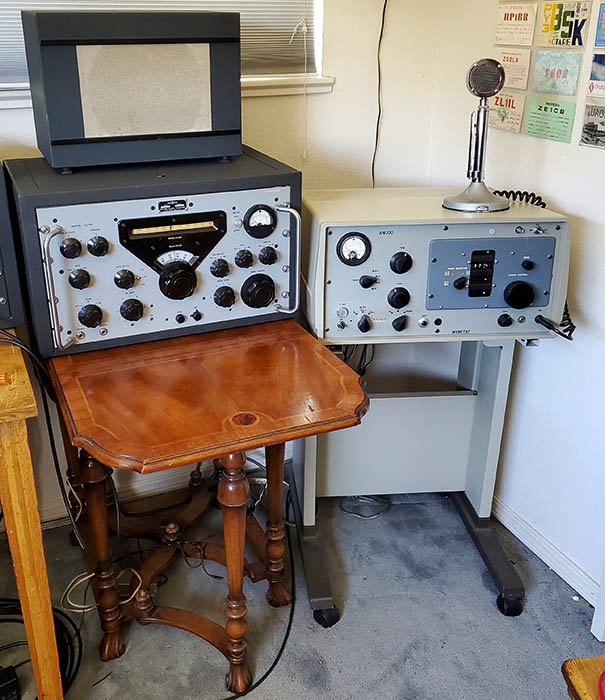
goes down. All testing and listening for the past month has been with a Pixel Loop or with a 84ft sloper antenna (with tuner.) The 51J-4, now operating with the Collinear Array as the antenna, is like a "new" receiver. Strong signals on 80M, 40M and 20M are always present now. WWV on any frequency will push the CL meter to +50db or more. Coastal beacons in China are strong (XSG or XSQ on ~16.85-.98mc or on 12mc later in the afternoon) and even the coastal beacon SVO in Athens, Greece is an easy copy on 8.4mc in the late-afternoon as is TAH in Istanbul, Turkey. Utilities stations, like Trenton Military, are easy copy on 15.034mc USB with aviation weather (VOLMET) out of Canada (Trenton, Ontario is near Toronto.) Some of the SW-BC stations are incredibly strong, especially those out of China in the late-afternoon. Though Radio Havana puts in a very a strong signal here in Western Nevada, I think the broadcast-quality audio of the Chinese shortwave stations is superior to RH. These powerful SW stations sound pretty nice with the 12kc RC coupler switched in (even though it's communications audio.) Strong signals make a substantial difference in the audio quality of the 51J-4. Weak signals are going to sound like "weak signals" and that's true for just about any receiver. A really good antenna does help provide more substantial signal levels with better audio reproduction results from the 51J-4. With antennas that are a "compromise," over-all performance will suffer somewhat. So, I like how this 51J-4 operates now with a full-size antenna and I do plan to incorporate it into a vintage station running with one of the Collins 32V transmitters. UPDATE: Feb 19, 2023 - J-4 SN:4723 "on the air" with the 32V-3 transmitter running with the collinear-array antenna on 75M. No problems in Q5 copy of all stations. Used RC coupler position for 12kc bandwidth. Nice sounding! UPDATE: Apr 1, 2023 - I've installed SN:4723 into a recently acquired, genuine 51J-4 Collins Cabinet. The loudspeaker is a 270G-3 I've had since 1970 (which is why it still has all of its original cream-color flocking.) The 51J-4 is now paired up with the W6MIT Homebrew "1625 Rig" which uses a T-368 Exciter to drive a pair of parallel 1625 tubes as the PA and another pair of push-pull 1625 tubes as the modulators. The 1625 Rig can produce 75 watts of AM carrier output power or 100 watts output in the CW mode. From this operating position the antenna used is the 234' Collinear Array. |
|
| UPDATE: Nov 25, 2024 - For the past few months it seemed that the sensitivity was down quite a bit on SN: 4723. If I connected an antenna directly, that is, not through the 1625 Rig and its antenna relay, the signal response seemed normal. If I connected another receiver through the 1625 Rig, it seemed to function normally. I finally decided to check the 51J-4 on the workbench and determine if there was a problem. I used a HP606B RF signal generator to input a known level of signal. The output attenuator on the HP606 is calibrated to a 50Z load so it's a close match to the 51J-4. I tested 7mc and had 30db on the CL meter but switching to 8mc, I then had 40db on the CL meter. I saw a gradual increase in the CL meter reading as I switched from 6mc to 5mc and then to 4mc. 4mc read 40db on the CL meter. It seemed something was causing a 10db loss on 7mc. The only circuits specific to 7mc would be the crystal oscillator 10.000mc crystal or maybe the C trimmer on the 4-7mc band was off. I realigned the 4-7mc band and got a 2db increase. I thoroughly cleaned the crystal oscillator switches with DeOxit. I cleaned the band switches with DeOxit. I removed all of the ten crystals and cleaned their pins with DeOxit and reinstalled them. This seemed to clear up the problem. All of the bands seemed to have the same noise response now. I connected up a shielded magnetic loop antenna and tuned AM-BC where KKOH showed 55db on the CL meter. I tuned 10mc WWV showing 45db, 15mc WWV showing 40db. 40M ham band seemed normal. 20M ham band seemed normal. I'm not sure what was causing the decrease in 7mc sensitivity but it probably was the crystal oscillator switches or the crystal sockets or maybe the band switch. I didn't clean any of these when I first was servicing this 51J-4 first time around. Maybe I should have been more diligent in my electronic cleaning. Anyway, it seems to be working normally now. When connected to the Collinear Array antenna going through the 1625 Rig, 15mc WWV pushed the CL meter up to 60db. 20mc WWV read 50db on the CL meter. I should have done this cleaning the first time around. |
|
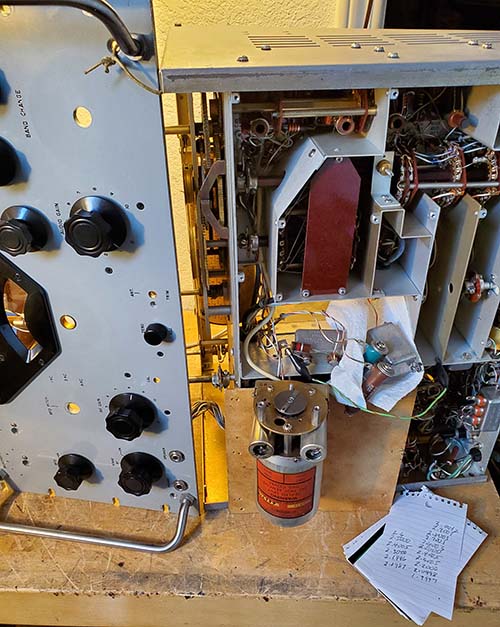
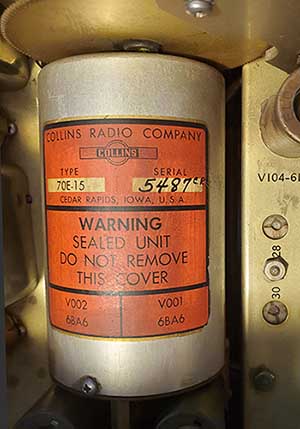
PTO Calibration for 51J-4 SN:4723 - PTO SN:6667C.R. Dec 23, 2025 - I've been having quite a bit of luck recalibrating the 70E-15 "CR" PTOs in the various 51J receivers. I'm down to the last receiver now, which is the Collins Lab 51J-4. Last time I tested the EPE I got 4.5kc so hopefully I'll find that the L002 trimmer still has some adjustability range so I can get the EPE down to <1kc. The formidable disassembly of the receiver isn't something to look forward to but it's necessary if PTO calibration is to be accomplished. It takes about one hour to disassemble the 51J-4 to the point where the PTO can "hang by its wires" out the bottom of the receiver. This position allows access to the front of the PTO to remove the hex-plug that covers L002 trimmer. A special unlocking tool is necessary to loosen the locking nut on the L002 shaft. V001 has to be temporarily taken out to be able to access the hex-plug which is removed using a 3/8" open-end wrench. V001 has to be then installed back in its socket. The only concern is that this receiver is a Collins Laboratory receiver and it must have gone through Collins calibrations many times. The last date on the Collins "test tag" is 1971. The concern is that the PTO has already been adjusted and 4.5kc is the best attainable EPE. Dismounting the PTO and testing the adjustment range of L002 is the only way to find out. This difficulty in accessing the front of the PTO was a deliberate part of the 51J-3/R-388 and 51J-4 design. It prevented casual tampering with the PTO calibration. Only a qualified technician would even attempt the amount of disassembly necessary. The photograph to the right shows SN:4723 with the PTO out and ready for calibration. Also visible in the photo is how much of the 51J-4 needed to be "taken apart" in order to have access to the PTO for calibration. Initial EPE measured 15kc but this was just a "quickie test" and was performed after the hex-plug was removed (no green Loctite on the hex-plug so this isn't the first calibration of PTO SN:6667C.R.) I loosened the L002 locking collar. I connected the DFC to the PTO output at the coaxial cable end connection. A close look at the photograph to the right and the two index marks, one on the Oldham coupler face and one of the PTO frame, can be seen. I use the index marks to accurately know the position of each turn as referenced to the center of span, which is 2.500mc output f from the PTO. I performed a couple of L002 adjustments and got the EPE down to about 1kc but with a slight increase at the 3.00mc end. I tried another adjustment and went too far. The EPE actually got even worse. Another adjustment of L002 in the opposite direction hit just the right spot with an EPE of <1kc and a linearity deviation of <1kc. I tightened the L002 locking collar with no change in the PTO output f noted. I removed V001 and reinstalled the hex-plug. V001 was then reinstalled. A couple of minor issues were encountered during disassembly. Some of the set screws were coated with green Loctite. The Antenna Trim shaft coupler set screws needed to be heated with a small soldering iron to "melt" the green Loctite. The most difficult were the two set screws in the KC dial. These also had to be heated with a very small but long tip soldering iron to soften the Loctite. The KC dial absolutely MUST be dismounted in order to access the three PTO mounting screws so why these sets screws were coated with Loctite is a mystery. Another problem was the stud in the lower hex stand-off unscrewed itself and remained in the PTO frame. This made the PTO removal much more difficult than it should have been. When I had the PTO dismounted, I fixed the stud's mounting into the hex stand-off so I couldn't "unscrew itself" again. One other problem happened when I attempted to clean the KC dial. I always have used Glass Plus to dampen a paper towel for cleaning the 51J KC dials and have never had a problem with the numbers on the dial. On most dials, the numbers are under a clear outer layer of the composition of the dial and can't be harmed with cleaning. On some later dials found on 51J-3 and 51J-4 receivers (but not R-388 receivers) the numbers are on the outer surface of the plastic and the back of the dial is painted white. I've never had a problem with the numbers on these types of dials either. However, this 51J-4 dial did show a little fading of the red numbers when cleaning the surface with a Glass Plus dampened paper towel. Fortunately, I saw what was happening right away and stopped. Only the "95" and "0" red numbers show any fading and it's minor. So, be careful when cleaning these later 51J-4 KC dials. |
|
| Reassembly took a little longer, mainly because of the need to
synchronize the PTO set to 2.500mc with the KC tuning being set to
mid-scale on the MC dial and both mating up with the Oldham coupler
middle bronze interface piece. A light coating of grease on the gearbox
side of the interface piece will keep it in place while the mechanical
alignment is adjusted. Also, when doing the reassembly one has to watch
that wires aren't pinched and that no binding is taking place. After
the reassembly is complete, then the KC dial is synchronized so that exactly
2.500mc output f on the PTO shows exactly 0.00 on the KC dial
with the fiduciary index straight up and the MC drum dial shows exactly
mid-scale. Since there was a slight error in the PTO tracking that's now
corrected, the
Variable IF will be slightly misaligned. Completion required a complete
alignment of the Vari-IF and the RF tracking. Full IF/RF Calibration Required - Dec 24, 2025 - In reading what I wrote about the fixed IF alignment a couple of years ago, apparently I didn't perform an alignment of the 500kc fixed-IF. I wrote that I thought it was "close enough" at the time. Since I've gone through all of the trouble to make sure the PTO of SN:4723 is tracking correctly, I'd better do a complete receiver alignment. Probably not necessary but when it's completed then I'll know that everything has been put into proper alignment and the receiver is probably working as well as it should. Well, the full alignment WAS necessary. Unexpectedly, the 500kc fixed-IF was off quite a bit. Even the adjustment for the mechanical filter assembly was significantly off. The Variable IF was off too. Since the PTO is tracking correctly now, it would be expected that the Vari-IF would be off since it's calibrated at the band edges. The RF tracking was off, probably because this time I was using the correct dummy antenna load. Also, I used the HP3325A Synthesized Function Generator for the 500kc IF and the Vari-IF which was probably more accurate than the HP-606B with a DFC for the signal source. I used the HP3325A and the FRNISI DPOS350P's Synthesizer for the RF tracking alignment. Modern equipment is so much more accurate it really makes the alignments much faster and a lot easier. About half of the alignment procedure in the manual consists of instructions for measuring frequency indirectly using heterodynes from the 100kc crystal calibration oscillator or using other receivers for measuring other types of frequency outputs. All cumbersome methods due to the limitations of the test equipment of the time. Modern test equipment allows measuring everything directly which is much quicker, much more accurate and a lot less of a headache. A full alignment using modern equipment takes about an hour. Performance Improvement? - SN:4723 now behaves like all the other 51J receivers around here that have also had their PTOs calibrated. The big improvement was in the RC network in the 6kc MF position. Before there seemed to be a slight loss when switching to the 6kc position but now there's no change in amplitude between selecting 3kc MF or 6kc RC. Also, the audio response in the 6kc position has never sounded so good. I can only assume that having all of the 500kc fixed-IF aligned correctly is responsible for that improvement. As far as the Vari-IF and RF tracking,...KC dial readout is "dead-on" accurate,...the RF Gain on 20M SSB signals now averages about 7 or so with the AF Gain at 7. Although it depends on conditions, at 1530hrs PST, WWV 15mc was running at +50db on the CL meter using the Collinear Array. I tuned in XSQ on 16.850mc coming in very strong (Guangzhou, China marine CW beacon.) Big improvement on the audio from the SW-BC stations when listening in the RC 6kc position. The upshot is,...even though I thought the alignment was close,...it really wasn't very close at all. The 51J Series receivers can be moderately out of alignment and will still pick-up stations making the owner believe the receiver is working fine,...but all NOS (or test as NOS) tubes and a full IF/RF alignment will almost always improve receiver performance. Especially if that receiver is then used with a full-size, matched antenna system. |
|
51J-3 to 51J-4 Conversion Using the 354A-1 Mechanical Filter Kit 51J-3 Collins Mfg. SN: 5282 Lots of Inept Repairs with Rampant Collateral Destruction, Loads of Missing Parts,...Extensive Restoration Definitely Required When ordered from Collins, the 354A-1 Mechanical Filter Kit came with all of the parts and components necessary for the installation. Included with the kit was a 28 page manual with its 78-step list of instructions with appropriate "check-off" boxes after each step. The 354A-1 installation wasn't for beginners. It required a person with considerable experience, both mechanical and electronic, meaning that the conversion work would have best been performed by a professional electronics technician. This 354A-1 installation certainly shows what can happen when an inexperienced "technoid" takes-on a project that they aren't remotely qualified to do. This write-up is concerned with correcting a litany of self-inflicted, electro-mechanical problems involving the installation of the 354A-1 kit along with years of destructive, incompetent maintenance that has left this receiver almost a derelict. Additional Note: I'm a long way from calling this receiver a genuine 51J-3. It has only one indicator and that's the lack of any military inspection stamps. The positive indicator, the PTO, isn't original and is a Collins replacement from the mid-1960s. The data plate indicator isn't the original data plate. Having a MFP-coated chassis applies to all 51J-3 and to all R-388s. So, with just a lack of mil-stamps, this receiver is just a "maybe 51J-3." |
| Discovery
- Mar 10, 2023 - I came across this receiver while I
was researching 70E-15 PTO serial numbers as part of this "51J Series"
write-up. The receiver was listed on eBay as a "R-388" but when looking
at the photographs to see if the seller had included a chassis photo
that showed the PTO serial number, I was surprised to see the 354A-1
Mechanical Filter Kit installed. Then I noticed the serial number of the
PTO was 11277 with no "M" prefix that indicated to me immediately that
this was a replacement PTO. The serial number for the PTO was from the
1960s. I was intrigued and studied the condition of the receiver as much
as could be determined from the photographs. I noticed that the AUDIO
terminal strip was a replacement. I also noticed some
mismatched screws. The most glaring absence were the two grab handles
and the missing top cover.
The megacycle dial drum had a few fairly severe scratches. In all, the
receiver looked in decent condition and worth taking a chance on since
it was the only time I'd seen a 354A-1 Mechanical Filter conversion to a 51J-4. I asked for
and received a 25% discount and the receiver was purchased, packed,
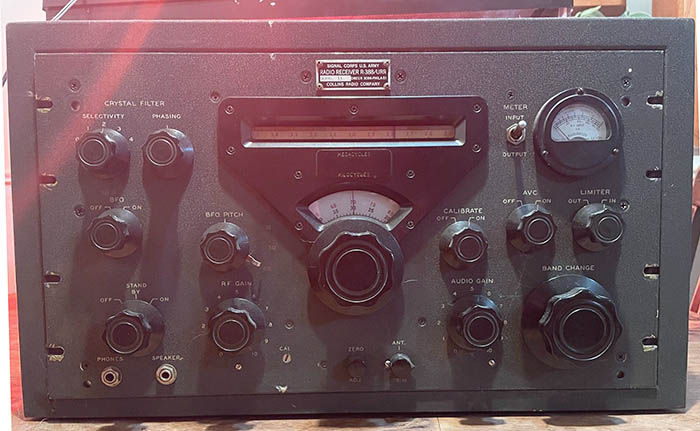
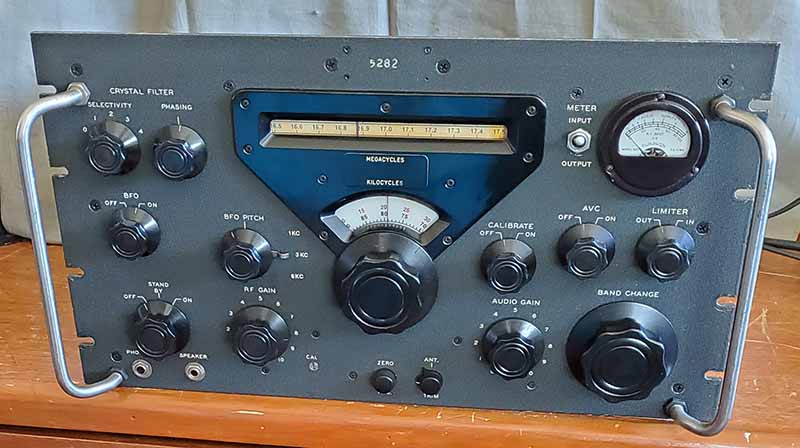
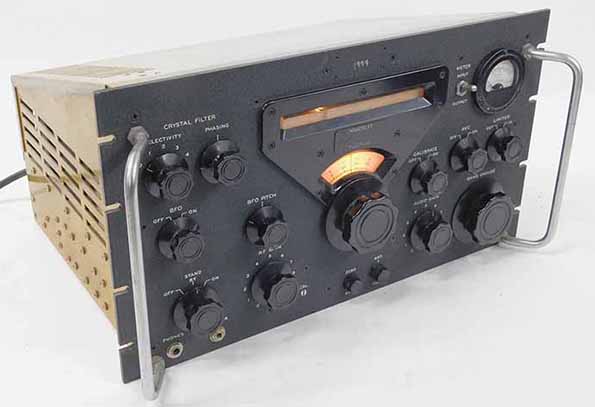
shipped and delivered within a few weeks. The photo to the right is how the receiver was shown on eBay in "as found" condition. As seen in the photo, the receiver had a 1951 R-388 data plate installed but I was sure it wasn't original to the receiver. The entire receiver was much dirtier than it appears in the photo. The chassis was covered with greasy grime and the front panel had streaking where rusty water had dripped down the panel. The red flare is from a window reflection. This is actually a very poor quality photo compared to the chassis photo from the same auction, shown below. At least it does show that all of the knobs were present and in good condition, the meter was correct, the bezel was undamaged and the condition of the front panel was decent. |
|
| Inspection
- Mar 28, 2023 - Here's what was noticed in the visual inspection after the
receiver was unpacked. 1. No top cover (known in advance - kia.) Dial Cord - This is actually called "flexible wire rope - extra small diameter - nylon coated" and it's available from McMaster-Carr. The original spec was for .015" diameter but, per the manual, .032" diameter was optional for repairs. McMaster has .024"dia and .032"dia. McMaster PN 8930T51 for .024"dia and PN 8930T53 for .032"dia. Original installation cables had brass crimp fittings but repair instructions indicate "knotting" was acceptable. I can salvage the cable from my "parts set" 51J-2. Although the Army TM R-388 manual states "nylon covered string" for the drum drive repair, all R-388s I've examined have nylon covered flexible wire rope for both the dial pointer drive and the dial drum drive. The AN/URR-23A Navy manual and the 51J-4 manuals call it "nylon covered cord." Non-original AUDIO Terminal block - I should be able to salvage a correct style replacement from the "parts set" 51J-2. Crystal Filter Controls - There is an adjustment guide plate mounted to the backside of the front panel for adjusting the position and angle of the control shafts as they exit the front panel. Filter Capacitor Hold-down - The 51J-3 should have a 5V4G rectifier tube which then uses the "flat" hold-down. Many times the 5V4G was replaced with a shorter 5V4GA tube and the "flat" hold-down couldn't secure the 5V4GA. Receivers like the 51J-4 used a "stepped" hold-down specifically for the 5V4GA tube. Sometimes, when a 5V4GA was installed in a mil R-388, the depot would cut the "flat" hold-down so that it only worked to secure the filter capacitor. I had a spare "half a hold-down" with the grommet still present. Since this filter cap hold-down was possibly a depot-modified piece, I installed it using a proper wing-nut. Data Plate - One is never sure anymore whether a data plate is original to the receiver or not and a data plate that's mounted without locking washers is always suspect (like this one was.) The Collins production serial number of 5282 along with the MFP date of Oct 1952 seems late for a 1951 contract receiver with an early Mil SN of 33. Usually the Mil SNs were consecutive within the contract which should indicate that this receiver was among the earliest supplied on the 1951 contract. As said, one never knows anymore whether any data plate is original or not and I really doubt this one is. Since it seems possible that this receiver is a 51J-3, then what about a 51J-3 data plate? It undoubtedly never had one. Why else would someone install a non-original R-388 tag? A "tag-less" 51J-3 that was misidentified?,...possibly. Dial Drum Scratches - These scratches are pretty deep and removed some of the dial background color. These scratches align with the screws on the 354A-1 MF kit. The installation instructions give explicit directions to cover the dial drum with heavy paper or other protective material to prevent dial scratching during the kit installation,...but who reads the instructions? Touch-up shouldn't be too difficult. The remaining sections of the dial are in very good condition so a new overlay isn't really necessary. ZERO fiduciary adjustment control shaft bearing is Missing - Luckily, one of my "junk" R-388 front panels had this piece and the mounting screws and nuts and washers (same piece for either R-388 or 51J-3.) Grab Handles - I bought a set off of eBay for $25. Included the correct mounting screws and locking nuts. |
| Detailed Under-Chassis Inspection Nets
Disappointing Results -
Apr 5, 2023 - As much as I wanted this receiver to be a R-388 conversion
to a 51J-4 that was performed at a military depot (and be about as close as
one can get to a R-388A,) or, at least to have been a commercially
owned 51J-3 that was maintained by a business that employed their own
technicians, I'm now convinced that the receiver is an unfortunate victim of an inexperienced technoid-ham that wanted to
change the receiver from whatever it was into a 51J-4. Whether the
receiver started out as a 51J-3 or a R-388 can't be positively determined now,
since the PTO has been replaced. The perpetrator could afford all of the necessary Collins parts but didn't have the
mechanical aptitude nor the electronic experience to perform any of the
repairs competently. Combining hamster ineptness with a crude soldering technique
and "strong-arm" component removal/installation resulted in the worst
level of destruction I've seen to a vintage receiver in a long time. The
354A-1 installation and all other repair work used lots of mismatched "junk
box hardware" and revealed a persistent use of screws
and nuts installed without locking washers, or, even more
common,...leaving the screws out altogether. Soldering was an important clue to the level of workmanship. It's difficult to rework any electronic device that has been MFP-coated. However, experienced professional electronics techs that have been trained using the proper tools for cleaning the MFP'd joint, performing the rework, resoldering the joint and then recoating the joint with new MFP, will produce excellent quality workmanship. None of that happened. The MFP was burned-through with the soldering iron, the wire "ripped out" of the terminal, the joint not cleaned afterwards, the wire ends not reconditioned and, after the rework accomplished, the new solder joint wasn't recoated with MFP. Also, in examining the type of wire lead wraps, which should be a good clean full wrap of a properly tinned wire end, it was found that many of the joints weren't wrapped at all but were wires "pushed though a lug hole" and then soldered, which is just one step above "tack soldered" joints. So,..."hamster work?" Definitely. Since the receiver has had its "originality" as a stock 51J-3/R-388 destroyed, I won't feel too guilty in going through the receiver and correcting the quality issues with the goal of making the installation look (and function) more like a "professional rework job." Also, other quality issues, like the use of dial string for the dial drum cable or the missing or wrong types of screws and the litany of missing lock washers or the scratched dial drum, will be corrected. Where MFP should have been reapplied, I'll recoat using my mix of yellow-tinted lacquer that looks like MFP but doesn't have the fungicide in the mix. I might feel a little guilty going in and disturbing such a perfect example of incompetent electro-mechanical reworking technique, that while the installation does "sort of work" (which may have been all that was desired) shows the complete lack of professional technique that we all hate to see. |
|
| 70E-15 PTO SN:11277 End-point Error Test shows 7.5kc EPE! - I performed a "quick test" of the receiver to determine if it could be powered-up. The quick test is to pull the 5V4 rectifier tube. That way no B+ will be created and only the filaments are on. Also, the HVAC can be tested at the rectifier socket. This quick test assures that the power transformer is okay and all of the low voltage circuits are operational. All tubes tested okay - not great but okay. I reformed the filter capacitor and afterwards it measured 48uf and 42uf with the spec'd capacitance being 35uf, so it was okay. I installed a plug on the less-than-perfect AC cable. I connected a speaker and 10ft test antenna. I reinstalled the 5V4 tube and then brought the 51J-3 up using a Variac, just in case. No problems and the receiver started to reluctantly pull-in WWV on 10mc. Went to 15mc and WWV was present. I checked the Calibration Oscillator and it must have been off frequency by at least 3kc. Luckily, the CAL trimmers brought the oscillator beating with WWV, so that was close enough. Using the Calibration Oscillator, I tuned through from 14.5mc to 15.5mc noting each 100kc increment. I was expecting very little End-point Error since this was a much later replacement PTO but the EPE measured 7.5kc! This was totally unexpected! >>> | >>> Though unexpected, this EPE test does confirm one thing
about 70E-15 PTOs. The excessive EPE wasn't ever corrected in the 70E-15
PTO because the problem might not be solely with the ferrite core
but partially in how the receiver was used (also air contamination from
PTO vacuum degradation over the years.) This receiver does show signs of
excessive use with lots of discoloration of the MPF everywhere (MFP
darkens as it ages under a heated environment.) There
are wear patterns by the MF bandwidth switch indicating that a lot of
the use was post-conversion. One might think that this receiver had been in some type of
commercial use where 24/7 operation occurred and the excessive heat
build-up affected the ferrite core just like most of the military "M" PTOs
were affected. However, I've run across many old "ham receivers" that
appear to have been left powered up for considerable lengths of time.
At 7.5kc EPE, it might be possible to adjust out the error but that's probably just a wishful reverie. |
|
Rework Details |
| Replacing the Dial Drum
Cable - This was white fabric dial cord with a fiberglass
core which is pretty strong stuff but the original cable was a .015" diameter
flexible wire rope with a nylon covering. As mentioned above,
replacement flexible wire rope can be purchased from McMaster-Carr. I
used original flexible wire rope harvested from a "parts set" 51J-2
receiver. The installation instructions are the same in all manuals for all 51J
receivers. BFO and MF Switch Shaft Bushing - This piece was missing. It's a standard .250" shaft bushing that must mount with a panel thickness of less than .125 inches. The MF Kit panel is .060" aluminum with an over-size mounting hole to allow centering the bushing. Because of the over-size hole, two washers or adapter plates have to be used. Originally the assembly used a square shaped spring washer but the washers or adapters would also work fine. Found a .250" bushing that would work and made the square adapter plate out of .060" aluminum. BFO Coupler - This was a more difficult piece to find. As mentioned, the receiver has a homemade solid brass coupler. The 354A-1 instructions are explicit that an insulated coupler has to be used to avoid noisy operation of the BFO. Unfortunately, one side of the coupler has to interface with the 3/16" BFO coaxial shaft from the front panel and the other side of the coupler has to interface with the 1/4" shaft from the BFO LC assembly. I found an insulated coupler that was for a 1/4" shaft on one side and for an 1/8" shaft on the other. I just enlarged the 1/8" hole to 3/16" (used successively larger drill bits to keep the hole centered.) Broken AVC Switch - This is a fairly common problem. Only half of the switch is actually used and normally the half that would break off was the unused section. Since it didn't affect operation, a lot of the broken switches were left in place. However, these fiber board switches are extremely fragile and have become even more fragile after three-quarters of a century of existence in some types of environments. This AVC switch broke when I was cleaning it and that was when gently cleaning with DeOxit and a small paint brush. At least I had the broken piece. It's very easy, if you have the front panel dismounted, to use epoxy to repair the broken switch. As mentioned, only half of the switch is used so it's not ultra-critical in its operation but it should have good alignment so the switch operates easily. I applied the epoxy with a wooden toothpick and was careful to not allow the epoxy to "run" into the contacts. I used just enough to hold to broken piece securely. The reason only half of the switch is used was so Collins could use the same type of switch for four different switch applications, AVC, BFO, LIMITER and CALIBRATE. |
The Original 51J-4 Cabinet
- First, this 51J-4 cabinet needed a little mechanical "tweaking"
to get it straight. I used a pipe clamp to slowly straighten the
cabinet so it was again square. Then I had to use some bodywork to fix the
left side of the cabinet where it had been pushed in. This allowed the
front panel to set in the recessed area correctly. This was followed by
a thorough cleaning and paint touch-up.
I haven't decided whether I'm going to use the cabinet since the
receivers are so small and light weight when not installed in a cabinet.
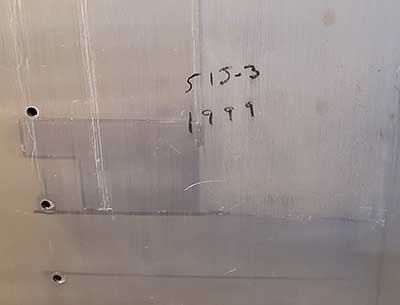
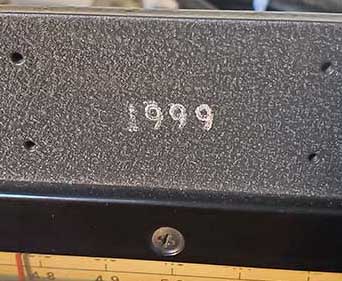
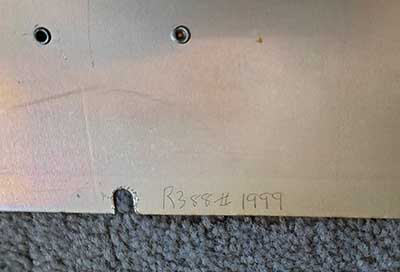
Cleaning Chassis and Front Panel - The chassis top was covered with greasy grime. I used WD-40 to cut the grease and cleaned the WD-40 residue with Glass Plus. R-388/51J-3 chassis will usually clean-up quite well because of the MFP coating protects the metal from corrosion (most of the time.) I used acid brushes, small paint brushes and Q-tips along with paper towel strips for cleaning the chassis. The front panel had to be dismounted and completely stripped of parts for a thorough cleaning using Glass Plus and a variety of brushes. I inspected the front panel carefully to see if I could find any residue of orange SC acceptance stamps but there didn't seem to be any indication of mil-stamps. Most of the time with wrinkle finish I can use a brass bristle brush in a gentle motion to remove thick grime in the wrinkle convolutions. Otherwise, acid brushes and small paint brushes are used. I was very careful around the "1KC, 3KC and 6KC" nomenclature since that wasn't original silk-screening and consequently was extremely faded. While cleaning didn't damage it, it didn't improve it either,...it's still pretty faded. Once the front panel was clean, I touched up most of the nicks and scratches using Artist's Acrylic mixed to match St. James Gray. Then the front panel was given a rub down using "3 in 1" machine oil to bring out the luster. Excess was wiped off and the following day another rub down with oil and wipe off the excess. This treatment lasts for several years. KC Dial Oddity - I thought this KC dial looked slightly different from the front. The white background seemed to be very slightly "streaked" as if it was brush-painted on. Also, the numerals were slightly thinner and somewhat pale looking. Once I had the KC dial dismounted and could look at the backside I found that it was painted! This KC dial is different than the normal R-388/51J-3 dials in that the numbers and scale index are engraved into the plastic on the backside. Then the numbers and scale index were filled with the appropriate red or black paint and then the entire back painted with a semi-transparent thin white paint. All R-388 KC dials I've seen were plastic laminations with no engraving. So, where did this KC dial come from? I've had a report from another Collins collector that found this same type of dial also installed with/on a replacement PTO. UPDATE: I've also found this type of KC dial on the Collins Lab 51J-4 and 51J-3 SN:1999. Maybe the type of KC dial manufacture used for non-military receivers. |
| Front Panel Remount -
The grab handles must be mounted first since the flat head mounting
screws are covered by the side panel flanges. After that, I used two 16 gauge wires the were attached to each top corner of the
front panel and to the top corners of each side panel. This allows the
front panel to be supported while laying "face down" in front of the
receiver. This allows easy installation of all of the controls, switches
and harness clamps. There are control internal tooth locking washers that must be
installed on each control. The AF Gain, RF Gain and the OFF-STAND BY- ON
switch all have their lock washers mounted so they are on the outside of
the front panel. The BFO, CALIBRATE, AVC and LIMITER switches all have
their lock washers mounted on the inside of the front panel. Care must
be taken when mounting these four switches that they are exactly
vertically aligned. This is because these switches have shaft flats that
align with the set screws of the knobs so that the index line will be in
the proper position to indicate the correct function of the switch. I
mounted the carrier level meter while the panel was down (the meter was removed
for cleaning.) The panel had to be raised up to be able to mount the AVC
and LIMITER switches (I just shortened the support wires.) Once all the
controls were mounted then the panel was guided so the CAL. shaft and the ANT
TRIM
shaft were in their panel holes and then as the panel was close to being
in position, the CRYSTAL FILTER controls were guided though their holes.
Then the support wires were removed. Once it's assured that no wires
were being pinched by the panel, I installed the screws. Once the panel
was mounted, then the screws, lock washers and nuts that retain the two
harness clamps could be installed. All that remained was final "snugging
up" of the control mounting nuts, cleaning and installing the knobs,
aligning the KC dial and the MC drum dial, reconnecting the CL meter and
mounting the METER switch. AUDIO Terminal Block Replacement - I found a NOS terminal block that was identical to the original but it looked so new that it was obvious that it was a replacement. I removed the AUDIO terminal block from the 51J-2 "parts set." It was in good condition and showed the patina of age that made its installation look original. One would think that there wouldn't be any problem with such an easy task but,...the non-original type of terminal block had mounting holes that were spaced slightly further apart than the original. In typical hamster fashion, instead of modifying the part, another hole was drilled in the chassis apron to mount this incorrect part,...unbelievable. I filled the non-original hole with epoxy and touched it up to match the MFP color of the chassis. The installation of the correct type of terminal block was easy. Oh, and of course, the incorrect part had been mounted without lock washers so I had to install the correct #4 external tooth locking washers when mounting the original type part (sometimes Collins would mount terminal blocks without lock washers but would use green Loc-tite to secure the screw and nut.) |
SO-239 Replacements
- These two UHF coaxial receptacles are for the IF OUTPUT and the
ANTENNA input. Both receptacles had severely broken and mostly missing insulator material
inside the barrel. Although this usually doesn't really present an
operational problem, it does indicate careless and indifferent users in the past. I
replaced the SO-239s with "used-good" condition Amphenol units so they would have
the proper insulator material (not Teflon) and would look authentic. I
had to use a long-thin pair of needle-nose pliers for installing the
locking washers and nuts since reaching the two upper mounting screws is
fairly difficult just using fingers. When "snugging up" the mounting
nuts, I used a 1/4" open end wrench to reach to upper nuts. New AC Power Cable - The original cable was dried-out and split in several places. Also, the wire insulation inside the cable had cracked and split so replacement was going to be necessary. The original power cables were two conductor which was standard for the early-1950s. In many installations, especially military ones, the AC power was fully-floating, that is, the neutral didn't really exist. It didn't really matter how the AC cable was connected since polarized plugs and grounded neutrals were somewhat in the future. Nowadays, unless you operate the receiver from an isolation transformer, one side of the house AC is grounded at the breaker box and that side is supposed to be the NEUTRAL. Since this is the case, I just go ahead and install a three conductor power cable. In this installation, the HOT (the black wire) is connected to the rear of the fuse holder. The NEUTRAL (the white wire) connects to the tie point strip terminal on the side chassis wall. The GROUND (the green wire) connects to the adjacent terminal on the same tie strip that is the grounded terminal. When installing the AC plug, brass screw terminals are HOT, silver screw terminals are NEUTRAL and green screw terminals are GROUND. Keep the chassis-side wires as short as is necessary to make a nice looking routing to the connection points. |
| Repairing L-110
- It's really strange that L-110 had such catastrophic damage and yet
there wasn't really any evidence as to the cause. At any rate, the slug
was broken in two pieces and was detached from the slug adjusting screw.
The coil form was snapped off at the base and the small gauge attachment wire
was broken. I checked continuity to make sure that the only problem
electrically was the wire break. Each wire end measured correctly
indicating that only the wire break had to be fixed for electrical
continuity. The wire break at the coil end had only about .060" of wire
"stub" to connect to. This required soldering an extension made of 36
gauge magnet wire. All coil wire ends had to be cleaned of the enamel
coating before they could be soldered. I used a tiny three turn coil on the
extension end to slip over the coil end stub and this was soldered
(magnification required here since the connection was so tiny.) The
extension was about 2" long but would be trimmed as necessary during the
final soldering hook-up. My first attempt at repair was to use a .250"
rod as a guide to keep the barrel in alignment and then to epoxy the
coil form back in place. Even though I thought I was careful not to
allow epoxy to get inside the barrel, apparently some did. This made
removal of the rod difficult and removing it from the barrel ultimately
broke the repair joint. Reworking MFP Joints on L-110 - The next repair attempt required removal of the entire fiber board assembly to allow better access to maintain alignment and also not have epoxy going down the barrel. There are seven wires that have to be unsoldered and then four screws removed to dismount. The main difficulty is unsoldering the wires when they are vinyl-insulated wires that are coated with MFP. While the typical method is to scrape the solder joint with either a small solder-aid wire brush or a X-acto knife to remove the MFP first before then using Solder-Wick or a solder extraction tool, the heat involved usually will severely damage the vinyl insulation on the wires. The only method that saves the wire insulation is to clip the wires and leave about a .125" stub on the coil assembly side. When reinstalling the coil assembly the stubs will have their insulation removed and the wire stub tinned. Then the proper wire from the circuit is stripped of about .125" of insulation and tinned. Then a helicoil made out of 26 gauge copper wire is used to create a soldered "butt joint" that has good mechanical and electrical properties. Since the helicoil (looks like a small coil spring) is up against the terminal on the coil assembly it almost goes unnoticed and additionally it can be MFP'd to look like an original connection. |
|
|
|
L-110 Coil Barrel Repair -
Once L-110 was removed from the receiver I had much better access to
L-110. This allowed closely examining how "square" the broken joint was
and how to align the barrel for smooth travel of the slug. I had to use
a X-acto knife to trim each barrel end just a little to get the two
pieces to align. Once I had that accomplished, then I used three thin
strips of blue masking tape to hold the barrel together while making
sure that the slug could travel up and down the barrel without any
interference. I then applied epoxy to just one half of the break and
made sure no epoxy could get inside the barrel. After that cured (about
an hour) I double-checked and the slug still traveled freely in the
barrel. I then applied more epoxy on the remaining half of the break and
let that cure. After about an hour, I removed the masking tape and
checked that the slug still traveled freely, which it did. Next was to
repair the coil wire breaks. Since I had already soldered an extension
to the bottom coil wire end, this was wrapped and soldered. The upper
end of the coil wire also needed to be reattached and soldered. I tested
the DC resistance of the coil at the end connections and got a DCR of
2.8 ohms and that sounded about right. Coil L-115 wasn't pushed-in the mounting hole enough to be "snapped" into the fiber board correctly. I wondered why it had been setting slightly tilted and could easily be moved when I was doing the inspection. Once the fiber board assembly was out of the receiver, I could see that one side of the spring retaining tangs wasn't "sprung out." A little manipulation with the tip of the X-acto knife got the tang to "spring" out and fully support L-115, which is now straight and secure. Reinstallation of L-110 into the R-388 - I had a triple-marking for the correct wire installation. First, a drawing showing the where each wire went based on color code and then where each of the wires went by number and then each wire had a small piece of blue masking tape attached with the proper number. It made for a very easy reinstallation. The helicoils eased the soldering job. Once the wires were soldered, they were double-checked using the listed color code. I robbed a L-110 slug out of the 51J-2 parts set and installed it in the R-388. Mechanically, the travel of the coil was excellent and straight. In operation, I could tune in 100kc markers but no other signals. Since there was no change in L-110 throughout the entire 51J production, I think the 51J-2 slug should have the required permeability. Hopefully, alignment corrects the AM-BC operation. |
| Slight Hum
- I noticed this during the first tests. I thought the dual section 35uf
filter capacitor was usable but maybe not. I had a few of the
40uf-40uf plug-in replacements left, so I reformed a couple of them and
tried them in the receiver. That seemed to reduce the hum to almost
nothing but after several hours of operation the modulated hum seemed to
return. I installed a
"known good" filter capacitor and had the same modulated hum. I also
eliminated the bias filter cap as the cause. More involved
troubleshooting necessary to locate the cause of the modulated hum.
See "PTO mounting" for the solution to the modulated hum. BFO Noisy - What the 354A-1 manual says about using the insulated coupler is absolutely true. The BFO, with its solid brass coupler is noticeably noisy in operation sounding almost "microphonic" in nature. I disconnected the coupler from the shaft and then merely adjusted the BFO by turning the coupler with my fingers and, as expected, no noise. The lack of the bushing to support the MF switch shaft results in excessive lateral movement of the BFO knob and the movement of the 354A-1 assembly when operating the MF bandwidth switch. Both of these problems are easy to solve even with the receiver back together. R-142 3rd IF Amplifier Plate Load - This 1 watt CC resistor had been replaced sometime in the past and it was obviously a poorly accomplished repair since the end going to the IF transformer was wrapped around a lead from a capacitor going to the same point. Since the MFP wasn't cleaned off, that joint was a cold solder joint. R-142 was unsoldered, the joints prepared correctly and the resistor resoldered in its correct location. |
PTO Mounting, Another Front Panel
Dismount, Chassis-Ground Connections over MFP - In checking the
soldering of the wires coming from the PTO into the circuitry, I
happened to "bump against" the PTO case and, to my surprise, it physically moved!
I checked the mounting and to my surprise (well,...maybe not) two of the
mounting screws weren't tightened and the third screw wasn't even
installed! I tried several methods to avoid dismounting the front panel
to access the PTO screws but nothing would work in such a confined area.
The panel isn't too difficult to dismount if you just want to access the
KC dial and the PTO screws. Yes, the KC dial has to be removed too.
Installing the missing screw with locking washer and then tightening the
other two loose screws, that surprisingly had their locking washers, was
a quick job. Remounting the panel also was an easy, quick job. I had noticed before that in tuning the receiver, the frequency change was very slightly "jittery" - not mechanically but in the actual frequency change. That problem was now gone, the tuning change was smooth as it should be. A surprise was that the modulated hum was gone. I think the fact that the PTO case wasn't really grounded very well had something to do with it. The tuning did seem a bit tight. I thought that probably with the loose screws and one missing screw, the so-called tech had probably adjusted the oldham coupler for that set-up which now, with the proper PTO mounting, left the oldham coupler with very little (or no) clearance. I loosened the set screws on the front section of the oldham coupler and slightly moved it further forward on the shaft to have some slight clearance between the three pieces of the coupler, then the set screws were snugged up. That fixed the "tight" tuning and now it feels like a typical R-388/51J-3 when tuning. I had also corrected a ground on the MF Kit installation that had a tie point ground lug mounted on top of MFP with no locking washer (to cut through the MFP.) I cleaned the MFP off of the area AND installed a locking washer for a good solid chassis ground. With the modulated hum gone, I reinstalled the original dual section filter capacitor and it worked fine now. |
| Installing the MF Switch
Shaft Bushing and the BFO Insulated Coupler - I can't
believe that the bushing was never installed and the coupler was made
out of a solid piece of brass. I was able to easily find a proper
bushing and I made the square adapter plate out of .060" aluminum. The
adapter plate has to be very narrow on one side to allow it to be placed
close to the side of the MF kit housing. The front side of the bushing
can use a standard fender washer but the back side has to have this
special adapter so the MF shaft can be adjusted to allow the BFO shaft
to mate with the BFO shaft coupler.
The insulated coupler was one I found in the spare parts. It looked close to the original and had a 1/4" opening on one side and 1/8" opening on the other side. To enlarge the hole I drilled using incremented drill bit sizes to easily finally drill the hole at the required 3/16" diameter. That was all the coupler needed to have done to it to work correctly. There's a procedure in the instructions to have you adjust the bushing position, then dismount the 354A-1 box to allow tightening the bushing nut and then remounting the 354A-1 box. Of course, this is all supposed to be done before the kit is wired into the receiver. Since it was never done, I had to adjust the bushing with the shaft in place and then carefully use a long blade screwdriver and "wedge" the nut flats as tight as can be done in that manner. There's not enough room for a wrench unless the MC dial drum is dismounted. Well, the "wedging" worked fine. >>> |
>>> Once the bushing is installed then the rest of the BFO/MF switch
coaxial shafts are slid into place making sure that the backing clamp
and the MF switch clamp are installed on the MF switch shaft as the
assembly is slid into place. The smaller BFO shaft exits the MF shaft
behind the bushing and is inserted into the BFO coupler and the set
screws tightened. The clamps are put into position and then tightened. The last step was to "rough set" the BFO, just to make sure everything worked correctly. With all of the mechanical parts installed like they should have been years ago, the receiver now operates the BFO noiselessly with no microphonics. MF switching doesn't move the entire MF kit assembly now. I just can't believe that this 354A-1 was installed this poorly,...and apparently functioned to a level that satisfied the owner. But, then on the other hand, he probably blamed Collins and the 354A-1 kit for the performance problems rather than his own incompetence. But wait,...there's even more,... |
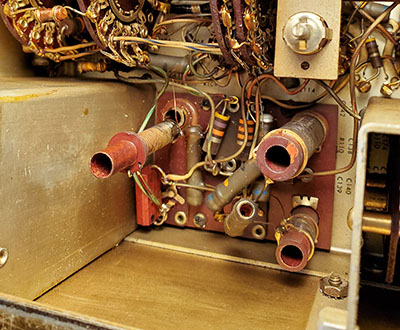
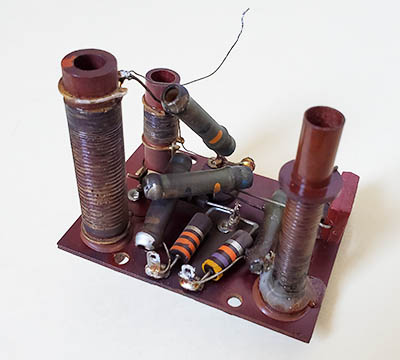
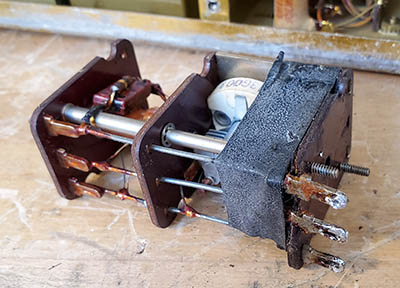
| Yet Another BFO Problem
- When powering up the receiver "cold" there seemed to be a
lot of instability
in the BFO. I pushed on a couple of connections on the BFO coil base and
the instability stopped but a subsequent push could get the instability
going again. It was then that I noticed a lot of the fiber
board base material around the three terminals on the BFO base was missing and the two
of the terminals were very loose and not supported. I unsoldered the three TC wires to the BFO, then loosened
the shaft coupler, then removed the four nuts and lock washers to allow
dismounting the BFO assembly from the chassis. Shown in the photo to the
right is what I discovered. Black electrical tape wrapped around the
area where the fiber board was missing in an attempt to hold the two
unsupported terminals secure. I removed the tape and noticed that one of
the NPO caps was partially broken. I had a good condition BFO assembly still installed in the "parts set" 51J-2. The BFO assemblies are almost identical with the two NPO capacitors being the one obvious difference. Since the BFO circuit is essentially the same in all 51J receivers and just two NPO capacitors were added for the later units, I decided to go ahead and install the 51J-2 BFO in this 51J-3. I swapped the shield-can so the BFO assembly would look original and performed the installation. I had a slight diversion to clean the chassis area since the can was off and I also discovered that the second IF transformer had very loose mounting nuts that needed to be tightened. Once the 51J-2 BFO was fully installed, I powered-up the 51J-3. The BFO seemed to be much stronger and a lot more stable than what I had been experiencing before. I'll have to notice if there is any BFO drifting without the NPO compensating capacitors. |
|
|
|
Complete IF/RF Alignment
- April 19, 2023 - I think I'm at the point where
this receiver can be aligned. The Crystal Oscillator trimmers were
adjusted first. Most were okay but several were so far off that there
was virtually no output. Fortunately, all trimmers did work and all were
adjusted for just under -2.0vdc at V-102 using the VTVM as the measuring
device (470K series isolation resistor required for the VTVM.) Next, was the 100kc Calibration Oscillator. This had the front
panel trimmer set at minimum C. I set it to about 40% mesh and then set
the main trimmer to zero beat WWV. This allows using the front panel
trimmer for future adjustments, if needed.
500kc IF - The 500kc IF requires a series RC shunt lp filter as a load but one has to be careful on the plate side adjustment since B+ is present. This moving the shunt to both the input and output sides of each IF transformer is probably the biggest headache in doing the IF alignment. If you have the shunt already made-up with the 4.7K resistor in series with a .01uf capacitor with about 5" flexible wire leads with small alligator clips, it becomes a whole lot easier. Only one lead has to be moved since the other is always at chassis ground. The 354A-1 alignment instructions say to turn off the receiver when moving the shunt because of the B+ on the plate side of the IF transformers but, interestingly, no other 51J manual has this warning. The IF section was way out of alignment but nothing unusual was found in the IF alignment and it went smoothly. Variable IF and RF - Again, this section of the receiver was also way out of alignment. I suspected that the ANT/RF slugs and trimmers would be out of alignment because the ANT TRIM was resonant for 50Z loads at fully unmeshed. The ANT TRIM variable condenser must be set to half-meshed before aligning this section of the receiver and the proper dummy load between the RF signal generator and the receiver must be used (47 ohm in series with a 100pf cap in series with the RF signal generator.) A couple of the trimmer capacitors were slightly stuck but came loose with a gentle movement. There was one stubborn trimmer that refused to budge. I used a hand-held heat-gun to apply heat to the trimmer. About 15 seconds of moving the gun around was all that was necessary. The trimmer became "unstuck" very easily. The heat-gun is the safest method to loosen stuck trimmers. The rest of the Vari-IF/RF alignment went normally,...except,... |
|
Weird AM-BC Band 1 Problem - This
band is still non-functional. Signals do come through but they are at a
very low level. All trimmers and slugs seem to actually "peak" but the
signal response is very low. Since the receiver now functions great on
Bands 2 through 30, the problem has to be associated with the Band 1
Mixer. I checked the various circuits with a signal injected and looking
at the signal progress with an oscilloscope. Nothing was coming out of
the Band 1 Mixer. A check of the plate voltage read zero. A close
inspection revealed no wire going to pin 5 of the Band 1 Mixer plate. A
check of the schematic showed that B+ to the plate went through the L-124
wave trap. Close inspection showed that the very fine coil wire from
L-124 to mixer plate pin 5 was broken (or cut) and "tucked under" L-124. I
cleaned the wire and resoldered
the connection. This corrected the problem and the AM-BC band or Band 1 now
functioned as it should. I suppose this broken wire could have been collateral damage from the L-110 break BUT even that broken L-110 was mysterious since there wasn't any physical evidence as to what caused the breakage. If someone wanted to disable just the AM-BC band while leaving the rest of the receiver working fine and to have "fixing" the disabling be rather involved, breaking L-110 and cutting the plate wire from L-124 would be a very easy way to accomplish that. But why? Commercial use and preventing the "goof-off" employees from listening to AM-BC on a company receiver? Who knows? Probably just more collateral damage. Wrap-up - April 22, 2023 - I need to find a top cover for this 51J-3/51J-4. Also, in the future is a 70E-15 tweak. If I ever locate a "parts set" R-388, I'll swap out the BFO coil assembly. Otherwise, the receiver is now a pretty good example of a possible 51J-3 receiver that has had the 354A-1 Mechanical Filter Kit installed. After the alignment, a casual test listen checked in on Trenton Military on 15.035mc, aviation weather out of Trenton, Ontario. Also, XSG and XSQ, the Chinese Coastal Beacons on 16.898mc and 16.952mc. On 20M, a 9V2 station and a VP2 station were easy copy. A couple of CE stations from Chile and W1AW CW bulletin on 17M. Also, I tuned in XSQ on 16.952mc and left the receiver on for about an hour. I never had to retune and the CW and "chirping" never changed pitch in that time. I don't think the 51J-2 BFO coil assembly will be any problem. Stations on 40M are pretty strong with the usual west coast variety of hams on in the afternoon. Audio quality is "typical 51J-4 mechanical filter" with very strong stations, like AM-BC, not sounding too bad. Weak AM stations (SW-BC usually) are pretty bad because the phase distortion limits which sideband you select since the "best one" always seems to change. SSB is pretty good but of course the BFO to signal ratio has to be controlled and distortion happens on strong SSB signals, especially found on 40M and 80M. RF Gain has to be below 8 for most strong SSB signals and below 7 for the blow-torch signals. SW-BC normally sounds poor but in the late afternoon, the Chinese SW-BC stations show up on 23M and they are very strong signals that reproduce quite well, even though the audio quality is limited by the 6kc mechanical filter. Also, the Crystal Filter operation is excellent now. >>> |
|
|
|
>>> A subsequent improvement for this receiver would be to go though and test
all of the tubes again. Some of the 6BA6 tubes tested just at "minimum
acceptable" and, though none of the tubes tested bad, none of them
tested like NOS tubes either. A set of "test as new" tubes would
probably noticeably improve performance. Right now, the CL meter reading is +30db
average for 10mc WWV.
With "test as new" tubes, +50 to +60db would be typical for 10mc WWV
(depending on propagation conditions.) Wrap-up - At first I thought this receiver was almost beyond hope. It had A LOT of things wrong with it. Years of rough treatment, years of incompetent and destructive maintenance with an utterly dismal quality of repair work and countless missing screws and locking washers. But, the initial close inspection revealed that most of the receiver was in decent original condition and still in pretty good shape. Only where the receiver had been "worked on" was there rampant damage. After about ten days of "reworking the rework" I was finally able to correct all of the problems and everything now operates as it should and looks like it should under chassis. Ultimately, the receiver cleaned up quite well which actually allows the overall nice condition to be easily visible. Now SN:5282 looks like a "well cared-for" 51J-3 ("without data plate" type) and, best of all, it works like a R-388/51J-3, too. Plus, it has mechanical filters - a "kit-type 51J-4," but wait,...aren't all 51J-4 receivers like that since all J-4s have the 354A-1 installed. UPDATE: Apr 28, 2023 - I went through all the tubes and tested them again. The PTO tubes were weak. NOS 5749/6BA6W tubes usually test about 70 on a TV-7. Minimum is 41. The PTO tubes tested 38 and 22. Most of the IF tubes were between 40 and 50, so not terrible. I installed all NOS 5749/6BA6W except for the CAL oscillator that got one of the best used 6BA6 tubes. I had to do a minor tweak on the BFO and on the CAL oscillator afterwards. I also replaced one of the 12AX7 tubes with a "tests as new" tube and both 6AK5 tubes with NOS tubes. With the best tubes installed, now SN:5282 runs 10mc WWV up to +48db. During the winter, the reception level would have probably been +55db or more. Typical pre-summer poor propagation. |
| UPDATE:
Apr 30, 2023 - I set-up sn:33 with the Collins 32V-1
transmitter and used both on the Vintage Military Radio Net this
morning. Conditions were challenging due to the high level of
atmospheric QRN but sn:5282 provided solid copy. I was using the NL, which
was okay, but the best results were reducing the RF Gain until the CL
meter read about +40db. Most signals were +40db or higher, so those
strong ones would still show the RF level on the CL meter and those
signals that were under +40db still could be copied. This reduced RF
(about 8.5) practically eliminated the QRN. The audio quality is the typical 51J-4 sounding
6kc MF AM
and is exactly as I remember the 6kc MF audio sounding on the two stock 51J-4 receivers I had years
ago. The best audio response on most
strong signals was tuning to the USB. Some of the weaker signals were
better tuning center frequency. Most strong stations were pushing the CL
meter to +55db, good average signals were around +40db (equivalent to
S-9.) KØDWC, at only 2 miles away, was at +60db. Tuning to
USB or LSB will affect the apparent dial calibration since you
essentially have to tune "off frequency" but, when tuned to
"center-frequency" (without any dial calibration performed earlier,) the
KC dial was only off 1kc which isn't bad. Operation of "break-in" via
K101 worked fine. I was using a 270G-1 Collins loudspeaker. UPDATE: June 5, 2023 - Although the BFO coil from the 51J-2 has been functioning fine in this receiver, I did want to install a correct R-388/51J-3 BFO coil eventually. I was able to purchase (off of eBay) a set of IF transformers and the BFO coil that had been taken out of a R-388. The BFO coil will be installed into SN:5282 to replace the 51J-2 BFO coil presently installed. Also, planned for SN:5282's return to the workbench is to apply dry transfer letters-numbers for "1KC", "3KC" and "6KC" since the lettering at present can hardly be seen. Lettering size is 1/8" and the font that's closest is R R Gothic. Color is white. The lettering that is present isn't even close as far as the font type used and the placement of each group is too close to the chrome switch lever. I'll probably have to apply a little "touch up" paint first to hide these transfers and then apply the new, more correct style with the proper spacing from the switch lever. Back on the Bench - June 22, 2023 - The 51J-3 was on the bench. The 51J-2 BFO had been removed and I was ready to install the replacement R-388 BFO. BFO Assembly Problem - I inspected the replacement BFO closely because it's very easy to correct any problems found now before the BFO is installed. Lucky that I "looked first." I noticed that the BFO shaft was rough-feeling when rotated and there was a very slight "metal to metal" contact sound. A closer look and I could see all of the variable-C plates were shorted together. The plates weren't bent but the rotor had changed position (probably the retaining clip came off) and that resulted in the rotor plates shorting against the stator plates. I thought about bending the plates to get the clearance but replacement of the variable-C was actually the best option. Luckily, the variable-C in the original R-388 BFO was okay. There are only three connections to the variable-C, so the transplant wasn't difficult. Interestingly, I looked at all three variable-C components (51J-2, R-388#1 and R-388#2) and all three were different. All three had different part numbers stamped on their ceramic bases. The 51J-2 and #1R-388 had the same number of plates but #2 had two less plates. NPO capacitors were also different styles between #1 and #2. Obviously, these were minor variations in components used from different vendors throughout the production runs and these variations don't affect the operation of the BFO noticeably. So, the variable-C from the original BFO assembly was removed and transplanted into the replacement BFO assembly. MFP inside the BFO Can - One thing observed was that the solder joints on the BFO assembly were all MFP-coated (and this would be inside the BFO shield-can!) This means that MFP-coating was a process that took place at all stages of assembly, even at the component assembly level (since these types of components wouldn't get MFP-coated with the final application, it had to be done ahead of chassis assembly.) The transplant was slightly complicated by the MFP since the solder joints had to be scraped cleaned first, then "solder wicked," the wire unwrapped and the Variable-C removed by dismounting the two screws and washers. The same steps had to be performed for both the donor assembly and the assembly being repaired. Mechanical Alignment - Once the transplant was complete, the BFO assembly was installed into the "original to this receiver" shield-can, the BFO coupler installed and the entire assembly loosely mounted. The alignment of the BFO shield-can to the Mechanical Filter switch assembly is why the BFO can't be mounted tightly at first. Once the BFO shaft is installed and the BFO assembly and shield-can and the BFO coupler all line-up, then the nuts can be tightened (under the chassis.) Next, the three TC wires are connected and soldered. The ground wire TC had been cut at sometime in the past and then tack-soldered with a glob of solder. I removed this wire and installed a new 18ga TC wire soldered from chassis to the BFO terminal.
Test and Alignment - The
receiver was connected up for normal operation. Upon power-up, there was
no indication that the BFO was operational. But, I turned on the
Calibrator and tuned in the heterodyne for a good strong signal. By
turning the BFO on and off, I could hear that the BFO was coming on but
was "way off" frequency. I had pre-set the BFO vari-C for zero-beat
(half-mesh,) so the
main L adjustment was off,...and off by a lot!. I turned the L adjustment
about five full turns before I heard the heterodyne coming close to
frequency. It probably was off that much because the variable-C had two more
plates than the one that I had been removed. Anyway, I did a typical BFO
alignment and everything was working fine.
Touch-ups and Pre-alignments - I thought it would look better if I completely covered the old extremely faded MF nomenclature. They were too close to the MF switch lever so they would show a little if I left them. I used matched St. James Gray paint and used just barely enough to cover the old lettering. I had to mark in pencil where the MF switch positions would be to have a letter alignment point (when finished the pencil marks were covered with the St. James Gray paint.) I used to do this type of dry transfer lettering quite a lot on prototypes and on test fixtures where I used to work, so I've had considerable experience with dry transfer lettering. Trouble is, that was over 30 years ago,...but I think I still remember how to do it. The 51J-3 panel is sort of easy because it already has a lot of nomenclature on the panel that can be used for reference alignments. The dry transfer letter sheet will have alignment lines along with observing the line along the tops of the other letters that will help keep the position of the transfer sheet straight. I had to use the MC dial cut-out edge for a straight reference along with the alignment lines on the transfer sheet. The letters and number really have to be close to perfect in being straight and spaced evenly. If well-done, the lettering will look original,...even if the font is slightly different from what Collins used. The other thing that really helps is each position only has three characters, a number and two letters. That's much easier to keep straight than long words or multiple words on one line. Three characters is nice.
"Toning Down" and Added Protection
- Once the application of the transfers was completed it was obvious
they were "bright white" which wasn't totally unexpected. Although the
other original nomenclature looked really white, it wasn't, since it had
years of aging that had discolored it somewhat. I had to "tone down" the
new white nomenclature to match the aged nomenclature but whatever I
used to do that had to be colored but transparent. I thought it would be a good idea
to experiment first since the dry transfer application looked
really good except for being very white. I applied some dry
transfer letters to the "parts set" R-388 front panel and began
to experiment. I tried dark tea, Polyshades Walnut and Artist's
Acrylic gray paint mixed with tea. The last two worked pretty
well with Polyshades doing the best at a match. The added benefit is that the
instructions for the 354A-1 kit indicated that the decal originally supplied with
the kit should be coated with clear lacquer for protection, so the
original MF conversions had a coating on the 1KC, 3KC and 6KC
nomenclature. I applied the Polyshades to the 1KC, 3KC and 6KC
nomenclature with a very small paint brush with very light
coatings to "work up to" the best match. The Polyshades has to
dry for a few hours before the lettering could be touched,...if
you wanted to touch it.
|
|
1952 51J-3 - SN: 1999 - Refurbishing, Servicing and Alignment Many of the 51J-3 receivers that were shipped out of Collins Radio Company didn't have data plates to identify what type the receiver was. Identification of these "tag-less" 51J-3 receivers was originally by way of the Collins Manufacturing Serial Number that was punch-stamped on the rear of the chassis and ink-stamped on the front panel tied to the original 51J-3 manual and other paper-work that originally came with the receiver from Collins. Most of these receivers have long since lost their matching original manual and paper-work so unless one is familiar with the 51J-3 and the R-388 there isn't an easy way to actually identify what type of "tag-less" receiver they might have. Nowadays, identification has to use the very subtle physical differences between the R-388/URR receivers built between 1951 and late-1952, taking into account their "military" end-users and the civilian 51J-3 receivers built between 1951 and 1953. For these "tag-less" 51J-3 receivers, the PTO serial number is the most important "identifier" and gives positive indications of who the end-user originally was. Other subtle indications are also observed to help confirm the identification of a "tag-less" 51J-3. |
|
|
The Purchase - I first saw this receiver as an eBay listing from Ham &
Hi-Fi, a NW Nevada dealer in vintage electronics gear. Ham & Hi-Fi
is located in Sparks, Nevada which is about an hour's drive from Dayton
Valley, Nevada, my QTH. I don't really know why I looked at the listing since it
just had "Collins R-388 SN:1999" in the header. Among the many
photos were a
couple of good chassis shots that showed the PTO serial number, 5487C.R.
clearly, a
definite indicator that the PTO was for a civilian receiver. I checked
the under-chassis photos and enlarged them to see if the PTO was
original. The wiring for the PTO was still laced with other harness
wiring using the original waxed-string. All
other components seemed to be original which indicated that there had
been no restoration work performed. A close-up of the front panel looked
like the data plate screw holes still had paint in them indicating a
data plate had never been mounted.
On the downside,...the MC drum dial looked very faded and was barely readable,...at least in the photographs. The one questionable find was under the top cover where a schematic was glued with "R-388/URR" shown as the title. I studied the photographs for several days,...in fact,...for several weeks. Finally, I had the opportunity to travel over to Sparks, so I called ahead and set up an appointment to stop by Ham & Hi-Fi. A deal was made and I took SN:1999 home with me. Nov 4, 2025 |
| The Inspection:
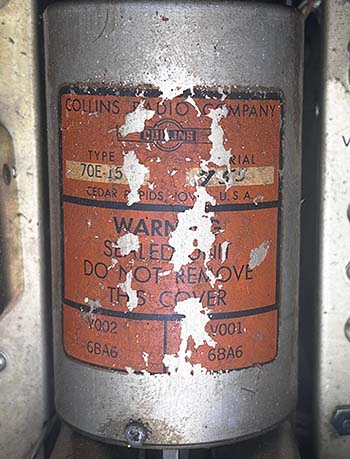
The overall cosmetic condition is exceptional. The front panel has no
serious
"rack rash" and the edges of the panel are square and not marred or
dented, even the paint on the panel edges shows very little wear. The case
for the CL meter is semi-gloss and not scratched in any way. The tuning
dial bezel and the knobs are excellent. It appears that the receiver must have been in
a business operation where it was hardly used. Maybe some type of
commercial or private citizen use. If the owner was a ham he certainly
wasn't a "hamster." The chassis has some oil spotting that wipes off
easily with WD-40. The tube shields appear slightly oxidized. The MC
dial drum had a white powder coating, like dry talcum powder, that easily wiped off with a dry
cotton-flannel cloth. Underneath the powder, the MC dial drum scale was
perfect. The white powder was deliberately put on the MC dial as some
sort of protection. The powder was no where else on the receiver
chassis, just on the MC dial. Whatever it was, it did protect the MC
dial very well. Just a slight amount of
dust under the chassis, almost all of the bottom cover screws were
present (with their locking washers.) The original garolite
alignment tools were present in their holders. The four Bristol wrenches
were present in their holders under the top cover and the angled
Phillips screwdriver was in its holder on the back of the top cover.
Having all of the tools present is unusual and indicative of an owner
that "cared for" the receiver (or a receiver that wasn't used much
and didn't go through an annual alignment servicing.) The only
non-original part is the AC power cable and the missing strain-relief
that was replaced with a large rubber grommet. Authenticity Concerns - While SN:1999 has nearly all of the indications of being a genuine "tag-less" 51J-3, here are two observations.
1. The C.R. suffix on the PTO serial number implies that it came
from a 51J-4 receiver. However, the wiring looks stock original but I
suppose it's possible that a replacement PTO could have been installed
professionally with all of the proper lacing - but by whom? Collins? If it's a
mid-production 51J-4 PTO, where did it come from and who did this ultra-authentic
installation? Would Collins perform a PTO replacement job and use a
current production 51J-4 PTO? Photos below
show the PTO and the wiring which looks Collins-authentic to me.
Observation of the solder joints show they are
top-quality work with the proper wraps and professional
soldering but there doesn't appear to be any MFP on the four solder joints.
All of the solder joints have the patina of age. Either this is the
original PTO with a "C.R." suffix, or, the other possibility is that the PTO is from the
time period of the mid-production 51J-4s and is
a replacement installation that was performed by Collins. That would
only have been done to a 51J-3 receiver, not to a R-388 receiver.
I can't
explain the "C.R." suffix but the installation just looks "too good" to be anything
but original or a replacement that was installed by Collins (this is
especially true of the PTO output cable-shield where it's soldered to
chassis-grounding lugs - it's too good to be anything but Collins work.)
UPDATE: Dec 21, 2025 - I
performed a PTO calibration on SN:1999 so I had to dismount the PTO out
of the receiver. This allowed a very close inspection of the soldering
joints involved with the PTO installation. These soldering joints are
excellent, top-quality work BUT they aren't original - at least, I'm
about 90% convinced that this work, while not the original soldering, is
so good that it had to have been done at Collins as part of a customer
repair. The installation of the PTO is nearly perfect, but close
inspection shows no MFP on the solder joints. Of course, the other
indicator was the "C.R." suffix that never did seem to "fit" the time
period. I now believe that PTO SN: 5487C.R. was
installed around 1957 as a repair performed by Collins. Collins would
have only done that type of work on a 51J-3 receiver, not on a R-388. |
|
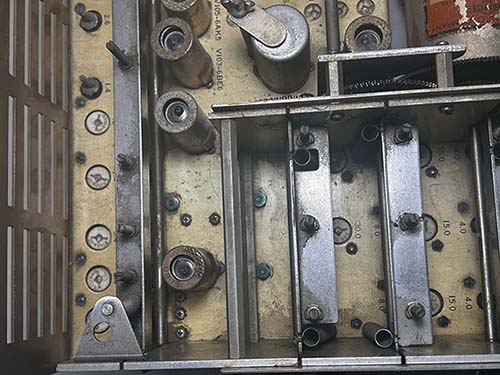
|
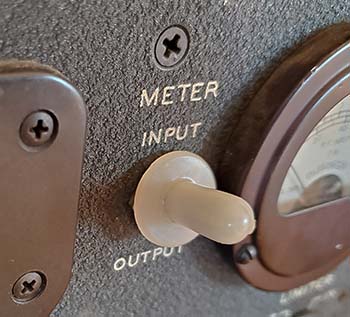
Cleaning
- I've already mentioned the white powder on the MC dial drum. It wiped
off very easily and left no residue. The chassis had numerous but small
oil spots that had trapped dust. These cleaned off very easily with WD-40 and a
small paint brush. After
the entire chassis was cleaned with WD-40, it was again cleaned with
Glass Plus to remove the WD-40 residue. Intense cleaning wasn't
required since the only spots were oil-based and easily cleaned.
The tube shields appeared to have some oxidation but once I pulled one and examined it closely I could see that the coating was MFP. The heat generated by the tubes had turned the MFP color very dark so it looked like oxidation. The tube shields were just wiped down with Glass Plus to remove any dust or oil spots. The back apron just needed a bit of Glass Plus and a small paint brush to clean the terminal strips. The two SO-239 connectors were also cleaned. Since the SO-239s are silver-plated, they are always oxidized and dark color but since silver oxide is conductive it doesn't matter. The front panel didn't need cleaning, it was in immaculate condition. The bakelite bezel was dismounted so that the glass windows could be cleaned using Glass Plus (I ended up replacing the glass since the MC glass was chipped badly.) The knobs were all very nice so they were only dismounted, wiped down with Glass Plus, wiped with a cotton-flannel cloth and remounted. At this time, I didn't drop the front panel. I will do that if I find it's necessary later during test and alignment. |
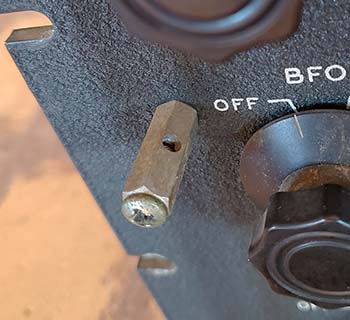
|
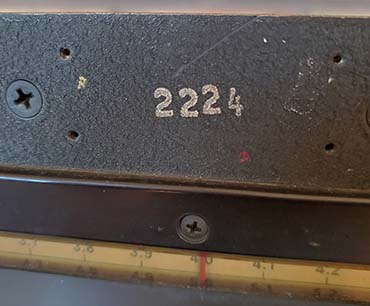
Testing Tubes - The vacuum
tubes installed were of all different manufacturers. Not typical for the
military use or even commercial use but something that would be expected
in amateur service.
However, after 70+ years, it's difficult to say when any of the tubes
were replaced. I tested all of the tubes using the TV-7B tube checker. I
found five questionable tubes.
V102 - 6BE6 - 1st Mixer - 37/36 - At minimum acceptable V105 - 6AK5 - Crystal Osc - 22/22 - At minimum acceptable V106 - 6BE6 - 2nd Mixer - 24/36 - weak ~ 33% below minimum acceptable V110 - 12AX7 - Det/AVC Rect - 20/42 and 15/42 - both triodes weak and ~ 50% below minimum acceptable V111 - 12AU7 - AVC/IF Output - 60/52 and 100/52 - unbalanced for some reason. Replaced as a problem-preventive measure. The other 13 tubes all tested significantly above (>50%) minimum acceptable. None of the tubes were "bad" - that is, open heater, shorted or no emission - just weak, that is, being at or below minimum acceptable on the TV-7. Having all of the tubes being NOS or testing like NOS assures that the receiver will align correctly and perform well. Tube testers aren't the final word however. A Mutual Conductance tester, like the TV-7, will test the tube at 60hz and at voltages that aren't anything like how the receiver's tube circuit is designed. The tube working correctly in the receiver is the final test. |
|
|
AC Power Cord
- This, at first glance, looked like a very good installation but one could tell immediately it
wasn't
original. The AC cord should go through the chassis using a plastic
strain-relief (Heyco 6P.) Under the chassis, the wires should
be as short as possible but still have a slight bit of slack. This installation had the
cord tied in a "big knot" so it wouldn't pull through the grommet.
Soldering was obviously not original. I had to check the part bins to see if I had an
original type and correct size strain-relief (and I did, but, if needed, there are a
multitude of listings on eBay, seach "Heyco Strain-relief." Heyco is still
in business making these parts.) These strain-reliefs are difficult to install if
you don't have the proper tool. Unfortunately, I haven't even seen one
of the correct tools (in person) for about 30 years (again,
there are multiple listings on eBay for the correct tool at around the $35 to
$40 price range.) Installation can be accomplished
with other tools but the correct tool makes the job super-easy. It's rather
difficult using small vise-grips or channel locks and 14 gauge twisted wire wraps for
compression, but it can be done (and that's how I accomplished the
installation.) Three-Wire AC Power Cord? - The three-wire power cable upgrade was performed on a lot of R-388 receivers, probably by military depots where the installation was first-class. I would think that a commercially used receiver that was maintained by professional technicians would also have had the power cable upgrade. I was all set to just use the "as-original" two-conductor power cable that was installed and just do the strain-relief installation. However, when I cut the power cable to start the installation, I found the cable was actually an 18-3, a three conductor power cable, that had the ground wire cut and was only using the hot and neutral wires. When I unsoldered the wires, I found that they had only been tack-soldered,...not even a wrap or anything,...just a glob of solder. So, the power cable installation was obviously a "hamster job." I decided at that point to do a professional installation as it would have been done to a R-388 at a military depot and use the three conductor cable, a Heyco 6P strain-relief and a vintage high-quality three pin (grounded) AC power plug. I don't know what to think about the "hamster" AC power cable installation. It was the only example of inferior workmanship I found in the receiver. Initial Test - Nov 9, 2025 - At this point, SN:1999 was ready to have power applied. A 4Z loudspeaker was connected and I used my indoor W6VLP shielded-magnetic loop "test" antenna. The operational point where the B+ has come up but before the reception point had quite a bit of a noticeable hum level. That subsided as the receiver "came to life." But, the hum level was enough that it modulated any type of heterodyne. It was very noticeable with the CAL heterodyne. As far as reception, I tested 20M and heard many stations in CW and SSB. I tested XSQ on 16.874mc and it was coming in just audible. WWV 15mc ran the CL meter up to about +20db. The BFO was set up 180º out although it will work as set up. It's just the opposite of normal 51J set-up for the BFO. So, there's still some more work to do plus the front bezel glass is filthy, so that needs to be taken care of. Checked WWV 15mc using the Collinear Array antenna and the CL meter indicated +40db which is just about normal although a freshly-aligned 51J receiver will usually have WWV 15mc push the CL meter to over +50db using the Collinear Array. |
|
PTO End-Point-Error - I don't know
why I expected this 70E-15 to be any different from all of the other
70E-15 PTOs I've tested. EPE was 11kc, which is beyond the point at which the
L002 adjustment can correct. If I wanted a frequency meter, maybe I'd
think about trimming L002, but, as it is, if I calibrate the PTO and
tracking at the center-point of the 3.0mc to 2.0mc PTO span, the
tracking error doesn't exceed 5.5kc in each direction from center and
the adjustable fiduciary can correct
for that error. This amount of EPE does seem to confirm that this
probably is the original PTO (although I have a spare mid-1960s 70E-15
that has 15kc EPE!)
Testing the Filter Capacitor - This receiver had been tested a Ham & Hi-Fi but it was just a quick test for functionality. Since the receiver had been powered up, the filter capacitor was probably already somewhat reformed. Or,...maybe not. The C measurement showed 45uf and 42uf. The 42uf seemed erratic. When in operation there is a noticeable hum that modulates the BFO heterodyne but otherwise is fairly low level. I have several spare filter multi-section capacitors. Hopefully, there's a good one in the group. I had to use a 45uf-45uf multi-section (for the R-390A.) These are physically the same size with the same connections but with a slightly higher capacitance per section. I used a 1958 date-code multi-section. This capacitor eliminated the hum problem. Or, maybe I just thought it did. The hum seems to come and go. More hum info further down in "Hum Problem." Cleaning Bezel Glass - I removed the dial bezel to clean the glass and found that the MC dial glass had a good size chip on one end. I had a perfect spare glass piece so it was cleaned and installed. I also replaced the KC dial glass with a perfect spare that was cleaned and then installed. All knobs were removed and cleaned, then reinstalled. Run Time - Before the alignment, I like to operate the receiver for a couple of days. This gives the tubes time to get up to full emission (if possible) and for all of the components to have some run-time put on them to make sure everything is okay. I didn't replace any components except for the filter multi-section capacitor. All other components are original. Most of the time, with R-388 receivers, running on all original components is not too much of a problem. Nov 10, 2025 Hum Problem - This was a modulated hum. With no signal, no hum was heard through the loudspeaker. If a CW or SSB signal was tuned, there wasn't any hum because the RF Gain was greatly reduced for proper demodulation. The hum was affecting AM reception with the RF Gain at maximum. It didn't matter whether the AVC was on or off. The first step was to isolate where the hum originated. I used a function generator to input an audio frequency sine wave into the grid of V112 (1st AF amplifier.) The audio output at the loudspeaker was clean with no hum. That test eliminated the power supply as the source of the hum and also the audio output section of the receiver. Next, I input 500kc into the grid of V107 (1st IF amplifier.) I modulated the 500kc with a sine wave and the audio output at the loudspeaker was clean with no hum. This eliminated the 500kc IF as the source of the hum. Next, I switched on the Calibration Oscillator and tuned in that carrier (the Cal Osc is connected to the RF amplifier grid.) Now I had the hum. This meant that from the grid input on the 500kc IF through the rest of the IF, Detector and audio circuits, including the power supply of the receiver were operating correctly (well, didn't have any "hum" problem.) Therefore, the hum had to be in the front end of the receiver. Most likely one of the "tested" tubes had a slight leakage from the heater to the cathode,...not enough to show as a short on the tube tester but still enough to modulate the cathode with 60hz AC. I swapped some of the mixer tubes around and it seemed that the one 6BE6 that wasn't replaced might be the problem tube. One mixer tube is only used on Band 1 so I put the suspect tube in that location for now. It would be nice to have all NOS tubes in the front end, so I replaced all of the Mixers (three of them) with NOS tubes. This seemed to cure the problem. Or, did it? Still, the hum problem seemed to come and go,...sometimes there would be noticeable hum. Other times, clean and clear. See update at the end of this 51J-3 write-up. |
|
|
Photo Details Showing Areas of Interest or Concern |
|
|
This shows that the PTO installation in SN:1999 appears to be original to the receiver, note the lacing that appears to be as original. The wire wraps on the terminals are perfect and the soldering is at a professional level. This might be the original PTO but more likely it's a replacement that was installed by Collins as part of a customer repair. |
Written in black grease pencil, this is located on the inside of the bottom cover. It shows that someone else thought that SN:1999 was a 51J-3. Or, maybe they "knew" it was. Unofficial notations maybe interesting but can't be relied upon as accurate information. |
This close-up of the Collins Mfg. SN and the data plate area of the front panel shows that the original paint is still inside the data plate mounting holes. This area of the receiver is very important because it's obvious that a data plate has never been mounted here. Normally, when a data plate was installed, the wrinkle finish paint near the screw holes will be compressed. This results in the paint around the screw holes looking "glossy." So, observing that the paint is still in the screw holes and the wrinkle finish hasn't been compressed, no data plate has ever been mounted to SN:1999 which indicates the receiver wasn't a R-388 when it left Collins. |
|
This shows the area of the side panels where typically an "eagle" type of military inspection stamp is found. While the absence of mil-stamps isn't a positive identifier, since they can easily be washed off, the absence, when combined with other indicators, helps to confirm the civilian status of the receiver in question. |
A thorough inspection did turn up this Anchor ink-stamp, probably USN approval for the component itself. It's logical that since the same relay was used in both R-388s and 51J-3s, all of the Break-in relays were stocked with one part number. When a receiver was assembled, the parts were pulled from stock and, since the stamp was the result of a component test-inspection and approval they would end up in either R-388s or 51J-3 receivers. |
I've seen these stamps on almost all R-388 CL meters. It's probably for the same reason that the Break-in relays have the mil-stamps. Since the R-388 and the 51J-3 use the exact same CL meter, all of the CL meters were stocked as one part number. The stamps are probably for component test-inspection and approval to allow Collins to put the meters into their stock "ready-to-use." The orange writing at the bottom of the meter is "SEALED DO NOT OPEN." |
I found this pencil note under the top cover about where the center wing-nut notch is. An unexpected notation and one that adds slightly to the concerns about the correct identification of the receiver. Of course, it's not a Collins-official notation. It might have been an erroneous assumption made from referencing the schematic title. Unofficial notations maybe interesting but can't be relied upon as accurate information.
|
| Using Modern Test Gear Makes
Alignments Easy - In all of the 51J alignment procedures, a lot
of what is described are methods using duplicate receivers, the
Calibration Oscillator and other methods to confirm the accurate setting of the signal generator's
frequency or determining the PTO output. Using modern test gear will eliminate ALL of these steps. The PTO output can be measured
directly with a digital frequency counter (a big help and a lot more
accurate,...use a shielded cable or 10X 'scope probe for isolation.) Using a synthesizer generator will eliminate the need of
confirming input frequencies and amplitudes. Using a VTVM is still good
for monitoring the Diode Load voltage for peak aligning as the meter needle is easy to determine where the
peak is. NEARLY HALF of what is written in the 51J alignment procedures
can
be eliminated if modern (fairly modern, at least) test equipment is used. I used the following
equipment,... 1. HP 3325A Synthesizer Function Generator (up to 20mc) providing fixed 500.000kc for IF alignment. This synthesizer can also increment frequency changes for checking crystal filter. 2. FNIRSI DPOS350P Synthesizer RF Signal Generator providing RF (up to 50mc.) This unit is also a two-channel oscilloscope, a frequency counter and a DVM. It also can provide limited spectrum analyzer functions and allows fully incremented adjustments for all functions. This unit could provide all test functions but the HP synthesizer I think is easier to use for the IF and Crystal Filter alignments (the large buttons on the HP 3325A are easier to "punch" than the screen menu access used on the DPOS350P.) The ME-26D VTVM is easier to use for the Diode Load measurements. 3. ME-26D - Military-HP VTVM allows an analog measurement of the Diode Load voltage for easily observing the "peak voltage" during alignment. Also, for the Crystal Oscillator adjustments the VTVM is easier to "see the peak" and then adjust to < -2vdc. 4. General Radio 1192-B Digital Frequency Counter for PTO and KC dial set up with shielded cable or 10X 'scope probe for isolation. 5. Original alignment tools provided with the receiver. The original tools make adjusting the IFs and the ceramic trimmer caps easy. Reproductions of the tools might be available. |
This isn't an "indicator" since these ink-stamps are sometimes also found on R-388 receivers. Over the years, most receivers have been "cleaned" extensively and these water-soluble ink inspection stamps seldom survived. This is one of the better examples I've seen. Sometimes the "Line Inspection" stamp will be located on one of the side panels, especially on later production. |
|
Manuals and Alignment Info - The 51J-3
alignment should be the same as a R-388 alignment but the procedure in
the 51J-3 manual is somewhat different than the Signal Corps TM for the
R-388. The differences probably wouldn't affect the receiver
performance. For instance, the TM says to use a 270 ohm resistor load
between the signal generator and the antenna input while the 51J-3
manual says to use a series RC dummy antenna consisting of a 47 ohm
resistor and a 100pf capacitor. The detuning loads for the IF
transformers are the same and the isolation R for the VTVM for the
Crystal Oscillator adjustment is the same. The 51J-3 manual is much more
detailed on certain adjustment methods while the Army TM is more brief
(the TM alignment procedure is only two pages.) Interestingly, the USN
manual for the AN/URR-23A agrees with all of the 51J-3 manual. I used
the 51J-3 manual most of the time. Alignment Hints: 2. When connecting the IF transformer load the pins on the transformer involved will be pin 1 and pin 4. The 2pf coupling capacitor also connects between these two pins. With the receiver on its left side, looking at the IF transformer bottom, pin 1 is to the upper left and pin 4 is to the lower right. Make up the series 4.7K and 0.01uf cap with two flexible leads with small alligator clips to allow easy connecting. Since the RC detuning network always has one end connected to ground-chassis, that lead can stay in place. Then only the remaining lead can be moved to the required IF transformer pin. With pin 1 loaded you adjust the bottom IF trimmer. With pin 4 loaded you adjust the top IF trimmer. Move the load lead as instructed in the procedure. This method is just about as easy as it gets for the six "loaded" adjustments. >>> |
|
|
|
>>> 3. Set the PTO output to exactly 2.500mc as measured on a digital
frequency counter. MC dial will be exactly mid-scale. Loosen the set
screws (Bristol type) on the KC dial hub. Set the KC dial to read exactly 0.00
with the fiduciary straight-up and snug-up the set screws. Rotate the KC dial half a turn and then
retune the KC dial to 0.00. Verify that at exactly 0.00 on the KC dial
and mid-scale on the MC dial the PTO output is exactly 2.500mc. This is
the easiest and most accurate method to setting up the PTO and KC dial. Post Alignment Performance - 500kc IF was pretty close, Vari-IF way off, RF way off, so alignment made a significant improvement in the receiver operation. Tracking is right-on at the center of the MC dial and skews out about 5kc at each end band which is no problem for the fiduciary to correct. WWV 15mc will push the CL meter to +40db (+55db after CL adjusted) using the Collinear Array. Tuned in Trenton Military 15.035mc USB. CW Chinese Maritime beacons XSQ on 16.879mc and 16.854mc. 20mc WWV was +40db, lots of 15M activity (contest going on.) Heard PS7MA on 15M CW out of Brazil. Alignment completed on Nov 15, 2025. And, don't forget like I did,...to adjust the Carrier Level meter. The meter adjustment was pretty far off and driving the meter to the negative side stop pin when the RF gain was at max with the AVC on. The meter adjustment pot is a little touchy so go slow. Once the narrow area of adjustment is found, it's easy to zero the CL meter. After adjusting the CL meter, now 10mc WWV runs the CL meter up to +55db. 15mc WWV is also going over +50db. 20mc WWV at +45db. And, I also didn't adjust the CAL C-trimmer for the 100kc Crystal Calibration Oscillator. The CAL C-trimmer didn't have enough span for zero-beating WWV, so I had to adjust the ceramic trimmer on the chassis. I first set the CAL to mid-C and then adjusted the ceramic trimmer for zero-beat. I then "fine tuned" the heterodyne that results from WWV's carrier beating with the CAL oscillator by adjusting the CAL for less than a one cycle beat note, so the CALIBRATE is now right-on 100.000kc. |
|
UPDATE: Nov 17, 2025 - More on
the hum issue,...this seemed to be actually coming from
somewhere other than the receiver. At first I thought it might be the
"smart" furnace with its modulated blower. Then I thought it might be
that the receiver's bottom cover needed to be mounted securely with all
of the screws and locking washers. Last year, when I was working on
several NC-173, NC-183 and NC-183D receivers, I was experiencing minor
instabilities that seemed to be coming from the receiver's HFO. These problems
seemed insolvable. But, the instabilities were eliminated when I moved
the receivers from the repair shop over to the ham shack. So, I moved
the 51J-3 out of the repair shop over to the ham shack. When powered up,
the receiver was perfectly quiet, no hum at all, no modulated hum and no
distortion (other than what's normal for 51J audio.) Then I had a
thought,...why not put the original filter multi-section capacitor back
in the receiver? So I did and it functioned fine with no problems,...no hum,
no distortion, etc.,...hmmm. I went ahead and installed and snugged-up
ALL of the bottom screws with locking washers. I installed the top
cover. 51J-3 operation was perfect,...no hum, no distortion. What's
different? The AC house circuit I believe. I'm now powering the 51J-3 on
a different AC circuit on a different breaker at the box. I had
wondered about the AC line in the repair shop before. Some receivers
seem to be immune to the instabilities while other are affected
significantly. It will definitely
require further investigation on that matter. To isolate the problem's
source, I'm going to use a 50 foot AC extension cable to actually power
the 51J-3 from the work shop AC line but have the receiver located in
the ham shack. That should indicate whether the instability is from the
AC line or something affecting the room that the work shop is located
in. Test showed no problem with AC line. At any rate,...now, the 51J-3 is working beautifully in
the ham shack and sounding great,...well, as good as a 51J receiver will
sound (remember the specs,...<15% distortion,...the 51J receivers aren't
for audiophiles.) At least, no hum and no audible distortion, just nice clean CW heterodynes
and
nice clean AM modulation,... UPDATE: Nov 29, 2025 - I've had an empty but very nice Collins 51J cabinet just setting around here for quite a while. I'm not a fan of "cabinetizing" any of the 51J receivers because it adds to the overall weight. But, I really think that SN:1999 was in a cabinet originally, so I'm going to try the installation and see if I can become accustomed to the appearance. See the photo above,... UPDATE: Dec 22, 2025 - SN:1999 was removed from the cabinet for calibration of the PTO. This allowed assessing if there were any advantages to having SN:1999 installed in the 51J cabinet. The cabinet just takes up too much room and adds too much weight. I've placed the 51J-3, sans cabinet, on top of the 32V-3 transmitter, slightly elevated to not block the V-3 vents. UPDATE: Dec 21, 2025 - PTO Calibration - I've been having pretty good luck recalibrating 70E-15 "CR" PTOs, so I decided to go in and recalibrate this PTO. This involves some time consuming disassembly, like dismounting the front panel, dismounting a few components, all to be able to dismount the PTO but leaving the wires connected so the receiver can power up the PTO. I was very careful to preserve the lacing as I dismounted the PTO since this is one of the key indicators that either the PTO is original to the receiver or it's a Collins-installed replacement (I was able to slide the lacing up the wiring so the knots were maintained.) A quick test of the existing EPE and I got an incredible 15kc! I had tested it at 11.5kc a while back. Although this test that showed 15kc EPE it was just a "quickie" test so maybe not all that accurate. But, the upshot was that this PTO was in serious need of calibration. The first adjustment of L002 was one turn clockwise. That got the EPE down to about 5kc. The second adjustment was for about half a turn clockwise. That got the EPE down to about 3kc. One more half turn clockwise and the EPE was <1kc and the linearity deviation was <1kc, which is good enough. This PTO was a "C.R." type and I've had very good luck just using L002 adjustments on these later 70E-15 PTOs that I've found with the hex plug still coated with green Loctite (indicates that the PTO has never been tampered with.) Reassembly took a little more than one hour. I was able to slide the lacing back down the harness wires so that it appeared exactly like I'd never dismounted the PTO. I checked receiver performance and all was fine but I'm going to go through the Vari-IF alignment and the RF tracking again since there are slight changes there due to PTO calibration, especially the Vari-IF that is cal'd at the MC dial edges where the EPE might have made a slight difference in the alignment. 12-22-25 - As suspected, the Vari-IF was slightly off but the RF tracking was not affected since it is aligned at the center of the band where the PTO was accurate prior to calibration. Now, the PTO is accurate from band-edge to band-edge and performance is about as good as it's going to get,...and that's excellent. |
| Conclusion
- All Collins Radio enthusiasts have their favorite models. For me, the
51J Series has the best of what I like - top-notch performance
characteristics with incredibly "good looks" and an impressive "bench presence." Add to that,
superior build-quality resulting in excellent reliability and you end up
with a really great receiver.
The earlier 51J-1 and J-2 have desirable features like the great front-end selectivity and the very tight IF selectivity. Performance of these initial versions is impressive, with zero drift and 1kc dial accuracy, making it possible to still use a J-1 or J-2 in a vintage ham radio station set-up, even in vintage CW or SSB stations. But, finding a good condition, original example of a J-1 is next to impossible and even the J-2 is a very difficult find. I have a 51J-2 that required two J-2 receivers to make one complete, functional receiver. But, it's an amazing performer considering it's one of the early versions of the 51J Series. I've recently restored a 51J-1 and returned it to its original specs. All of the classic "51J characteristics" are present, even in this earliest version of the 51J Series. It's lucky for those amateurs and collectors who want to own and use potentially the best all around performer,...and they don't mind digging into (or maybe just putting up with) the infamous 70E-15 "M" PTO,...the military R-388/URR can provide the vintage military radio user with a great performer. A little wider IF bandwidth provides much better AM audio quality than the earlier 51J versions. Thousands and thousands were built in the early fifties - a time when vacuum tube design was peaking and the military demanded the very best radio gear. The R-388/URR is probably the easiest version of the 51J Series to find and they are usually the best bargain (I've owned many R-388s and have worked on many more,...although I only own one example now, they are excellent receivers.) The most difficult 51J to find is the 51J-3 but it's identical to the R-388 (excepting military acceptance stamps, data plate and PTO serial number) and performs just like the R-388 although the 51J-3's 70E-15 PTO might be in better condition since most J-3s weren't used 24/7 like the military R-388 (but don't hold your breath,...there's much more to the early 70E-15 problems than just 24/7 operation.) The 51J-4 can be a very practical vintage receiver that's easy to set-up and use as the station receiver. Most J-4s don't require too much work to have them performing at their very best. The J-4 has mechanical filters and a crystal filter that allow the user the best in QRM-fighting tools to provide reliable communications in crowded band conditions. I have a Collins Lab 51J-4 and it's a very sensitive receiver that can deal effectively with almost any type of QRM making it a pleasure to operate. In this 51J-4 Lab Model, Collins substituted their own plug-in RC coupler unit for the 6kc mechanical filter giving this receiver very nice communications audio in the AM mode.The best communications equipment design and manufacturing company at the time, Collins Radio Company, provided a couple of "winners" in the 51J Series with the both the R-388/URR and the 51J-4. If you own a true civilian 51J-3, it's a rare one and will perform just like the R-388. And, of course, the 51J-1 and 51J-2 have their fans too (I'm one.) All 51J versions are receivers that are either at or fast approaching septuagenarian status, and yet, they are still easy to use for reliable communications "on the air" on any ham mil-rad net or any amateur AM-CW-SSB vintage radio net or for ultra-easy "band cruising" as a SWL receiver on any frequency range just listening for interesting signals (and there are a lot of those.) |
| References: 1. Nick England's great website www.navy-radio.com has a very detailed section on the R-388/URR receiver and all of the variations. Also includes a lot of info on the 51J-4 and many of the numerous 51J variations. Lots of photos. Detailed list of R-388 contracts. As seen by the many listed references to "navy-radio.com" throughout this web-article, there's a tremendous amount of information about the R-388 and 51J-4 receivers on Nick's site. Nick has contributed a lot of information included photos on the elusive 51J-3 which was greatly appreciated. 2. Manuals for 51J-2, 51J-3 1952 edition, 51J-4 4th edition, Signal Corps R-388/URR, U.S. Navy AN/URR-23-A, 9th edition 51J-4 manual (1961), Beckman/Berkeley Frequency Measuring System manual(s), 354A-1 Mechanical Filter Kit manual - Some manuals are original, others are copies. Originals are nice to have but copies are often free downloads and do provide the information needed. 3. Bill Orr's R-388/70E-15 PTO article "New Life for the 51J PTO" from December 1969 "Ham Radio" magazine. PDF available at www.collinsradio.org 4. Bill Orr's Feb 1978 article "Modifying the 51J for SSB" in "Ham Radio" magazine is a PDF available at www.worldradiohistory.com/Archive-DX/Ham%20Radio/70s/Ham-Radio-197802.pdf 5. "A Guide to the Evolution of HF General Coverage Receivers at Collins Radio" - Collins Signal, 1st Quarter 2014 CCA www.collinsradio.org 6. "The Collins 51J-5: The Dream Receiver that Almost Was" by Bob Thomas VE3TOU - Collins Signal, 3rd Quarter 2013 CCA www.collinsradio.org 7. "Hollow State Newsletter" articles by Dallas Lankford have a lot of information on the 51J-4 and R-388 - Hollow State Newsletters can be found at various locations on the Internet, including www.navy-radio.com 8. Thanks to Jan Wrangel SM5MRQ for his procedure and photos for accessing the 51J-4 Crystal Filter. 9. Thanks to WB2GCR "Bear" for providing the four photos of four different light-gray panel 51J-4 receivers. 10. Thanks to W3TA Tom for providing the photo of Beckman/Berkeley greenish-gray wrinkle 51J-4 panel plus the Beckman Frequency Measuring System manuals and schematics. 11. Thanks to VE7CA Markus for the write-up on his light-gray panel 51J-4 and the photo of the Collins RC-coupler. www.ve7ca.net 12. Photo of the Beckman/Berkeley Rack Mount Frequency Meter System at KPH. www.radiomarine.org 13. Some original and some reproduction parts for R-388 and 51J receivers can be purchased from W3HM Radio Labs, Howard Mills, e-mail is: w3hm@frontiernet.net E-mail to check on what is available and prices. 14. Thanks
to all of the 51J Series enthusiasts for conversations, information,
photographs and
anecdotes that have been exchanged "on the air," online and "in person"
over the years. |
| Henry Rogers, Radio Boulevard, WHRM © December 2013-2026,.......edits as follows,....Nov 2018, added extra info on 51J-3,...May 2020, edited and corrected various sections,...Oct 2022, added light-gray panel J-4 photos,...Jan 2023, added info on SN:4723 J-4, info on RACAL RA-17,...Jan 2023, major write-up revision and expansion with lots of new information and new photographs in all sections,... Feb 2023, sixteen more new photos added, info on 70E-15 "M" PTO and 70E-15 "CR" PTO, more details on Break-in use, new info on 1952 R-388 sn:161, 17 more new photos added, 51J-1 details added, R-388 to 51J-4 conversion receiver. Adjustment Tool drawing for 70E-15 PTO, Odd/Even Sideband Selection drawing added Mar 2023. Restoration write-up on a vintage installation of 354A-1 into a R-388 added Apr 2023. The entire 51J Web-article split into 3 Parts now, Apr 2023. 51J-1 restoration section added to Part 3, May 2023. 51J-3 identification details changed to reflect new information discovered, June 2023, more 51J-3 info Aug 2023, even more 51J-3 data added Oct 2025, all three parts of this write-up were re-edited and minor corrections and more information added in all sections, Oct 2025, re-evaluation of the 354A-1 MF conversion to 51J-4 receiver now assumed to be a converted 51J-3, Oct 2025. Completely reorganized, edited, made minor corrections, added new photos - Nov 2025, added 51J-3 SN:1999 write-up - Nov 2025, More info on calibrating "CR" 70E-15 PTOs using just L002 - Dec 2025, Re-edited for a 4-part article - Jan 2026, |
| GO to Part 1 GO to Part 2 GO to Part 3 Return to Home Index
|
Radio Boulevard
Western Historic Radio Museum
Vintage Radio Communication Equipment Rebuilding & Restoration Articles,
Vintage Radio History and WHRM Radio Photo Galleries
1909 - 1969
- 60 years of Radio Technology -
This website created and maintained by: Henry Rogers - Radio Boulevard, Western Historic Radio Museum © 1997/2026