Radio Boulevard
Western Historic Radio Museum

E.F. Johnson Co. - Viking Transmitters

Viking 1 - The "W7TC" Viking 1 - Rebuilding for a Second or Third or Fourth Time Around

Viking Ranger - The KK7EI Transmitter and the Exciter for the Desk KW

Viking Desk KW - Found Disassembled at the University of Nevada - Reno

Viking KW Matchbox - The Ultimate Balanced Antenna Matching Device

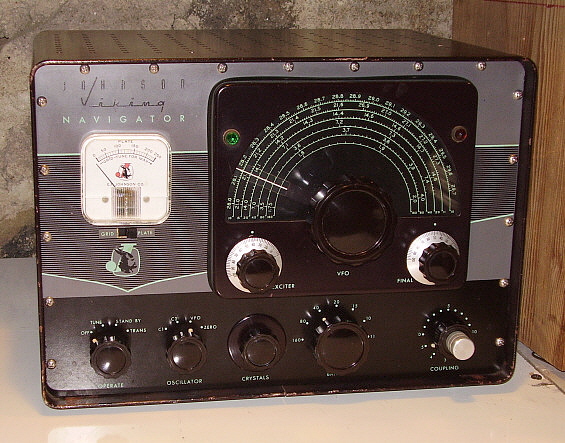
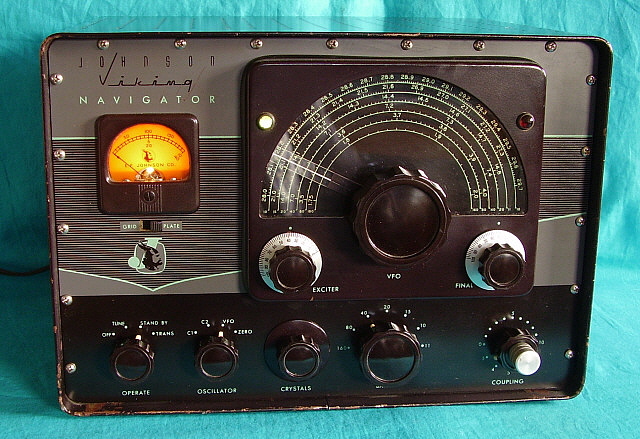
Viking Navigator - The Navigator DeLuxe - or - How to Get Rid of that Worthless
Iron Vane Meter and Install an Accurate Viking Ranger Meter making the transmitter a "Navigator
DeLuxe"


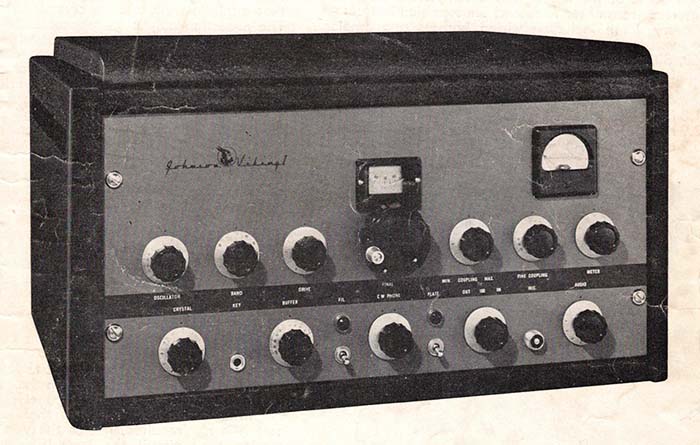
The Viking 1 Transmitter  ca: 1950

This web-article is about a bunch of Johnson-Viking transmitters that I have restored or rebuilt over that past few decades.

The Viking 1 was first rebuilt in 2008 for W7TC, a longtime ham-friend of mine. Sixteen years later, after "TC" went SK, I then owned that same Viking 1. I went through it in 2024 and again for the end of 2025. Lots of details on the Viking 1 (it's approaching OCD) but some interesting finds on the Johnson Mod "B" along with info on the transmitter bias voltages and the adjustable B+ divider-resistor and how those can seriously affect the transmitted signal quality these voltages are not adjusted carefully. The manual instructions makes use of the Mod current meter to adjust the Screen B+ but that assumes that the meter shunt is accurate. Much more accurate methods and equipment are easily available nowadays to adjust all of the voltages in the Viking 1 for excellent performance. Shunt soldering problems can seriously affect the meter accuracy because of the very low resistance values.

The Viking Ranger was Sharon's Novice transmitter in 1975. She was WN7AZE then, she's now KK7EI. The Ranger has been rebuilt a time-or-two and had a near-catastrophic disaster while helping out Ham & Hi Fi test out a Desk KW they had. A Ranger "parts set" was required for that repair (which was provided at no charge by Ham & Hi Fi.)

The Viking Desk KW was disassembled on the second floor of the Electronic Bldg. at UNR. I got a "'phone tip" from my old friend N7PSA (now W4YBS) and I was able to make a purchase just before it was to be parted-out.

The Viking KW Matchbox shows how a true balanced antenna matching device should work. It's such a good design, I have two of them. Three, if you count the little 275W version.

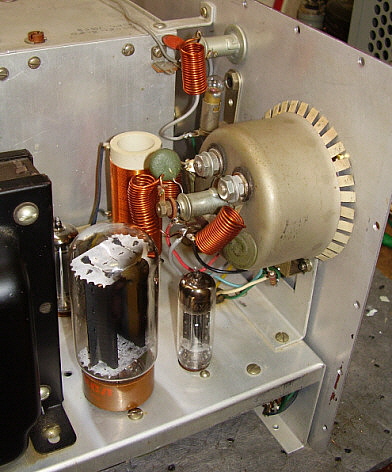
If, like me, you absolutely HATE the original Navigator iron-vane meter, this section shows how I eliminated that cheap-o, piece-of-junk, iron-vane meter and replaced it with a genuine E.F. Johnson Viking Ranger. It's a real D'Arsonval meter movement that's a lot more accurate, it has an illuminated scale and the scale even has the "Viking's Head" logo on it. It's what Johnson wanted to install but that would have made the Navigator even more expensive than it already was. I've included the "how to" instructions for changing the plain-old Navigator into the "Navigator DeLuxe," something that E. F. Johnson would certainly approve of. 

E. F. Johnson Co. - Viking 1 Transmitter Kit

The E. F. Johnson Viking 1 Transmitter Kit

The Viking 1 History - Introduced in late-1949, E. F. Johnson Co. entered into the ham transmitter market with the Viking 1 Transmitter Kit priced at $209. Edgar Johnson had been in business since the early-1920s building components for transmitters and ceramic insulators for their "Q" antenna systems. In 1947, they purchased Speed-X from Les Logan and started to provide both straight keys and speed keys. Starting with the Viking 1, Johnson went into the ham transmitter market and quickly expanded their equipment line, becoming one of the top ham transmitter producers in the late-1950s up through the late-1960s. Unfortunately, rather than developing modern, improved ham transmitters in the late-1960s, Johnson decided to dive into the new Citizen's Band market place. They sold their Speed-X line to William Nye and ended all ham equipment production in the early-1970s. The CB market didn't last and Johnson couldn't compete with the imported Japanese ham gear, so the company went back to just producing small components which are still their main products today.

The Viking 1 Circuit - The transmitter used a Raytheon 4D32 as the PA modulated by a pair of 807 tubes. There were instructions included to change the final to an easier to obtain surplus 829B tube that produced about the same power output. The Crystal Oscillator was a 6AU6 tube and the Buffer/Doubler was a 6AQ5 tube. The speech amp was a 6AU6 and the audio driver tube was another 6AU6. Negative feedback was included in the speech amplifier to improve audio quality although the actual gain in the speech amplifier and audio driver stage wasn't sufficient to fully modulate the transmitter. The rectifiers consisted of a parallel set of 5R4 tubes for the +HV, a single 5Z4 tube for the +LV and a 6AL5 bias voltage rectifier. Ten crystals could be installed on the chassis and then front panel switch-selected for convenient QSYing but most users opt'd for the Johnson Model 122 VFO when it became available. The input power at the 4D32 PA was 150 watts on phone or CW. Output power was guaranteed to be at least 100 watts into a 50Z load. The output matching used a Pi-network. All parts were included with the Viking 1 kit including a pre-assembled harness that eased the wiring, an already punched aluminum chassis, a silk-screened steel front panel and a table cabinet (early cabinets were aluminum, later cabinets were steel that added quite a bit of weight.)

Obtuse Assembly Instructions - The assembly instructions were difficult to use. Very few photos of the assembly process were included and absolutely NO drawings showing details for the more difficult assemblies. Step-by-step written instructions had to be followed and each step was numbered with the intention that the assembler would "check off" the steps as they were completed. Of the numerous radio kits that I've rebuilt, by far, the Viking 1 assembly instructions are the most difficult to follow. Additionally, even the tube layout isn't provided in the manual. One has to use the chassis assembly layout that provided "X" socket numbers and then correlate that to the "V" tube ID number on the schematic - unbelievable! Of course, it's not at all difficult to actually know which tubes go where since the circuit is pretty basic, but still,...most kit instructions assume you're not very experienced and need all the help you can get. But,...not at Johnson. Due to the obtuse assembly instructions, most Viking 1 transmitters seem to have a lot of evidence of rework here and there. Probably from assembly mistakes. Apparently all of the Johnson kit assembly instructions were difficult to follow. I had a Johnson 500 around 1991 that had originally been a kit. The harness had several wires inside that had burned up due to wiring mistakes. There were 42(!) wiring errors in that "500" and at least half of them were probably due to poor assembly instructions with NO drawings and only a few photos (I'm sure the builder's inexperience was the major factor.)   

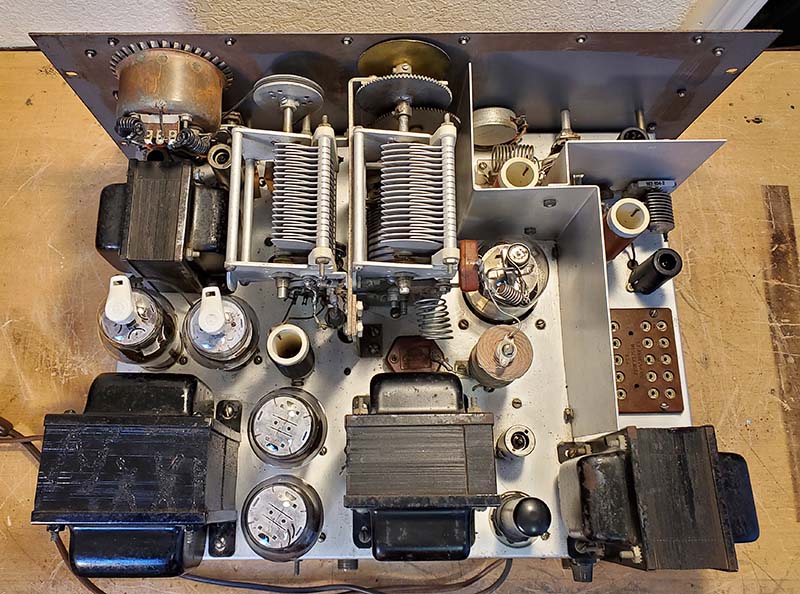
160M IN-OUT Switch - Fortunately, the Viking 1 circuit is basic and the chassis doesn't really have anything that is difficult to access,...except the "160M IN-OUT" pulley-driven switch. I know it was a "last minute design thought" to include 160M on the transmitter but this switch really is "Rube Goldberg." The problem is that the pulley-drive set up has to be fully assembled before the Pi-network is mounted to the chassis and before the front panel installed.

The "TC" Viking 1 (shown in the photos) never had the dial string installed to make the 160M IN-OUT switch pulley-drive system work. The initial assembler must have thought "I'll never work 160M. Who cares." Well, 160M capability is one of the great features on the Viking 1 and that meant the 160M IN-OUT switch had to function. Installing the dial cord onto the two pulleys, one on top of the chassis and one underneath, can't be accomplished after the Pi-network assembly is completed. To install the dial cord required that the Pi-network be partially disassembled and removed in order to "string the pulleys" and get the 160M IN-OUT switch to function. Since the Viking 1 was designed to be built by hams, the disassembly of the Pi-network is really pretty easy.

My First Viking 1,...ca. 1990 - I've owned two different Viking 1 transmitters. The first one was purchased around 1990. It had come out of the National Guard Armory in Carson City, Nevada. This transmitter was in fantastic cosmetic condition but, despite what the seller told me about how nice of a transmitter it was, it really didn't function very well at all. All of the electrolytic filter capacitors were bad and had to be replaced. I replaced the electrolytics and also the paper dielectric capacitors. That got the Viking 1 working okay. It seemed that 100% negative modulation was impossible to achieve, even with the Audio Gain at maximum. Then I found out about "Johnson Mod B" - a product of the engineers at Johnson responding to that exact "stock" modulation problem.

The Importance of Johnson Mod B - As originally designed, the Viking 1 couldn't achieve full audio modulation. It's thought that the Johnson engineers' initial belief was this would protect the modulation transformer from "amateurs who are always over-modulating" since that condition now couldn't happen with the Viking 1. Enough complaints poured in that Johnson came up with Mod B for both the Viking 1 and the Viking II. What Mod B does is to change the audio driver tube from a pentode to a triode by rewiring the socket to connect the screen to the plate using a 22K resistor. Then the negative feedback is not necessary so it's removed,...also removed is the connection or need of the -20vdc bias voltage since the audio driver stage is now self-biased. The gain of the audio speech amplifier is increased by changing the value of some of the resistors. Cathode bypass electrolytic capacitors are added to the audio circuit and 22 ohm CC resistors are added in the plate leads going to the 807 tubes. Mod B provided an audio response of 250hz to 3000hz and the ability to easily over-modulate the transmitter. One change that wasn't part of Mod B but one might think could help the lower end response is to change the speech amp grid load resistor from 1meg up to as high a value as 4.7meg. This would only benefit crystal microphones connected directly to the speech amplifier grid. At the time of Mod B, the use of crystal microphones versus dynamic microphones was about evenly divided, so Johnson opt'd to keep the 1meg grid load to help reduce audio frequency response below about 250hz. If you intend to use a crystal mike that is a direct grid connection (no Astatic amplified base) the optimum value for the grid load resistor is about 5meg ohms (according to Astatic.) However, any value from 1.0meg up to 2.0meg is okay but if you install a 5meg you might find that the very high R-values of grid loading might affect how the modulation responds. Too much "lower end audio" will not allow the full audio range modulation because the lower audio frequencies will tend to have more "power" and will achieve -100% modulation levels (cutoff) before the mid-audio frequencies do, resulting in an average modulation level that's very bassy but not at a high average level where it's important,...in the mid-range. I wouldn't install a grid load any higher in value than about 2meg. If you intend to use a dynamic mike then the grid load can be 1meg or less. Remember that the Astatic TUG-1 amplified base found on most D-104 mikes will have an output impedance much lower than the actual Astatic D-104 crystal element. If you intend to use a TUG-1 amplified base, then leave the 1meg installed. I installed a 1.3meg resistor and it's a fine compromise that doesn't affect the average modulation level.

That first Viking 1 did get used quite a bit and I even wrote up an article for the Carson Valley (Minden, NV) Ham Club Newsletter about that Viking 1 used in combination with a National HRO-5TA1 receiver I had (still have.) I even used the first Viking 1 on 160M CW a few times. I had many high-speed CW practice QSOs with W7TC using my first Viking 1. I didn't use the Viking 1 after moving to Virginia City in 1993 and ended up selling it around 1999. 

The "TC" Viking 1

My Second Viking 1 - THE "TC" VIKING 1 - I first encountered my second Viking 1 shown here in these photos in 2008. My old friend, Tom Corditch W7TC (now SK) became interested in having a Viking 1 for some reason. He had found or had purchased three of them. One had a very nice front panel but the chassis was virtually destroyed by hacked-in modifications. The second transmitter had a very nice chassis but the front panel was really beat-up and so was the cabinet. The last transmitter was just a chassis that was used for a parts source. "TC" wanted me to "build" a nice, working Viking 1 for him using these three examples he had found.

The rebuild used the good condition chassis to start. This chassis was the earlier type without any TVI modifications. The best parts from the other two chassis were transplanted as needed. I had to entirely rebuild the Pi-network using parts from both of the "parts sets." The nice front panel was further cleaned and given a very gentle rubdown using Wenol's polish. I didn't want the panel to be glossy but to just have a slight sheen. The front panel was the later version (a TVI kit that could be purchased to install on the Viking 1) that had holes along the upper edges. This was for TVI shielding that had been taken off in the past. The holes were filled with a dozen screws and nuts. The meter shield was also something found on later TVI'd Viking 1 transmitters. A good set of knobs were cleaned and polished. I found that the chassis had just a portion of Mod B installed, so I completed the installation of Mod B. All paper dielectric caps were changed to new polyfilm types. New electrolytic capacitors throughout. A "zip cord" line was brought out to drive a Dow Key relay that would operate in parallel with the Plate switch. "TC" also had acquired a Johnson Model 122 VFO that had a few problems with unsoldered connections that created some unstable output. Fortunately, I kept a list of all of the problems to give to "TC" and now, 16 years later, I have that very same list. It shows that 30 steps of assembly or operational problems were found in completing the job. I was surprised in rereading this list at how many problems were related to poor soldering. But, after rebuilding several ham radio kits now,...maybe I'm not that surprised. I ended up delivering the complete and functional Viking 1 and the Model 122 VFO to "TC" in March of 2008.

"TC" used the Viking 1 quite a bit. He even used it through an attenuator to drive a Johnson Thunderbolt amplifier. In 2015, "TC" went SK. I handled the deposition of his ham gear for his XYL. The Model 122 VFO was gone, I never did find it. The Thunderbolt had gone to W6AQU Bob in Montegue, California. The Viking 1 was sold to KØDWC here in Dayton. "DWC" had to buy a Model 122 VFO off of eBay but eventually did get the Viking 1 on the air a few times. He also "touched up" the cabinet with official Johnson brown paint although it wasn't wrinkle finish paint. With other distracting interests, "DWC" had packed the Viking 1 away in storage. In 2023, "DWC" had expressed an interest in acquiring a BC-224 receiver. I knew he still had the "TC" Viking 1 stored away, so I proposed a trade,...a really nice, working BC-224 with dynamotor and shock mount for the "TC" Viking 1 and a Model 122 VFO. The trade happened on Jan 2, 2024. To me, this wasn't just any old Viking 1. This was the one that I personally had built for "TC" so I really had a special interest in preserving this transmitter.


Viking 1 top of the chassis

Refurbishing the "TC" Viking 1 in 2024 - The transmitter seemed to still be in good shape after 16 years. I tested all of the tubes to see if anything had changed there but all tubes tested "like NOS." I already knew about the 160M IN-OUT switch not being functional. I had told "TC" back in 2008 that getting the pulley system to work would require disassembling the Pi-network (again.) His response was "I'm not going to work 160 meters! Don't bother fixing it." If one was really lazy, I suppose that if 160M operation was desired, with AC power off, one could lift the lid on the transmitter and reach in under the Pi-network antenna-side air-variable and use one's fingers to rotate the 160M switch pulley to change switch positions. "TC" never did that and I wasn't going to do that either. So, the 160M IN-OUT switch pulley stringing was installed.

I found that the chassis had a light-grease film on it that cleaned off with WD-40. I thoroughly cleaned the ceramic sockets of dirt and grease. I removed the 1meg grid load on the speech amplifier and replaced it with a 4.7meg resistor (as a test - not very good results. Ended up with a 1.3meg.) The resistor has to be entirely shielded and that requires insulating the grid lead from the shield. I used heat shrink tubing for insulation on the grid lead.   >>>


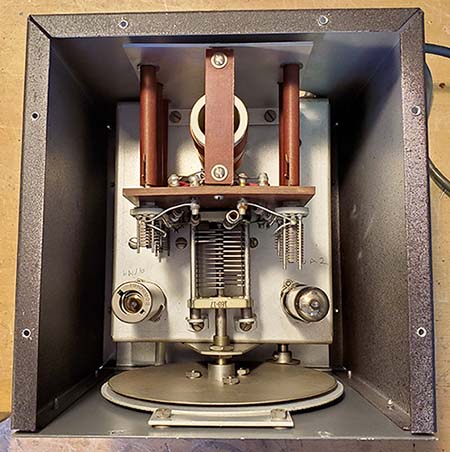
Looking at the top of the Viking 122 VFO

>>>  I also installed some insulating sleeves on some of the component leads in the audio section just for added protection. I found several screws and nuts that weren't very tight, probably not loose enough for problems but I "snugged" them up anyway. From disassembling the Pi-network, I discovered that the front two screws of the bracket mounting assembly had never been tightened (guess I missed that in 2008.) Also, from this recent disassembly, now the alignment of the network dial didn't exactly line-up with the dial opening. This required some screw loosening here and there to get everything back where it should be.

Next, the Model 122 VFO needed to be inspected. "DWC" had purchased this unit on eBay and it did function but he never looked inside. Before I could power up the "TC" Viking 1, I had to check-out the Model 122.

Viking Model 122 VFO - Uses a 6AU6 for the oscillator and a 0A2 for the regulator. Basically, it's the same circuit used in most of the later Johnson transmitters with built-in VFOs. This one was obviously a kit assembly with poor wire lead prep and some bad solder joints. In looking it over, I'd almost believe that Johnson provided the inductor assembly with the trimmers "pre-wired" because the soldering is at an entirely different level (professional.) I had to resolder the 6AU6 tube socket connections. There were two different components that had bare leads that were shorting against grounded brackets or other bare component leads. The 0A2 would arc in the TV-7 tube tester so I replaced it with a tested-good regulator. "DWC" got this Model 122 VFO off of eBay and did use it, so I guess it did function. The problems found were minor and probably only caused minor issues that went unnoticed on the reception end of the QSOs.


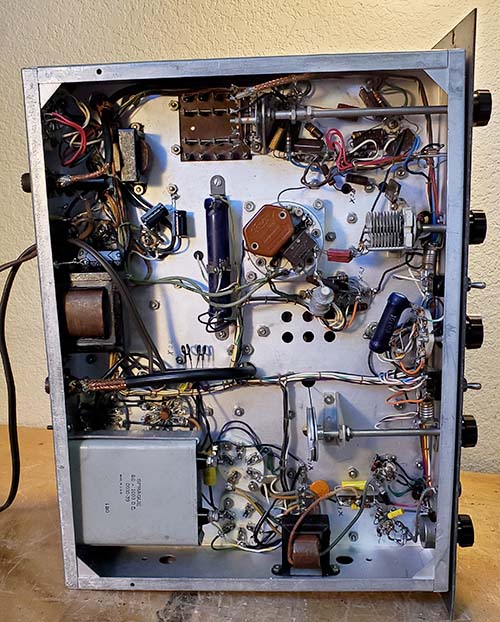
Viking 1 under the chassis
The two insulated wire "coils" in the center of the chassis are the shunts for PA and MOD current

Interesting Observations - After working on many ART-13s and Collins ham transmitters, it's interesting that one can be at full RF output power with the plate voltage going to the 4D32 and the 807s and the transmitter lid can be lifted up with no interruption of operation. There aren't any safety circuit-breaking switches anywhere in the Viking 1. I guess Johnson thought that if the ham bought and built the Viking 1 then he should know enough not to go touching the plate cap on the 4D32 with the transmitter producing full output.

There isn't any "push-to-talk" circuitry in the Viking 1. Also, there wasn't a socket to provide power for a T-R relay. Most Viking 1 transmitters will have wiring from the Plate switch that turns on the Plate transformer primary with 115vac and parallel wires in the form of a "zip cord" routed out through the AC power cord hole in the chassis in order to have 115vac available for a Dow Key relay when the Plate switch is ON.

There isn't any voltage regulation in the Viking 1. The Model 122 VFO does have a 0A2 voltage regulator.

The Viking 1 is cathode keyed in the CW mode. Blocked-grid keying was used in later Johnson transmitters.

Test Operation into Dummy Load - I tried a few of my spare "not in the box" 4D32s just out of curiosity and all of them were gassy or had erratic operation. I returned the 4D32 that was in the transmitter before. There was still some erratic plate current when the PA Tuning was adjusted. It seemed to be in the roller inductor. It was actually dried-up "clumps" of graphite grease on the roller shaft that was now acting like a semi-conductor and causing erratic contact. I cleaned the roller shaft and that ended up with the plate current smoothly tuning through resonance with no erratic jumps in the current.

I moved the Viking 1 to the shack and connected it to the Collinear Array antenna via the Johnson Matchbox. I was able to get slightly over 100 watts output when loaded to about 270mA of plate current with a 1:1 match on the antenna. I used a D-104 crystal mike on an Atlas stand, so no preamp, just the crystal element directly to the transmitter. No PTT on the Viking 1, so a grip stand wasn't needed. I thought the 4D32 is a little flat so I pulled a pretty new one out of the 32V-1 transmitter. The tube hadn't been in operation for about a year, so I let it warm up for ten minutes before trying it. I could get just over 100 watts. I tried a 4D32 that was in a 32V-2 I had in storage and it tested exactly the same. The test showed the all three good 4D32s worked exactly the same way. But, I don't know about the accuracy of the Drake W-4 wattmeter. I only use it for adjusting the Matchbox for a null in reflected power. I do know that the 32V-3 shows 110 watts output using the same W-4 wattmeter and the same antenna set up. So the Viking 1 does have slightly less output power than a Collins 32V-3. Probably because I run the 32V-3 at +700vdc Plate voltage and the Viking 1 runs about +600vdc Plate voltage.

Jan 7, 2024 - On the Air - I operated the Viking 1 on the Nevada Vintage Mil-Rad Net on 75 meters. No problems, all good compliments although one "bassy sounding audio" comment (I don't know if it was a compliment or a critique.) I haven't listened to myself on a monitor receiver yet. I didn't use a T-R relay but went directly to the Collinear Array through the Matchbox. The Meissner Traffic Scout receiver operated off of the Pixel Loop. I did this for a quick and simple set up for testing.

Feb 4, 2024 - Audio Testing - After the "bassy sounding audio" remark, I had to listen to the Viking 1 myself. By far the easiest way to listen to my audio is to go to N9AMI's Wavelength Radio youtube channel. John N9AMI records the Nevada Vintage Mil-Rad net and has the recordings available on his youtube channel. These recordings are of actual signals that are received "over the air" at John's QTH (about 25 miles east of my QTH in Dayton,) so I can get a pretty good idea of how a particular transmitter sounds. The Viking 1 sounds nice. Nothing really stands out. The audio bandwidth seems normal with no excessive bass. The sound is natural. There's enough bass response so that the signal doesn't sound thin like so many early Johnson-Viking transmitters do. I think the 4.7meg grid load (that I had installed then) in combination with the D-104 element directly connected to the first audio amplifier grid provides just the right amount of naturalness for the Viking 1 with Mod B installed. So, thanks to John N9AMI and his Wavelength Radio youtube channel, I actually got to listen to how the Viking 1 sounded myself.  


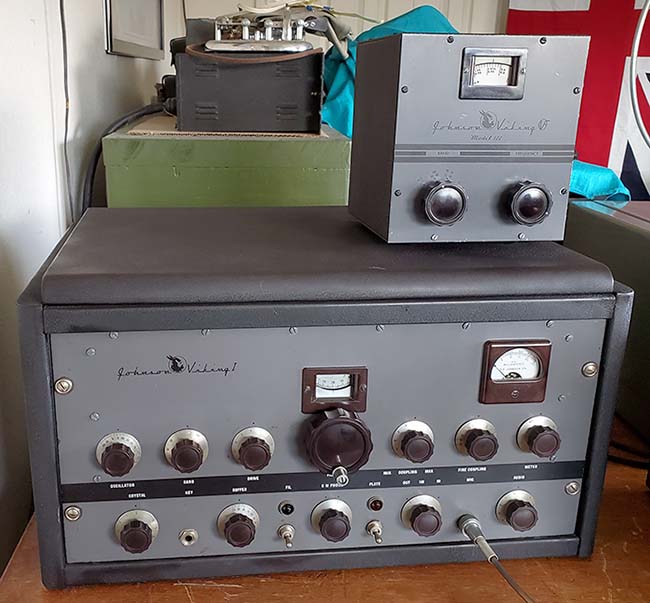
The "TC" Viking 1 with the Model 122 VFO
Steel Cabinet and TVI Shielding Front Panel

More Problems with the Viking 1

As it turns out,...there were several more problems with the Viking 1 involving incorrect voltage levels, incorrect bias levels, burned resistors, resistors that had drifted in value and much more. I don't know whether I missed that on the first rebuild or, the more likely explanation, is that these problems developed over the next sixteen ensuing years between 2008 and 2024. I'm not really sure how "TC" operated this Viking 1, especially when he was using it to drive the Johnson Thunderbolt. At any rate, I had operated the Viking 1 three times "on the air" before I actually got a definitive report that described the problems with the signal. So, even listening to an "over-the -air" recording doesn't tell you everything about your signal. I should have paid more attention to the modulation oscilloscope pattern. The 'scope showed there was a problem but obviously I just ignored it.

UPDATE: Apr 5, 2024 - First,...the Minor Stuff,...like Feet for the Viking 1 and More -  I've had the Viking 1 setting on a small piece of carpet because there aren't any feet under the cabinet and the bottom of the metal cabinet really can scratch the desk top. I have a set of rubber bumpers that were extras (leftovers) from installing replacement feet for 32V transmitter cabinets. For the Viking 1, it's a chassis out of the cabinet job because there aren't any holes at all for any type of feet in the bottom of the cabinet. I'll have to check where inside the cabinet the chassis is and then determine where I can mount the rubber bumpers so that the mounting stud and nut won't interfere with the chassis installation. There's well over 2" of clearance on each side of the chassis when its in the cabinet so there's nothing critical in mounting the rubber bumper feet. I measured, marked, center-punched and drilled the four 5/16" holes for the rubber bumper studs. I used a nut, a flat washer, a lock washer and another nut. I could adjust the bumper height by the position of the nuts. I allowed for about 3/16" height of the bottom edge of the cabinet off of the desk top. Once the rubber bumpers were installed and some other work performed on the chassis, I reassembled the Viking 1. Now its very easy to slide the Viking 1 on the desk top and there's no scratching in doing so.

As long as I had the chassis out of the cabinet I thought I should probably take care of some other minor issues.

1. First, when selecting the meter function, it seemed that the Plate current would read differently each time the switch was operated so I thoroughly cleaned the switch with DeOxit and a small brush. I also cleaned the Oscillator band switch although there wasn't really any problem there. Seems a little more consistent in the PA I reading now. Next time I have the Viking 1 out of the cabinet I'm going to resolder the shunt connections and the wire connections to the Meter switch. UPDATE: The refurb in Dec. 2025 found that these erratic meter reads were caused by very poor soldering of the two shunts for Plate and Mod measurements and the common chassis connection for the two shunts didn't have the solder lug tightened so the chassis-ground was not a solid connection.
2. Then there was the FIL pilot lamp that could hardly be seen and was erratic in operation. The bulb was loose and that caused the erratic operation but the lamp was a #40 (.155A) so I replaced it with a #46 (.250A) for greater brightness. Works great.
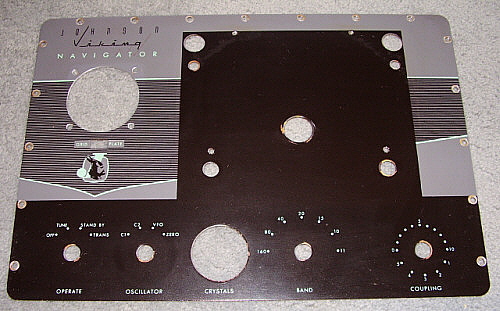
3. Then there were the twelve screws and nuts that were "hole fillers" in the panel. Although I'd like to just fill the holes and match the touch-up paint, with twelve holes,...any slight mismatch would be obvious. So, I decided to paint the screw heads gray and that way any mismatch wouldn't be a problem and the gray screw heads would blend with the panel. Looks better, not great but okay. UPDATE: Dec 2025 refurb got rid of this front panel. Details further down.
4. Then there was the misalignment of the FINAL dial to the index plate. That just required some more adjustment of the bezel and index plate to have it be a close fit. Looks and works fine.
5. Finally, I hadn't noticed how stiff, cracked and aged the power cord was. It's nothing special as far as appearance, so I replaced it with a similar-looking length of new 16 gauge brown "zip cord." I also replaced the heavy gauge zip cord and AC socket for the Dow-Key power to now using a very small zip cord and small AC socket. This was to allow both AC zip cords to easily fit through the chassis grommet.

UPDATE: IMPORTANT - Pay Attention to the Oscilloscope!  More Audio Updates on the Viking 1 - Apr 15, 2024 - I've noticed that the modulation envelope on the 'scope doesn't look like there's linear gain through the audio modulation amplitude range. There are very large, very narrow audio peaks and then many much smaller peaks that form the majority of the modulation envelope. The large narrow peaks are preventing adjusting the Audio Gain higher to amplify the remaining audio component of the speech pattern since these large peaks easily go into cut-off on the negative cycle. At first I didn't receive any "critical audio reports" so I thought the 'scope pattern wasn't particularly important. Listening to the Wavelength Radio recording and the modulation sounded okay (but N9AMI, Wavelength Radio, is only located about 25 miles away.) As summer conditions approached, with good propagation waning, signals generally weren't as strong. I started getting reports of "sounds like 50% modulation level" or "strong carrier but weak audio." Looking at the 'scope pattern when transmitting on the Collins 32V-3, it appears very different than the Viking 1 with the V-3 having very wide audio components and speech patterns that appear more like "sine waves." The Viking 1 'scope pattern looks like a few large, narrow "spikes" and the remaining just low level audio components. My first thought was the 4.7meg grid load on the Speech Amp was allowing too much low frequency audio component and that was dominating the speech pattern at the expense of the mid-range audio. A thorough check of all components and the hook-up didn't reveal any errors. For some reason, the Audio Driver cathode load resistor is discolored and has swelled in the middle indicating a lot of heating, but it still measures very close to 470 ohms. I really didn't see anything else that looked suspicious. I'm going to change the grid load to 1.3 meg since the lower end audio frequency is supposed to be around 250hz with that value load, which is okay. I'll also change the Driver cathode resistor to a new 470 ohm CC 1/2W. Also, although I don't think it would be the cause, a few resistors are "close" values but not what's called out on the schematic. For example, 22K installed for a 25K or 1.8K installed for a 2K but these values are within 10% so I don't think they are the problem (also, the later manual's parts list shows both values, e.g., 2K or 1.8K, etc.) The coupling capacitor is .0047uf and .003uf is called out on the schematic. That's about 50% more C but probably not causing the problem (I may change it anyway.)
Rebuild Mod B - Apr 16, 2024 - There aren't very many components used in the audio section of the Viking 1. I decided to replace all of the yellow-jacket polycaps with CDE 715P capacitors of the correct value. So, the .047uf coupling capacitor was replaced with a .003uf as indicated on the Mod B schematic. The 22K B+ dropping resistor was replaced with a 25K as indicated. The 1.8K cathode resistor was replaced with a 2K as indicated. The discolored and swollen 470 ohm cathode (Driver tube) was replaced (even though it still measured close to 470 ohms.) All components were either tested/measured or replaced with a confirmed value component. The soldering from the original build was terrible. It looked like the solder itself was defective (probably the "solderer.") All original solder joints are "push the lead straight through and solder-types" which makes disassembly easy but isn't a strong mechanical joint and depends on the quality of soldering which wasn't very good. I ended up having to resolder all joints since so many were cold solder joints or at least looked like cold solder joints. The lead dress was checked and components placed as shown in the under chassis photos in the manual.

It Seems That Other Problems were the Actual Cause of the Weak Audio - Since I really couldn't find anything that was blatantly wrong in the audio section, I started to carefully examine ALL of the transmitter circuitry and components. I noticed that the negative bias voltages are derived from a divider made up of several 1W CC resistors. Those have to be checked because incorrect negative bias voltage could cause problems in the modulator. Also, there is a larger 20K WW resistor R13 acting as a voltage divider that determines the level of the +300vdc plate voltage for the Speech Amp, Oscillator, Buffer and the Modulator Screen sections and that has to be checked. The plate load for the Buffer R26 is discolored and swollen that needs to be checked. I suppose my first assumption was that I had gone over this Viking 1 in 2008, so everything should be fine,...but that's certainly not true today. I don't know if I missed these potential problems 16 years ago but that's certainly possible,...I do remember that when "TC" was operating this Viking 1 his audio always seemed a little on the "light side" and he was only six miles away. At any rate, I need to thoroughly inspect ALL of the Viking 1 for the condition that it is in now.

The Gruesome Details - The Buffer plate load R26 measured 220 ohms, it should be 100 ohms. I replaced this resistor. R17, the 2700 ohm resistor that is the first resistor in the bias voltage divider measured 5200 ohms. I replaced this resistor. R19, the 68K resistor for the Oscillator Screen measured 52K, over 20% off, so it was changed. The values were confirmed by lifting one leg of the suspect resistor so I was sure I had an accurate measurement. These resistors had drifted in value probably due to long-term overheating. R26 and the Driver tube cathode resistor (designated as R7 as a Mod B component) showed definite signs of long-term overheating. However, R17 and R19 looked normal on their exterior but had obviously changed value. All voltage divider replacement resistors installed were JAN AB types CC 10% 2W. The manual instructs that R13 (adjustable wire-wound voltage divider) should be set for +350vdc up to +380vdc and that the resulting modulator idle current should be between 70ma and 90ma. When I checked the R13 divider, I had over +440vdc and yet the mod idle current was only about 40mA. The negative bias voltage to the 807 grids was over -40vdc and the 807 Screens were over +400vdc. No wonder some of the resistors were running hot and the audio sounded thin. I set the R13 divider to provide +350vdc (under load.) I paralleled a 2200 ohm 2W CC with the 1500 ohm on the bias divider to lower the 807 grid bias to -30vdc (Buffer bias went down to -16vdc.) Now I had 60mA of modulator idle current which is close enough (since I'm not really sure how accurate the shunts have to be for the meter to be all that accurate.) Now, the final change was to use a TUG amplified base with the D-104. The audio produced now sounds very good when listening on a monitor receiver. The oscilloscope pattern is now much more like the 32V-3's pattern with all levels of the audio speech being amplified and only once in a while hitting cutoff. The audio gain is set to 5. On the air is the next test.

ON THE AIR Results - Apr 28, 2024 - I have the Viking 1 set up with the National NC-183 receiver. They are contemporary with each other and comprise a believable circa 1950 ham station. As usual, it's very difficult to get detailed audio reports "on the air" so it's lucky that Wavelength Radio records most of the NV Mil-Rad Nets. I listened to Wavelength Radio's recording of the net and the Viking 1 has never sounded as good as it does now. And, looking at the recording's panadaptor, the spectrum is now filled with audio and it looks like the bandwidth is minimum 6kc and maybe even a bit more. It's a very helpful resource that John N9AMI provides in the Wavelength Radio recordings of many nets and other interesting ham video and audio recordings on his youtube channel. 


The Viking 1 with the National NC-183
 

Refurb #4 - Getting Rid of the Steel Cabinet and the TVI Front Panel

I never liked the looks of the dozen TVI screws on the front panel of this Viking 1. Then there was the steel cabinet. I just couldn't believe how much weight it added to the Viking 1. I kept remembering how my first Viking 1 was so easy to move around with its aluminum cabinet and how nice and clean its front panel looked without a dozen extra screws. In 2025, the exact parts were given to me that allowed returning the "TC" Viking 1 chassis back to having its original aluminum cabinet and its original front panel.

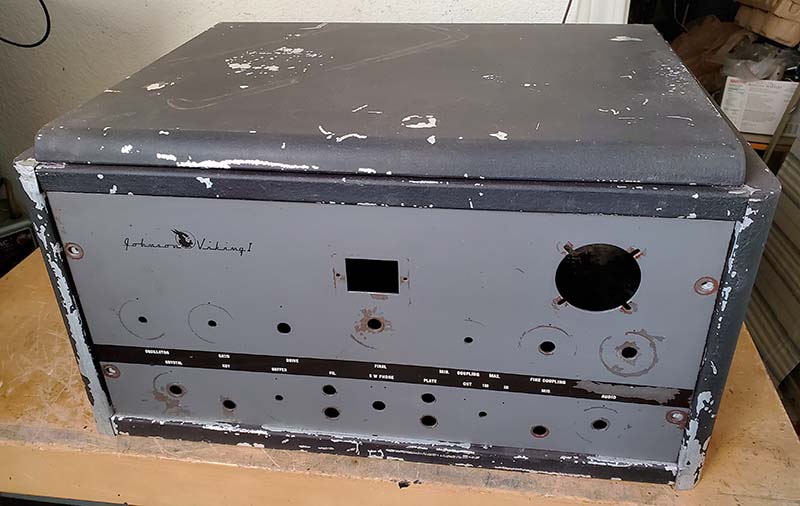
UPDATE: Nov 28, 2025 - Today I was given all of the other parts that W7TC had collected for his Viking 1 project back in 2008. KØDWC had these parts from when he purchased the "TC" Viking 1 back in 2015 from TC's estate. The parts were stored in an old broken-down wooden shed in DWC's backyard. He found them when he was cleaning out the shed for demolition. The parts consisted of the original aluminum cabinet for the Viking 1. The first cabinets that were supplied with the Viking 1 kits were constructed of aluminum and painted a dark brown (not maroon.) These aluminum cabinets reduce the weight of the transmitter significantly. Also included in the parts was the original early version front panel. These early versions didn't have the multitude of screw holes around the perimeter for the TVI shielding. This front panel is in need of restoration but I think it can be refurbished. Same with the cabinet,...it needs some refurbishing. Also included was the other Viking 1 "parts chassis." These were all of the parts that W7TC had collected when I first worked on this Viking 1 in 2008. I had removed some of the parts from the chassis for use in that 2008 restoration. The Pi-network is now missing from the parts chassis along with some of the RF chokes and capacitors. I had access to the original panel and the original aluminum cabinet in 2008 but I used the later steel cabinet because it had better paint and same with the front panel with all of the holes,...it was used because it was in the best cosmetic condition. Now, seventeen years later, I'd like to use the aluminum cabinet because that was the first type provided in 1950 and it's also very light-weight. I'm pretty sure that the aluminum cabinet and the older front panel actually "go with" the working Viking 1 chassis as far as "the original equipment." I just swapped parts around in 2008 for best cosmetic appearance. I've always found all of the holes in the newer and currently installed front panel to be awful-looking. Nothing can be done except installing screws and nuts then painting the screw heads gray,...and even that looks terrible. I think I can rejuvenate the original front panel to decent condition and even with the "touch-ups" it will still look better than all of those horrible gray screw heads.

The Front Panel - I'm going to use Testor's model paint. I'll have to mix and match for the missing gray paint and the missing dark brown paint. The white nomenclature is all in good shape except "METER" which is 99% gone. I have some white dry rub-on transfers that are about the correct size and font,...not exact, but close. But, if the dry-transfers are just not close enough of a match, I'll just repaint the missing brown and leave the nomenclature off completely.

The Meter that's Installed - As long as the Viking 1 is going to have its front panel exchanged, I'm going to check the meter that's currently in the transmitter versus this "parts meter." The meter now in the transmitter will not indicate a consistent level of PA current with the readings sometimes differing as much as 25mA or about a 10% error. Each time the transmitter is keyed, it shows a different level of PA current. Usually, this type of meter problem is due to wear in the suspension bearings. I'll use the meter that tests the best. Also, since the original early Viking 1 didn't have the meter shield, that will not be used in this rebuild.

PARTS METER TEST: I tested the "parts" meter and found that it is a 5mA FS movement. Since the plate current scale is 500mA FS, the linearity is very easy to check. 100mA error is 1%, 250mA error is 1.5% and FS 500mA is 3% error. This is actually normal for an analog meter. I pulsed the DC test voltage for 300mA reading and it repeatedly showed 300mA. This meter movement is going to be used but I'll have to install it into the other meter's case since this meter's case has a severe crack in the bakelite housing.

Aluminum Cabinet Body Work - This cabinet has several screws that mount the various panels together. The screws are all 8-32 pan head types with a washer and nut. Several of the screws had 10-32 nuts which of course can only be lightly tightened before they pull through because of the smaller 8-32 screw. I replaced these over-sized nuts with the correct 8-32 size. There was also one 10-32 screw installed and that was replaced with an 8-32 screw, washer and nut. With all screws tight, I could then straighten the cabinet. The front of the cabinet was in fairly good shape but the rear was bent quite a lot. Since this was a thin aluminum cabinet, I only used a small rubber mallet for straightening the bends.

Once I finished with the rubber mallet, I looked over the cabinet and it really wasn't fitting together very well. Luckily, the cabinet can easily be taken apart and that results in several flat (more or less) pieces that can easily be accurately straightened. Using blocks of hardwood and a body hammer, I was able to straighten all of various bends, crinkles and other defects in the aluminum. I also thoroughly cleaned all of the cabinet panels with Glass Plus. Then I reassembled the cabinet. It now set on the bench nice and flat and it looked square. I tried the old style front panel for fit with no problems. The "before" condition of the front panel and the condition of the "straightened cabinet" can be seen in the photo to the right. Painting is next.

Cabinet Paint - Artist's Acrylic paint allows color-matching exactly. I used the inside of the top lid since that paint was in perfect condition. The base color is Burnt Umber, which is a dark brown,...but not dark enough for the Viking 1. I had to add Mars Black to get a match to the correct Viking 1 brown color. Burnt Umber does have a slight reddish-orange tint, so only black was needed to get a good match.

I first had to "touch-up" all of the areas that were missing paint. As can be seen in the photo to the right, there was A LOT of missing paint. Once all of the bare metal was painted and left to dry overnight, then I could proceed with the "color wash." This process thins the paint mix to the consistency of thin oil. This is then "sponged" on to the cabinet paint. The sponge is used to "dab" the thinned paint onto the cabinet to add some texture and to reduce the "stripes" that could happen. The first coat has to dry several hours, overnight is better. A second coat is usually necessary and does produce a better end result. While this type of "touch-up" paint job isn't any type of substitute for a correct-color, actual wrinkle-finish paint restoration, it's pretty easy to do and the end-result is the correct color that looks good from a distance (about 4 feet or more away.) Close-up examination will show all of the "touch-ups" and minor cabinet defects. But, with other equipment beside the Viking 1 and the VFO set-up on top, the "touch-ups" look great. 


The Viking 1's Original Aluminum Cabinet and Original Early Style Panel
 after cabinet bodywork was completed but before painting. Front panel hasn't been "touched-up."

Panel Touch-up - Dec 24, 2025 - I bought Testor's model paint in brown, gray and black, both in flat and in gloss. I also had on hand blue, red, yellow, white and green,...just in case. I was reasonably sure that the gray had a lot of brown in it. The brown had a lot of black mixed in with it. The brown was matched only using gloss brown and flat black. The mix of flat and gloss gives the paint a matte finish which was like the original paint. The gray was very difficult to match. It took gray, black and brown with just one drop of blue. Luckily, most of the missing paint was located where knobs or bezels would cover the touch-up. The "METER" nomenclature was missing but I had the correct size dry-transfers but could only get close on the font. Probably not noticeable at a casual glance.

With all of the knobs, the meter and the bezel mounted, the touch-up job is pretty good. Certainly apparent if you know about the work that was done but probably not noticeable unless pointed out.

Meter Problems - Dec 29, 2025- I thought I was going to be using the same meter that had been in the Viking 1 before. I tested it thoroughly and there's nothing wrong with the suspension and the meter is fairly accurate. I suspect the problem is probably in the meter switch soldering or the shunts. The wires are just pushed through the terminals and soldered. With solid wire, there might be a cracked solder joint or maybe one of the solid wires is cracked. Eventually, I ended up replacing this meter with the one that I had tested (that had the cracked case) because the latter meter was more linear over all. 

Plate Tuning Bezel, Index and Rotating Scale Problems - Probably because the transmitter Pi-network was built using two different sets of parts, nothing really fits together exactly. I actually find that the bezel fits better and mates with the scales better if it's mounted upside down. Not really noticeable unless it's pointed out.

Too Much Plate Current, too little Drive, Other Issues - Dec 31, 2025 - I suspect that something is wrong with the shunt for Plate current. For 100 watts output, the Plate I on the meter shows about 400mA. It should be around 275mA. That should be with 12mA of grid drive but I when set to 275mA Plate I, the drive is barely above 0 and the power output is about 25 watts. I measured the transmitter power supply voltages and found +630vdc plate voltage and +330vdc for screen voltage. +LV measured +320vdc. Bias voltages measured -70vdc, -30vdc and -16vdc. All of the voltages seemed to be correct.

Since the meter actually measures a very low current across a low resistance shunt, if that shunt has a higher resistance than expected, more current flows through the meter resulting in a higher reading on the meter scale. It might be poor soldering, it could be the shunts are too long (they are made of short lengths of coiled wire) or maybe the chassis ground isn't very conductive.

The problem ended up being poor soldering of the shunts for both the Plate I and the Modulator I. Also, the ground soldering on the shunts was very poor and the solder lug for the shunt chassis ground wasn't tighten. I ended up removing the shunts and moving the chassis-ground connection closer to the shunts location that only required about a 1" wire to chassis. The shunt connections were cleaned and then the shunts soldered back in place. I now had 110 watts RF Carrier output power with 275mA of Plate I and the Drive was at 12mA grid current with the Drive control set on about 4. This all looked correct. I switched to MOD to measure the idling modulator Plate I and it was measuring about 30mA,...it should be between 60mA and 80mA. I readjusted the divider resistor to slightly increase the screen voltage and that got the modulator Plate I up to 70mA with +350vdc screen voltage, which is correct. I had to redo the solder on the divider resistor terminals also. In fact, the entire transmitter looks like it was assembled poorly with wire leads just pushed through terminals and then soldered. No wire wraps at all. The soldering looks like really cheap solder was used. Certainly not Kester 60/40 SnPb,...maybe just a soldering iron that was too cold. Fortunately, by now, with all of the rework that's happened over the past 17 years, most of the solder joints have been corrected,...hopefully.

Another Error - In looking over the schematic, I happened to check over the bias divider network and noticed that I had connected a 2.7K resistor in parallel with the 1.5kc resistor to lower the bias on the modulator tubes to -30vdc. I decided to just rebuild this divider network so the bias voltages would be correct. I ended up removing the ground lug that was tightened and redoing the divider network chassis ground connection. I replaced the out-of-tolerance 1.5K resistor using an A-B 1.5K 2W 5% CC resistor. The bias voltages are now -77vdc, -33vdc and -22vdc which should be close enough. I ended up entirely removing the 20K 100W WW adjustable voltage divider for the screen voltage adjustment since it was poorly soldered and any adjustment of the slider seemed to not make contact. I thoroughly cleaned the resistor, removed the rust from the inside of the slider, remounted the resistor and soldered the wires to the terminals. Now I had, +320vdc screen voltage and +600vdc plate voltage. Which looks very close to the specified voltages. BUT, when measuring the Modulator idling current it indicates about 40mA. It should be between 70mA and 90mA but that would require either lowering the modulator grid bias for which there's no adjustment. Or, the modulator screen voltage could be increased. The manual indicates about +280vdc modulator screen voltage under load but the schematic indicates +300vdc. With the screen voltage that low the idling current would be even lower than it already is.

Another Dilemma - So, what's correct,...the Johnson schematic, the Johnson manual or the RCA tube manual? None of these documents agree on expected voltages or currents. I had to slightly change the resistor values in the bias network to have -74vdc which is the bias rectifier output and can't be easily changed. Then I set the modulator grid bias for -30vdc which is the tube manual spec if the plate voltage is +600vdc and the screen voltage is +290vdc. I had to set the 20K divider quite different from where it had been set since the screen voltage had been running about +380vdc and +300vdc is maximum spec for the 807s. The bias voltage for the buffer tube is -17vdc which seems to be fine. The Viking 1 manual says to adjust the 20K divider for 70mA to 90mA of modulator idle current but that would require the screen voltage set to about +400vdc! With ALL of the 807 voltages very close to the RCA tube manual specs, I get 40mA of idle current. That is, with +290vdc screen voltage, +610vdc plate voltage and -30vdc grid bias voltage. I double-checked the idle current by pulling one end of the shunt and inserting a Triplett 630 to measure the current,...it measured 35mA, so the Viking 1 panel meter is fairly close. Running into the Collinear Array at a 1:1 match, I have 275mA of plate current with 12mA of grid drive. The power output is 110 watts on 3.974mc. The audio has never sounded better. My thought is that Johnson was providing a kit and had to make sure assembly didn't require in-depth measurements or hand-selecting certain parts,...even though the expected builders would have been hams. 

The Aluminum Cabinet - The two lower front panel mounting threaded holes were stripped and the holes enlarged too much to really do any type of repair. I tried installing clip nuts but the type I have (standard size 10-32) puts the hole too far inwards for the front panel holes to align. Clip nuts are the best solution so I had to modify the cabinet's mounting lip to allow the clip nuts to set outwards about 1/8" which then would have the hole align with the front panel holes. First, the 10-32 holes that were stripped and the two that weren't stripped had to be drilled out to 5/16" for the clip nut to seat correctly. Then I had to use a file to recess the mounting lip edge with about an 1/8" notch that would allow the clip nuts to seat correctly and align with the front panel holes. I used the old Viking 1 TVI front panel as a template to make sure the holes were in alignment. The four panel mounting holes now have clip nuts installed which then allows the front panel of the transmitter to be tightened up securely. Since the clip nuts have an actual steel nut behind the clip the front panel screws can be tighten as needed and, formerly, that would have "stripped out" the threaded aluminum holes.


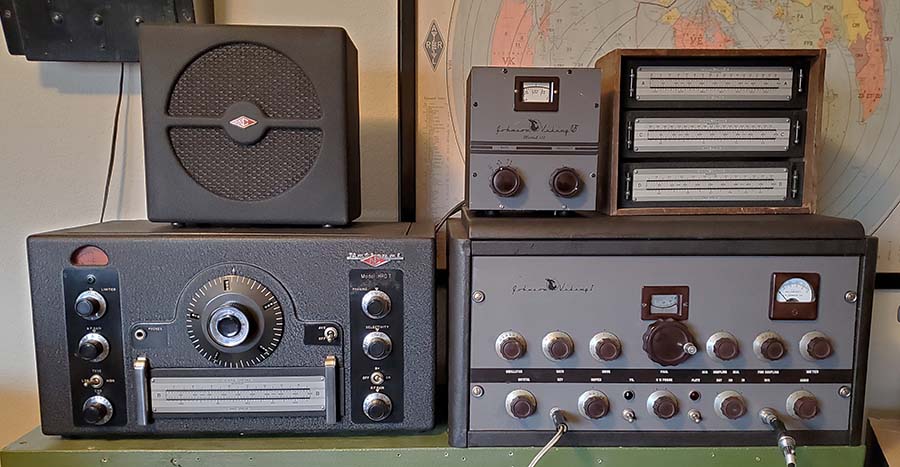
Viking 1 and National HRO-7S - 2026 Station

I just got this station set up on Jan 1, 2026. The photo to the right shows the set up. The Viking 1 looks nice, not perfect, but certainly the front panel turned out a lot better than I expected. The "touch-up" paint I color-matched is virtually undetectable. The gray mix actually has to be a shade lighter than the match because the paint dries slightly darker. This mix turned out excellent. The brown mix was much easier to match because it's a dark color. The "METER" dry-transfer nomenclature is difficult to notice at the distance this photo was taken. The size is just slightly larger but the font isn't too close. Still the "METER" difference is hardly noticeable. The cabinet is an excellent match for the brown color but the acrylic paint wash texture is only fair. The body work got the cabinet shape better than it had been but aluminum is pretty unforgiving for knocking-out dents, as can be seen in the photo. But, the difference in weight is the important factor in favor of the aluminum cabinets. The Viking 1 installed in the aluminum cabinet only weighs about 55 pounds and that made it easy to install on the desk riser where it now sets.

The receiver is the 1947 National HRO-7S. The "S" suffix is for Special which designates the black wrinkle finish paint with the smooth finish nomenclature panels. These versions were made to go with the HRO-7R receivers that came stock with a black wrinkle finish panel. Typically, the "R" rack-mount version was used commercially and was typically for use at Airports. The table HRO-7S in black wrinkle was for Airport use where a table version of the receiver was required. The matching coil sets are in the wooden holder setting on the Viking 1. The loudspeaker is a black wrinkle finish version of the standard 8" HRO speaker from National. The HRO-7S is very rare with only a few examples having been discovered. The stock HRO-7T is a silvery-gray color.


National HRO-7S Receiver with the Johnson Viking 1 Transmitter


Johnson-Viking Ranger

The Viking Ranger was a 75 watt CW or 65 watt AM exciter-transmitter that covered 160M to 10M and had a built-in VFO that was very stable. The audio section featured a special modulation transformer with a winding that was used for negative feedback resulting in excellent quality audio. The PA tube is a single 6146 and the modulator tubes are a pair of 1614 tubes (like a 20W plate dissipation 6L6.) The Ranger had all of the outputs accessible to interface with the Desk KW for sufficient drive for full output from the Desk KW. Better performance between the Ranger output and the Desk KW input requirements would require using a small -3db attenuator (about 30W dissipation) to allow better adjustment of the Ranger's drive and output circuits. Rangers were very popular as a stand-alone transmitter also, especially for Novices since the power limit then was 75W on CW only, crystal control (you got to use the VFO after you up-graded your license.) Still today, the Ranger is a popular transmitter for vintage AM because of its excellent audio and "bullet-proof" construction. Over 14,000 Rangers were built. They were available as either a kit or fully assembled. Prices were $293 assembled or $214.50 as a kit. The later version was designated as the Ranger II and featured different modulator tubes, a two-tone gray paint job and dropping the 11M coverage in favor of 6M coverage.

The very first transmitter I owned was a $75 Viking Ranger. I bought it when I got my Novice license in March 1970. At the time, Novices were limited to 75 watts input power, Crystal Control and CW only on 80M, 40M and 15M. Voice was allowed on 2M. I used the Ranger for six months, the length of time I had my Novice license until I upgraded to General Class. I traded the Ranger in on a Hallicrafters HT-37 that had a very oxidized chassis and certainly didn't work all that well. By December 1970, I had purchased a used Collins KWS-1 transmitter (that I still have.)

The Ranger shown belongs to Sharon KK7EI. When she became a Novice in 1975, I bought the Ranger for her from Bob Meckley (I don't remember his callsign,) who was the photographer at Bentley Nevada Corporation in Minden, Nevada (where I worked then.) I paid Bob $50 for the Ranger and it was operational and in good physical condition. Sharon's call then was WN7AZE. Novice Class at that time was still 75 watts maximum power input but the license was good for two years (non-renewable) and you could use a VFO, CW only on 80M, 40M and 15M. Sharon let that license lapse but got another Novice when we had the radio museum (in the 1990s.) She did the 13WPM CW test at the Novice exam (just to show-off, I guess) and then upgraded a month later to General doing the written exam then. She upgraded to Advanced with that written test the next month. The call KK7EI was the FCC-issued call she was given at that time and which she still holds.

The Ranger was a factory assembled one. You can tell because the tube sockets are riveted to the chassis while the kit versions will have tube sockets that are mounted with screws and nuts. The Ranger worked very well except for an intermittent problem. The trouble was with the 6AX5GT rectifier tube socket. It seemed someone had glued the loose base on the 6AX5GT tube and that glue had run down into the chassis-mounted tube socket. I cleaned the socket several times but it was always getting glue that was somehow caught inside the socket somewhere to cause intermittent problems. I finally had to replace the socket which was unfortunate since now that tube socket is mounted with screws and nuts instead of rivets. Of course, I had replaced the glued 6AX5GT long before. Other upgrades were replacing the capacitors, not with different values, just new capacitors. The regulator load resistor was changed to a 10 watt resistor but remained located in the VFO compartment. 

I used the Ranger for several years as the exciter for the Johnson Desk KW. That combo was on the Saturday morning 3870 AM net running 275 watts in the "Tune Mode." The Ranger's excellent audio is a result of its special modulation transformer that has a specific winding for negative feedback. I didn't have an attenuator between the Ranger's 50 watt RF output and the Johnson Desk KW that only requires about 30 watts of drive. Instead, I reduced the drive level on the Ranger until I had about 12mA of grid current for the Desk KW amplifier tubes. This really isn't the best way to drive the Desk KW. A -3db attenuator between the Ranger and the Desk KW would allow the Ranger to operate closer to specifications.  >>>

>>>   With the closing of the Western Historic Radio Museum in 2012 and the subsequent move to Dayton, Nevada, I disassembled the station in Virginia City. Since the move, the Ranger was used one time and that was with a different Viking Desk KW to help out Ham and Hi Fi try to get a Desk KW operational and ready to sell. The Desk KW had belonged to NU6AM who had used it for years. It was functioning fine until it was disassembled to allow it to be moved from Los Altos, CA up to Sparks, NV. H&HF reassembled the Desk KW but didn't have any way to drive it. I brought over my Ranger and the interconnecting cables to drive their Desk KW into their dummy load. Although it would power up the filaments any attempt at "Tune Mode" transmit (+1250vdc plate voltage) would blow fuses. In the last attempt more than just the fuse blew,...my Ranger's function switch arced-over. I suspect there was a "compatibility problem" with the H&HF Desk KW having something different in the wiring of the interface cable. I didn't really have the time or even the opportunity to investigate that possibility. I know my Ranger and cables and my Desk KW were wired exactly per the manual but I don't know about the H&HF desk (and they didn't get the NU6AM Ranger or the interconnect cable in their purchase, just the Desk KW.) H&HF gave me a "junker" Ranger chassis that was stripped but still had the Function switch, so I could repair my Ranger, which I did. I've used it a couple of times since then, whenever I needed about a 50 watt RF source for testing, but it hasn't really been "on the air" since 2012.


Ranger photo


E. F. Johnson Company -  Viking Desk Kilowatt found at the University of Nevada-Reno

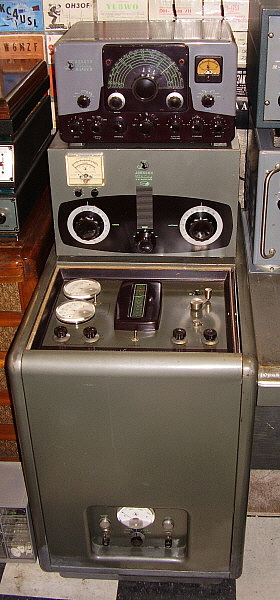
The Desk KW and the Ranger
with the KW Matchbox

The set-up was in the Western Historic Radio Museum located in
Virginia City, Nevada. ca: 2009

The Viking Desk KW was introduced in 1955 and was available up to around 1964. The "Desk" is a high power RF amplifier with a high power audio modulator, power supplies and all of the control equipment built into a fairly compact "pedestal." The Desk KW features continuous tuning from 3.5 to 30mc. The PA operates Class C and has two output levels, low power for tuning up or operation at 250 watts carrier output or high power for 1KW input power. Plate voltage is either 1300vdc or 2600vdc depending on the output power selection. Originally, 872 MV rectifiers were used for the Plate supply but many amateurs have replaced these with 4B32 Xenon rectifiers or with Solid State rectifiers. An external relay (operated by the exciter) must be used with the Desk KW for linear operation for SSB to allow switching between "Blocking Bias" and "Operating Bias." The PA requires 30 watts of drive for full output and the modulator requires 15W for full audio drive on AM. The PA tubes are a pair of 4-250A tubes (4-400 on later Desks) modulated by a pair of 810 tubes. The entire unit is on guides and rollers and is easily accessed for testing or adjustments. The desk itself was a $123.50 option that could be bolted to the side of the pedestal for complete operating station desk with room for the exciter and the station receiver. The Desk KW sold $1595 without the desk. The Desk KW shown is number 280 of the 402 built.

The Tip and Acquisition - The Viking Desk KW shown was partially disassembled and was going to be "parted out" by the University of Nevada-Reno (in 1997.) A friend of mine, N7PSA Craig Hundley (now W4YBS out of Alabama,...I guess Craig liked my call) worked at UNR's Seismology Lab back then and happened to see the Desk KW (disassembled) in the hall on the second floor of the Electronics Building. His phone call to me was something like,...

"Are you interested in a Johnson Desk KW? Well you better get over here, they're throwing one away!"

I left for Reno immediately. When I got to the UNR Electronics Building, I found the Desk KW on the second floor. It had been taken apart and looking like it was destined for destruction. I asked around and finally found that the UNR Wolf Pack Ham Club had gotten the Desk KW as a donation and they weren't sure what to do with it since they couldn't move it to the third floor where their ham club station was. They had disassembled it to see if they could move it up the narrow stairway to the third floor "in pieces" but, they really didn't know what they would do with it, even if they managed to get all of the pieces to the third floor. Since moving it seemed futile, they were actually considering "parting it out." In talking with the president of the UNR Ham Club, I found out the ham club actually wanted other more modern equipment that they actually needed so I made a deal with them of $250 cash for the Desk KW pieces, which was the cost of the equipment they wanted to buy. Luckily, there was an elevator from the second floor of the Electronics Building down to the loading dock. It took three of us (Craig had joined us by then) to load the main chassis into the pick-up (a '66 El Camino) that I brought. The desk and the rest of the parts also fit into the back of the pickup bed. Then the Desk KW was on its way up to Virginia City. The KW Matchbox was with the Desk KW and was included in the deal.

When I got back to Virginia City, I had to remove the plate transformer, the modulation transformer and the filter reactor to get the chassis light-weight enough that I could move it by myself. After a little inventory of parts I found the wooden frame trim piece was missing and so was the metal cover for the amplifier. I went back to UNR the next day to search around the third floor ham shack and there I found the wooden frame and the metal cover plus a few other little parts that went with the Desk KW. During UNR's disassembly I guess they moved a few things to the third floor but left the heavy pieces in the hall on the second floor.

The Rebuild - The former owner of this Desk KW had used it on SSB. He was driving it with a Hallicrafters HT-37 (I know,...unbelievable) and the bias set up was highly modified. Even different regulator tubes were installed in the regulator chassis. Also, there were changes in the insulated potentiometer board. Luckily, the manual provided all of the information I needed to return this part of the Desk KW back to original. Johnson liked to use solid TC hook-up wire in their harnesses. With the regulator chassis removal (a couple of times, at least) and other movement of the harness, two of the TC wires broke and had to be repaired. This seems to be a common occurrence when doing much under-chassis work on any Viking transmitter. The chassis is a "double-decker" with both bed plates being nickel-plated. These had a slight coating of oxidation from where the Desk KW had spent most of its existence (off the west coast probably.) This was easily removed with WD-40 and 0000SW. The former owner had punched several holes on the right side panel of the pedestal to have access to the bias pots. These holes were left since there wasn't much that could be done and they weren't really obvious. I pulled everything apart to check all components. I found the finals were RCA 6156 tubes, an equivalent of the 4-250A. The small fan inside the amplifier was okay but the large "push-pull" fans were worn-out. New open frame motors exactly like the originals were available. These fans are not balanced very well and to compensate for the rotor imbalance, the original metal fan blades have to be statically balanced and slightly tweaked until the fan runs smoothly. These fan motors have felts that should be saturated with light-weight machine oil every couple of years. The lower fan pushes air into the pedestal and the upper fan pulls the warm air out of the pedestal. There are three Potter-Brumfield relays at the lower front area of the Desk KW chassis that control all of the operation functions. The contacts on these relays were in poor condition but were easily cleaned up with 400grit AlOx paper. These contacts take a beating and need to be cleaned at least once a year for reliable operation.   

The Desk KW Check-out - I had the Desk KW pedestal chassis setting on a large furniture dolly to be able to easily move it around the work area. I had made an interconnect cable to go from the Viking Ranger to the Desk KW. This supplied the relay standby/operate lines and the modulator lines. The RF to the Desk KW is via a RG-58U coax with standard PL-259 connectors.

Since I had set-up the ham shack as part of the Western Historic Radio Museum, this area had been part of the basement of the Parish House. Sometime in the past, 240vac was installed in the basement for a washer-dryer combo. I rewired the entire ham shack to have all AC wiring in conduit and to have an actual switchbox and fuses on the 240vac line in. The 240vac outlet was a dryer type 50A outlet. I used a dryer AC power cable for the connection to the Desk KW. The orientation of the AC plug from the Viking Ranger as plugged into the AC outlet on the Desk KW is very important. In one orientation all relays operate from the Ranger's function switch but if plugged in with the opposite orientation, none of the relays function. I painted the top of the Ranger's AC plug red so I would always know the proper orientation.

The RF output of the Desk KW ran to a commercial Harrison Dummy Load that was rated at 5KW. The first test was low voltages only and no problems were encountered. Next was high voltage in the "Tune mode" which actually runs the high voltage at about +1250vdc rather than the full +2500vdc. The Ranger should provide about 12mA of grid drive. This test had the Desk KW running at about 275 watts output power. I switched to "Operate" and fine tuned everything, the power output was around 700 watts. That was the only time that I operated the Desk KW at full power but it seemed to handle it just fine.

Reassembly and Installation - Once the chassis was checked-out and operating normally, it was time to put the Desk KW back together. The chassis slides into the pedestal and rolls on side glides. The dolly had the chassis just about the right height to slide in. I used a 3/4" pipe as a lever to lift the back of the chassis into the pedestal and, once the back chassis is in, it's easy to slide it the rest of the way in. I had to make sure that the two RF cables (Ranger in and Desk KW out) were routed out the back. There's an interlock switch in the back that prevents power going to the chassis so the chassis has to be fully into the pedestal to operate. Two rear mounted bolts secure the chassis in place. The Ranger plugs into the back of the pedestal with the interconnection cable and the AC power plug. The 240vac cable also plugs in the rear of the pedestal.

The desk option generally is mounted to the right side of the pedestal. There are several bolts that provide the attachment. There's also a "modesty shield" in the footwell area. The pedestal has four leveling type metal feet and the desk attachment has two metal leveling feet. The Desk KW would be a lot easier to move if casters were installed but the museum shack has a linoleum floor so "sliding" is fairly easy (not now, the Dayton shop floor is concrete.)

I have the KW Matchbox on the pedestal and then the Ranger on top of the Matchbox. The metal cover for the KW panel stows in a pocket on the right side of the amp. There's also a cover that slides up and down for the lower panel with the plate voltmeter, mode switch, pilot lamps and fuses. When operating the Desk KW, the T-R relay has to have a slightly delay added using a RC network to allow about a half of a second hold when going to receive. This assures that the antenna load remains on the PA output until it has discharged.

Inside the Viking Desk KW - After several years of operation, I had to replace the two toggle switches on this Desk KW. The originals are rated at 3A at 125vac - a pretty hefty switch - but they became intermittent after 50 years of use. I replaced them with 10A 125vac toggle switches. For the AC power switch (SPST) this is no problem since there's plenty of room. For the meter selection switch though I had to modify the switch terminals by cutting them down as low as possible. Then I drilled a 1/16" hole in each shortened terminals for the wires to mount into. Also, the switch has to be mounted as far forward (towards the front panel) as possible. Because the switch is in front of the meter terminal board and both are located in the shielded meter box, there isn't much depth room for a large toggle switch but with slight modification to just the switch, it all fits together.    >>> >>>  The Desk KW chassis rolls out but only so far until you are going to have to support the front. I use a wooden furniture dolly that you can find at Home Depot or many other hardware stores. The dolly is placed under the Desk chassis and as you pull the chassis out you move the dolly more to the center of the chassis until the chassis is entirely out of the pedestal. Then you'll have a way to roll the chassis around for easy access to all areas. The chassis weighs close to 200 lbs with all of the iron installed, so the dolly helps a lot. When re-installing the chassis into the pedestal, I use a lever (a five foot long piece of 3/4" pipe) to lift each back edge of the chassis into the pedestal. Once both edges are in, then it's easy to push the chassis back in on the internal rollers.

I use 6156 tubes in the final PA because these RCA versions of the Eimac 4-250A are usually cheaper but have the same specs. The only difference is the 6156 doesn't have the metal base shroud to direct air flow around the tube. Since I only run the Desk KW in the "Tune Mode" it is never really running more than at just "an idle" and therefore the 6156s work fine. I also don't use the original 872 MV rectifier tubes but use 4B32 Xenon rectifier tubes.


photo above: Output Network with over-sized roller inductor and large air variable capacitor. Photo right: The finals - a pair of 6156 tubes which are the RCA equivalents of Eimac 4-250A tubes - they look a little darkened but worked fine in the "Tune Mode."


photo above: The modulator section showing the pair of 810 tubes and the huge modulation transformer. The lower deck can be seen and the Potter-Brumfield relays and the VR tube regulator chassis are visible. Also, note the replacement open frame motor for the fan. It's the original fan blade through.

Where's the Desk KW Now? That is February 2025 - With the closing of the Western Historic Radio Museum and the subsequent move to Dayton, Nevada, I had to disassemble the Desk KW for the move (even though it was only a 10 mile move that was all downhill.) Maybe I made a mistake in doing a total disassembly of the desk portion because here it is 12+ years after the move and I still haven't reassembled the Desk KW. At first, my excuse was that I didn't have 240vac available in the Dayton shop but a few years ago I did route the 240vac over to the radio-area of the shop. Next, was the lack of room in the shop with the Desk KW being a real "space hog." Then, there was the acquisition of the T-368 transmitter that runs more power and takes up less space (350W output for the T-3 versus 275W in the "Tune" mode for the Desk KW.) Every time I think I might have some room and enough interest something else comes along. Last entry was the W6MIT "Svoboda-Big Rig" transmitter. Again, a very small footprint transmitter that has 300W of output power. So, while I still have all of the pieces to put the Viking Desk KW back together, I just have to create a space for it that's near the 240vac line output and work on my motivation. Unfortunately, this move is actually more of shuffling around everything in the shop in order to get the Desk KW over to where the 240vac line output socket is located. Also, clearing a pathway for the move to take place is required. Lots of heavy lifting and pushing (which, at 75, is becoming more and more difficult.)  

Tune Mode versus Full Power - Of course, the Desk KW is really capable of about double what the T-368 can do, if it's operated at its full power of 1KW input. I did that into a dummy load years ago and I got about 700 watts output. But, due to the FCC 1991 rule change regarding AM operation, 1KW input power isn't the legal limit anymore. Now it's 1500 watts PEP output power into a 50Z load as measured with a Bird Watt Meter (didn't you ever wonder why there are so many Bird Watt Meters are around? With its multitude of tuning slugs and difficult to read meter, it's nice to have Federal legislation help sell your over-priced product and increase your business that way.) Although it sounds like more power (and it was for SSB) it's really less AM power because double sideband AM also adds the audio power as it modulates the carrier wave and the carrier power is usually measured in RMS, not peak-to-peak. Rule of thumb is PEP W ÷ 4 = Carrier power for AM with no modulation. So, 1500/4 = 375W of carrier power. But, the varying nature of the human voice only achieves 100% modulation once in a while. Most voice modulation levels are far less than 100% and, therefore, most of the time even with 700 watts RMS output, the actual PEP output rarely approaches 1500 watts PEP.

6156 Tubes versus 4-250A Tubes - The Tune mode on the Desk KW is accomplished by cutting the Plate voltage in half (~ +1250vdc.) Power output was usually about 275 watts. However, the 4-250A tubes weren't designed to be operated at reduced power over a long time period. The plates of the 4-250A tubes have to be dull red during operation to keep the tubes from becoming gassy. So, I don't know how well the 6156 tubes have handled the lower power operation. When I get the Desk KW back together I'll find out. As can be seen in the center photo above, the 6156 tubes were already showing signs of a lot of use with the darkened envelopes.

When I get started resurrecting the Desk KW, I'm probably going to replace the 6156 tubes with 4-250A Eimac tubes. I was never very confident in the 6156 tubes and if they were running at full power, I don't think they would last very long.

Using a Proper -3db Attenuator - Another thing, when the Desk KW is back together, I now have a very nice 50Ω -3db attenuator that would result in about 25W of drive power from the Ranger to the Desk KW. That would have the Ranger and the Desk KW operating exactly as the manual indicates. Something I didn't do when I used to operate the Ranger and the Desk KW. By reducing just the Drive on the Ranger, the 6146 wasn't operating correctly and I seemed to go thorough 6146 tubes rather quickly. I think the Ranger's PA will appreciate the use of the -3db attenuator.

Other Full Power Thoughts - I know of a couple of hams that run their Desk KWs at full power these days. With the advent of HDTV moving TV-BC up to the microwaves, harmonic TVI is a thing of the past. Also, I don't have any nearby neighbors here in Dayton Valley that could experience fundamental overloading. And, as to running 700 watts carrier output on AM,...I remember 20 years ago that W6HDU (SK) in Alameda, CA would run a 5KW Western Electric BC-AM transmitter at full power output on 3870kc but he would tell everyone he was running a Collins 32V-3! And, when one thinks about it,...going from 365W carrier output to 700W carrier output is slightly less than a +3db increase. Would that sound like an increase of one half of a S-unit at the reception end? Or, from S9+10db to S9+13db? Hmmmm. 

More to come if this project can ever get started,...


Johnson-Viking KW Matchbox

The Viking Match Box was a heavy duty, balanced antenna coupler that was link coupled, used bandswitching and had two split-stator variable capacitors that allowed matching various kinds of antenna loads to a transmitter. The Match Box was specifically designed for balanced antennas but could also match coax fed loads or end fed wires. The SWR bridge required an external Directional Coupler to function but the Match Box was available without the SWR bridge option in which case there is no meter installed. A built-in antenna relay is included inside the box with access via an external terminal strip mounted on the rear of the unit. Additionally, there was a terminal provided so the end-user could install a small air-dux type coil inside the unit to act as the RF monitor pick-up.

This KW Matchbox came with the Desk KW that I got from UNR. I suppose that the two were together since they were new. The KW Matchbox worked okay but I suspected that something wasn't exactly correct inside because it seemed to have trouble with matching some transmitters to a standard 135' CF open feedline dipole. When taken out of the cabinet, I noticed that the inductor showed signs of multiple soldering and unsoldering of the link taps. One link tap is for the 300Z ohm to the "Receiver" connection through the internal T-R relay. The other link should have been set for around 50Z for the transmitter. I could see evidence of where the 50Z link had originally been connected, so I moved that non-original connection back to the original position on the link. There were a few other minor things that needed to be put back to original and then the Matchbox was put back into the cabinet. After the changes, now the Matchbox loaded every transmitter I tried, matching the transmitter output network to the 135' CF dipole antenna.

One slight change I've made is to move the input wire to the relay terminal to the adjacent terminal. This bypasses the antenna relay. If it isn't done, the antenna relay will be in the "receive" position (there is a separate set of terminals for the receiver's antenna connection to the tuner) unless the relay coil is energized with 115vac. I didn't plan on using the internal relay so this easy and easily reversible change keeps the tuner always in the "transmit" mode without the necessity of providing 115vac to the relay. I've been using this Viking Matchbox almost continuously ever since I got it. It has been very useful and matches almost any balanced antenna to almost any transmitter. I also have the smaller version Matchbox that's rated for 275W. This is a pretty good version that works most of the time. I find that the KW Matchbox seems to be easier to adjust and it has a wider impedance range than the 275W version.

I'm currently using the Viking KW Matchbox with the 2 Element Collinear Array antenna in the upstairs ham shack.

NOTE: Dec 26, 2024 - Another Viking KW Matchbox was obtained in a trade. This one was very dirty and had been very slightly modified. Unfortunately the mod added another ceramic insulator that paralleled the coax input (probably to run an end-fed wire antenna.) This insulator was removed and the hole covered with a Cinch plug. Lots of cleaning and adjusting with the end result that this new KW Matchbox is operating almost exactly like my old one. I've removed the Nye-Viking MBV-A tuner from the shop antenna and now have Viking KW Matchboxes for both the upstairs ham stations (working the 2-Element Collinear Array) and the ham stations in the shop (working the 130' tuned dipole.)

NOTE: On the Nye-Viking MBV-A tuner,...these tuners are merely "high power rated" Pi-Networks that have a trifilar-wound balun that enables an unbalanced network to work with balanced loads. The losses in the Nye-Viking balun are legend. It might be a good tuner to work with an unbalanced to unbalanced load but it's not good for anything that goes through the balun. The losses can even be noticed in the receive mode. At any rate, the chance to replace the Nye-Viking came and I "went for it."


Photo above shows the Navigator with the stock iron vane meter and stock "Grid-Plate" slide-switch.    a 2004 photo

E. F. Johnson Company - Viking Navigator
 

The E. F. Johnson Company has been in business since the 1920s and is still active in the component business. During the post-WWII period up to about 1974, Johnson was a major builder of ham transmitters, ham accessories and other communications equipment. The Viking Navigator was introduced in 1957 and was available for about four years. It could be purchased as either a kit or fully assembled. The transmitter-exciter is only 40 watts input power with a little over 25 watts of output power on CW only. Coverage is 160 meters through 10 meters. The PA tube is a 6146 with about 400vdc on the plate.

The Navigator featured a fairly standard Johnson VFO, although regulation is somewhat different than their standard VFO as found on the Ranger, for example. Also, a keyer tube is used which provides adjustability of the CW keyed waveform shape. The keyer circuit is also quite different from the Ranger. The "Iron Vane" meter is a source of many problems and its accuracy is always in question. The slide switch that selects Grid or Plate current is also somewhat problematic. Many times, Navigators are found with these two parts replaced. A great QRP CW transmitter that is very small and light weight. Original selling price was $199.50 factory-wired and $149.50 as a kit. Only 840 Navigator transmitters were produced. The Navigator was donated to the museum by my old friend, Gerald Morris K6QY (SK) in 2004. Gerald's QTH was in Oakland, CA. His two-story, 1910 Craftsman-style house was in fabulous condition with loads of period woodwork inside. The house was located on a side street directly across from Kaiser Hospital in downtown Oakland.

The Navigator was non-functional when it was given to me. Gerald had purchased it at a Foothill College Ham Swap Meet (in Los Altos, California) from someone cleaning out a load of gear who wasn't the least bit interested in what they were selling, which was lucky for Gerald. The purchase price for the Navigator,...$20. As can be seen in the photo to the left, it was in excellent original condition. Gerald used it for quite a while until it quit working. I'm sure Gerald knew that the filter choke had burned up but he just didn't want to work on the Navigator, so it was given to me. I went though all of my filter chokes and I found one that was exactly the same type as the original. That was installed and the Navigator came to life again. As I used it, I began to notice that the iron vane meter was constantly "banging" against the needle stops. This couldn't be the way Johnson designed it,...or could it?

Just How Bad is the Original Navigator Meter? - Absolutely Awful. When operating a Navigator as a CW QRP transmitter, the "Iron Vane" meter is constantly "banging" against the zero-stop. Sooner or later, this must have resulted in the meter needle breaking off and ruining the meter. Also, switching transients sometimes caused the coil to "open." That's probably why nowadays so many Navigators have replacement meters. W6THW Mike has a Navigator and he installed a jumper across the original meter's terminals to protect the meter and then uses an external watt meter to load up the transmitter. After Mike told me about that "fix" I did the same to my Navigator. A defective original Navigator meter will be next to impossible to replace so this easy "jumper" protection assures a functional original meter will survive indefinitely (well,...maybe.) But, it's not a solution to the "bad meter" problem and disabling the meter prevents measuring the plate current and the grid drive (if you ever believed what that "junk meter" read.)

I can't stress the point strongly enough that the original Johnson Navigator "iron vane" meter is a real "piece of junk" and is not really repairable if a problem develops in an original unit (who'd want to fix it anyway.) The plastic cover is glued all around the perimeter of the meter scale backing plate and any attempt to cut away the glue cracks or breaks the plastic cover. Apparently, if a problem developed in the meter, Johnson wanted you to replace the entire meter instead of repairing it. That might have been okay in the late-1950s but now, 65+ years later, I don't think Johnson still stocks Navigator meters. Johnson's decision to install a $2 meter into a $200 (factory-wired price) transmitter was certainly profit-motivated. However, it is possible to fit a Johnson Ranger meter into the Navigator and with some minor adjustments to the shunt(s) it becomes an accurate and useable instrument (which the original Navigator meter never was.) Plus the Ranger meter is illuminated, it has the "Viking Head" logo and it even has "E. F. Johnson Co." on the meter scale. Johnson certainly would have wanted to install the Ranger meter but the price of the already expensive Navigator would have been even more. So, if you want the never-produced "Deluxe" version of the Navigator, here's how it's accomplished (after you've found a Viking Ranger meter, of course.)
 

E. F. Johnson's  Viking Navigator "DeLuxe"

I really had to think about this modification for a long time. It went against everything I advocated about restorations. The Navigator was a fun little transmitter but the iron-vane meter literally ruined the pleasure of operating. I knew that a Viking Ranger meter was really what Johnson had "wanted" to put into the Navigators but economics had forced them to install a totally useless "piece of junk" iron-vane meter instead. Every Navigator owner I've talked to feels the same way about the original "Navi-meter" - it's pure junk! Worthless and inaccurate,...an embarrassment to an otherwise nice little transmitter. Although I wasn't actively looking for a Ranger meter, one did show up at Ham and Hi Fi in Sparks, Nevada, making it an easy purchase. Now, a Ranger meter doesn't just drop-into a Navigator and work. It's a moderately complicated modification. Here's the process, with photos, of how to change your plain-old Navigator into a "Navigator DeLuxe." Of course, these aren't "step-by-step" instructions. I'm assuming that if you want to install a Ranger meter into a Navigator, you have the moderate electronic restoration skills and knowledge necessary for the task.

Installing a Viking Ranger Meter into the Navigator - In 2016 I got the chance to actually do something about the original "El Cheap-o" meter used in the Navigator. I was able to obtain a Viking Ranger meter from a junk Ranger that was being "parted out." I tested the meter, which was in very nice cosmetic condition, to see if it was usable electrically. The Ranger meter is a ~5mA FS unit that is a d'Arsonval rotating-coil meter. This design is far more accurate than the crude "iron vane" meter that relies on magnetic attraction of a "vane" to move the meter pointer. A quick test is to just measure the DCR of the meter coil. In this case it measured ~20 ohms. A more accurate test is to actually measure how much current is required for a full scale indication. An adjustable low-level dc voltage is connected in series with a 1K ohm resistor, a current meter and the meter under test. The dc voltage is adjusted until the meter under test shows a full scale indication. The current meter will now show how much current is needed for full scale deflection on the meter under test. In this case, it is 4.5mA. Linearity can also be checked at half-scale, in this meter it was 2.2mA. 

Something Interesting with the Original Meter - I hadn't operated the Viking Navigator since I had moved from Virginia City in 2012. The Navigator had been in storage in the upstairs lab which is a stable environment with no extremes of any sort. In my research before actually performing the Ranger meter installation, I thought I'd test the original iron-vane meter. A measurement of the coil showed no continuity at the terminals. I had run into this problem once before when I first got the Navigator. At that time, loosening the terminal nuts and retightening them got the meter functional. This time, no amount of loosening and tightening helped. The meter coil was somehow disconnected from the terminals. There is no repairing the original meter. It can't be taken apart since the plastic cover is glued to the back and any stress on the plastic results in cracks. Better to leave the original meter in good cosmetic condition albeit non-functional since I was planning on installing the Ranger meter anyway.  >>>

The Installation Plan - One can't just remove the old Navigator meter and bolt-in the Ranger meter. These are two different types of meters that have different FS indications and FS current requirements. This will require re-calculating the shunt values needed for the Ranger meter to accurately read PA grid current and PA plate current in the Navigator.

Additionally, the Ranger meter isn't exactly a perfect replacement fit. The original Navigator meter requires a 2" diameter hole while the Ranger meter requires a 2.187" hole. The original Navigator meter was mounted using a bracket that attached to the back of the meter and pushed against the back of the front panel to hold the meter secure. The Ranger meter mounts conventionally using four studs that use 4-40 nuts and washers to secure the meter to the panel. This means some modification to the front panel is necessary. Fortunately, if for some reason the original Navigator meter was to be re-installed, the modified larger clearance hole and the four mounting holes are covered up by the overall size of the original meter.

Originality versus Cool Functionality - Anyone who reads any of my articles knows I'm a serious advocate for strict originality. How could I actually want to modify a rarely encountered transmitter to the point where I'd actually be "cutting and hacking?" It seemed unthinkable! However, that's just how BAD the original Navigator meter is. I would think that the E. F. Johnson decision to use the iron-vane meter was based on keeping costs low so the Navigator would be reasonably priced (it really wasn't.) If Johnson could have put another $15 to $20 into the cost, they would have used the Ranger meter. The Ranger meter is a genuine, contemporary to the Navigator, "Johnson" part and it even has the Viking head on the scale. Additionally, it is an illuminated meter (the original iron vane meter isn't.) So, my argument for performing this modification is "Johnson would have liked to have built the Navigator this way but it would have cost a lot more and sales would have been even less than they already were!"  Maybe Johnson should have offered this version as the "Navigator DeLuxe."  

Before Cutting the Sheet Metal,...Test - Always a good idea. Make sure your modifications are actually going to function correctly. In this case, the modification was to the shunts used in the Navigator. We don't really need to know what the original iron vane meter required since it was now non-functional. So, if your Navigator has a bad original meter or some sort of replacement meter and you want to install a Viking Ranger meter, you'll need to calculate the shunts. Normally, you can use the formula of R shunt=R coil/n-1 where n=change in scaling. In the case of the Ip our FS is 200mA and the FS meter movement is 5mA so n=200/5 or 40, so n-1=39. The formula then is R shunt=20/39 or ~0.5ohms. An accurate digital current and ohm meter that will read low value ohms and milliamperes accurately helps in final accuracy of the shunt calculation and resistor selection.

I did a quick test for the grid current using 10mA FS with R shunt=20/4 or ~ 5 ohms. I installed a 5.1 ohm resistor for the grid current shunt. Although the original meter didn't require a shunt, the Meter switch has an extra unused pin (pin 9) that can be used for a grid current shunt resistor connection into the circuit.

During testing I wanted to double-check the accuracy of the Ranger meter and the shunts. I did this by using an accurate current meter installed directly into the grid circuit. I adjusted the Navigator to show 4mA of grid current. I then connected the Ranger meter which showed 2.5mA. A slightly higher shunt resistance was needed so I installed a 6.8 ohm resistor and this then allowed the Ranger meter to show 4mA. I did the same with the plate current shunt and ended up with 1.0 ohm, 1.2 ohm and 1.5 ohm resistors in parallel, or about 0.27 ohms, for an accurately reading plate current meter.

As to why the actual shunt values were slightly different from the calculated values was probably due to the meter I used to measure the Ranger meter coil resistance. I really needed a digital meter that was capable of measuring "very low ohms" accurately which I didn't have. Also, the actual measured FS current for the meter was 4.5mA and for some reason I used 5.0mA in the calculations. With these two changes my calculations would have been accurate. As it was, I got close and then "trimmed" the values to have the Ranger meter read accurately by comparison with a known accurate current meter.  >>>

Sheet Metal Work - Now that we had the Ranger meter working with the Navigator we had to actually modify the front panel so that the Ranger meter would fit and could be mounted. Trying to do sheet metal work with the panel mounted to the chassis will result in difficulty getting an accurate fit. It's better to entirely remove the front panel so you can rework the meter hole neatly and drill the four mounting holes precisely. There are many ways to enlarge the meter hole but since we were only removing 3/32" around the perimeter of the hole, I carefully used a nibbling tool and then finished with a fine round file. The mounting holes were drilled. See photo below for the appearance of this "hand fitting" job.

Mounting the Meter - When mounted in the Ranger, the meter had a full metal rear cover that provided shielding and mounting for the chokes, bypass capacitors and lamp socket mounting. The meter cover mounted via the two meter studs using various insulator washers and nuts. The meter itself mounts to the front panel using the four studs with lock washers and nuts. Then the meter cover shield mounts to the meter studs and has its flex fingers pushed against the inside of the front panel to provide a chassis ground connection. The lamp socket "snaps" into the hole provided and this has the lamp placed the proper distance from the meter scale for full illumination.

Meter Cover Shield Modification - To install the rear meter cover in the Navigator requires a clearance hole be cut in the bottom of the cover. This is necessary because of the proximity of the Grid-Plate slide switch (directly below the meter.) The opening width has to be 1.75" and the depth is 1.125" and this is easily cut using a hack saw and then dressing the edges with a file. If carefully executed, the opening looks stock. Mounting the cover requires an insulating washer on the inside and on the outside of each stud. I used the type of insulating washer that has a molded shoulder that provides insulation of the stud through the hole in the cover. See photo to the right.

Connecting the Meter - Each meter connection is filtered with a choke and bypass capacitor. The 6.3vac to the meter lamp is also through a choke and bypass capacitor. The meter studs have terminal solder lugs and the wires from these connect directly to the Grid-Plate slide switch. The meter lamp choke filter is connected to the 6.3vac dial lamp buss connection. The finished Johnson Ranger meter installation is shown in the photo to the right.


Is this cool or what? The Viking Navigator DeLuxe     a 2016 photo

Keying Adjustment - R-9 adjusts the keying circuit to produce a "shaped" wave envelope that has a somewhat slow start and finish to the pattern. This reduces "clicks" that are sometimes heard with CW transmitters. The procedure is to adjust R-9 for full "on" keying and then adjust in the opposite direction until the keying just turns "off." Then continue slightly past the turn "off" position. A little vague. I adjusted by listening to the keying with the Navigator on the dummy load and listening on a R-390A receiver. I found the best sounding keying was actually quite a bit farther into the pot rotation rather than just "slightly." I found the keying tended to "bloop" if R-9 wasn't adjusted quite a bit past the "off" position.

Panel Mounting Screws - Since the cabinet for the Navigator is made out of aluminum it's pretty easy to strip the threaded holes when mounting the Navigator chassis and panel into the cabinet. But, since the cabinet is aluminum is fairly easy to recondition the threaded holes to have enough material to allow gentle tightening of the panel screws. The holes can be deformed using a tool to compress the hole edge material  The compression will slightly reduce the size of the hole. A small vise grip type of tool can usually deform the aluminum enough. Then a 6-32 tap can "chase" the threads or self-tapping screws can be installed. In either case, don't over-torque the screws, just barely tight will work fine. I'm going to replace those Philips head screws with slotted screw heads. They were installed when I got the Navigator from K6QY. UPDATE: Apr 27, 2024,...I dug the Navigator Deluxe out of storage and, to my surprise, I had already replaced the Philips head screws with slotted screws. Don't know when I did that but I guess that means another photograph will be required. New photo below,...

Operation - Testing into a dummy load plus a Drake W-4 wattmeter showed that I could load the Navigator to about 25 watts maximum output power. The Navigator was rated at 40 watts input power so the 25 watts equates to about 62.5% efficiency which is about right for Class C PA operation at the plate voltage the 6146 is provided with (around +400vdc.) On CW, 25 watts output power is sufficient for communications provided a decent antenna is used. I used a 135' center-fed inverted-vee fed with 94' of ladder line. When used on 40M this antenna becomes "two half-waves in-phase" and begins to exhibit a little gain - not much,...maybe 0.5db over a regular dipole. I selected 40M so I could do my test QSOs during the day. Although there isn't a tremendous amount of activity on 40M CW during the day, there isn't any QRM either. The interesting thing was that, even then, I managed to work everyone that was a "daytime 40M CW op" in about three days (and that was in just three QSOs!)

Photo above-left shows the Johnson Viking Ranger meter installed. The top scale is 0 to 200mA and used for plate current. The 0-5-10 middle scale is used for 0 to 10mA grid current. The Viking Ranger meter has the perfect proportions, the correct matching shape and color, it's illuminated so the Viking's head shows up really well, even "E. F. Johnson Co." is on the meter scale. I'm sure ol' Edgar Johnson would have approved of upgrading the original Johnson Viking Navigator to the Navigator Deluxe.

UPDATE: Apr 27, 2024 - I took a new photo of the Viking Navigator Deluxe showing that the Philips head screws are gone and proper slotted pan head screws have been installed. I don't know when I did this,...I just discovered it today when I got the Nav-D-Lux out of storage.

It's been several years since I've operated the Nav-D-Lux. I'm going to return this little transmitter to the bench for a check-out. I know that I checked the general operation after replacing the burned up choke. The grid drive was always running too high when the Exciter was adjusted to resonance or peak. I used to reduce the drive by detuning the Exciter. I want to check the value of the resistors which I know I didn't do back in 2004 or in 2016. Also, the voltage levels need to be confirmed. Initially, the repair of the Nav-D-Lux was accomplished up in Virginia City where the AC line voltage was 115vac. Here in Dayton the AC line is usually about 122vac. So I'll have to run an AC line bucking transformer with the Nav-D-Lux for 115vac. Although, even in Virginia City, the grid drive was too high, so there certainly is something slightly off in the Nav-D-Lux circuitry. 


The Viking Navigator Deluxe - a 2024 photo


Return to Home/Index


Radio Boulevard
Western Historic Radio Museum

 Vintage Radio Communication Equipment Rebuilding & Restoration Articles,

 Vintage Radio History and WHRM Radio Photo Galleries

1909 - 1969

- 60 years of Radio Technology -


This website created and maintained by: Henry Rogers - Radio Boulevard, Western Historic Radio Museum © 1997/2026