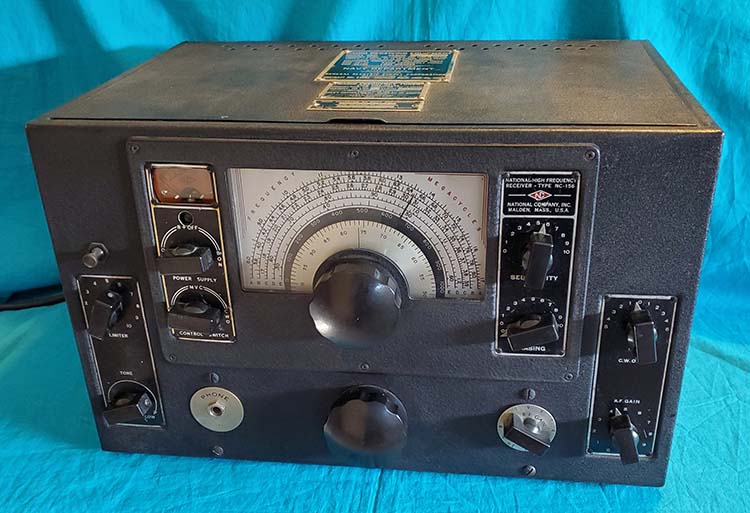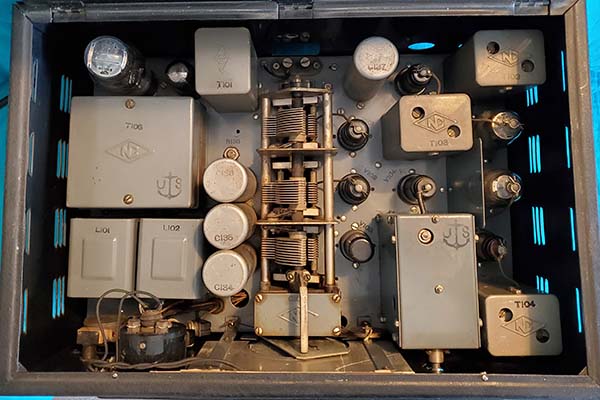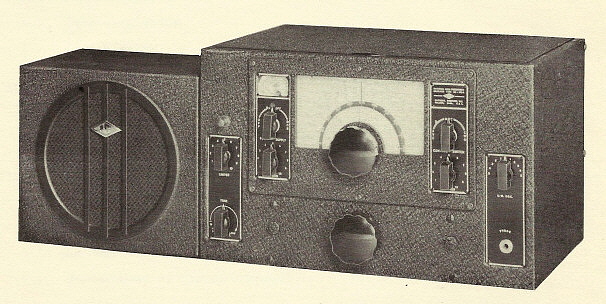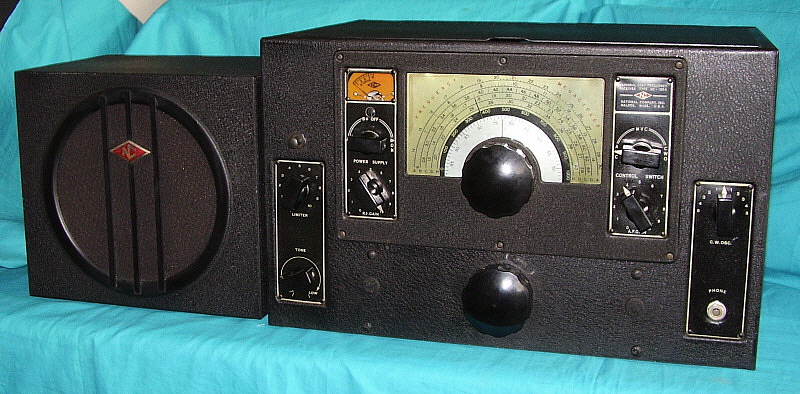
|
Radio Boulevard NATIONAL COMPANY, INC.
History of Design and Production,
Moving Coil Catacomb, WWII Versions, by: Henry Rogers WA7YBS-WHRM |
|
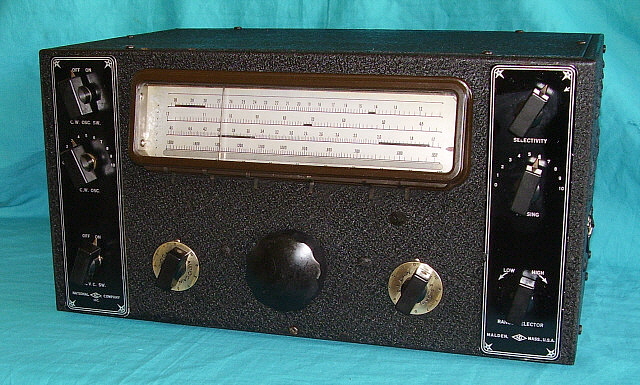
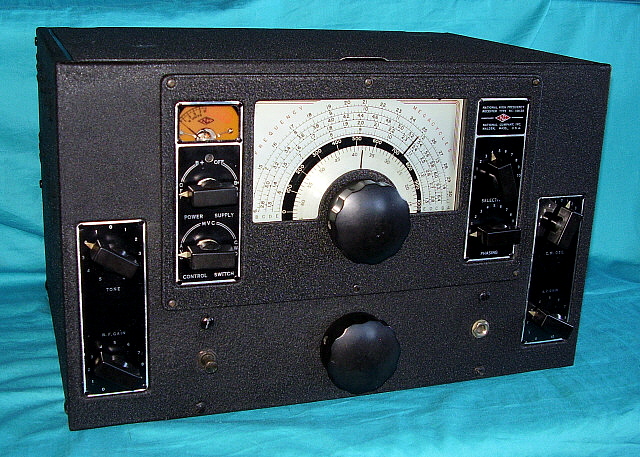
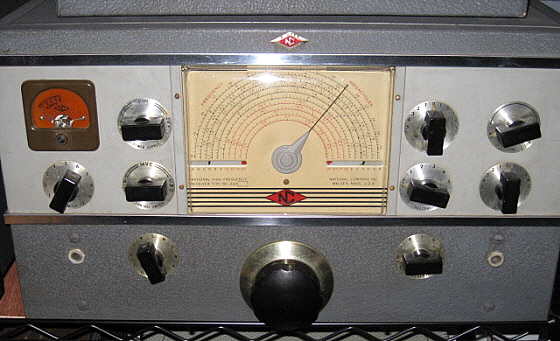
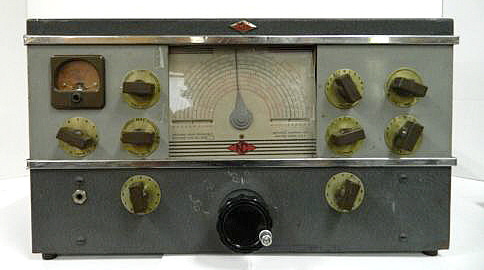
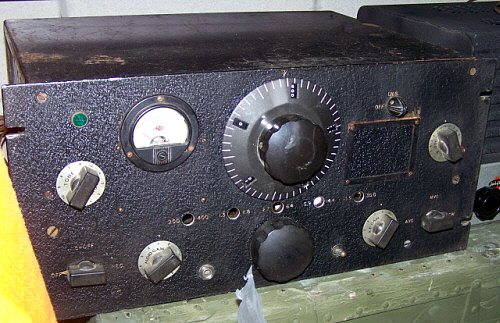
| Besides National's masterpiece, the HRO, another series of receivers produced by National accounted for a lengthy production history. The NC-100 Series "MOVING COIL" Receiver production spanned from 1936 up to 1949. Another masterpiece? Certainly the design of the "MOVING COIL" method for band change used in the NC-100 receivers impressed the commercial operators of the late thirties with modified versions being used by the CAA in airports around the country (even as late as post-WWII.) The NC-100XA version impressed the U. S. Navy whose WWII demand for increased performance with low Local Oscillator radiation spawned the famous RAO family of wartime receivers. Even post-WWII buyers could still purchase the descendants of the NC-100 in the modernized NC-240D receivers. This web-article details all of the various members of the NC-100 family and it became an extensive family that grew as National up-graded and improved the receiver over its 13 years of production history. - Henry Rogers - March 19, 2012 |
|
NATIONAL CO., INC. "MOVING
COIL" COMMUNICATION RECEIVERS |
|
NC-100 Series |
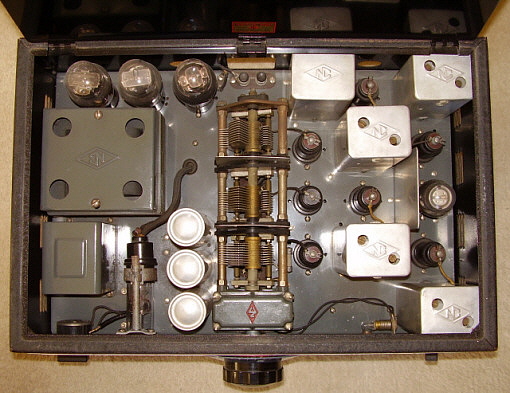
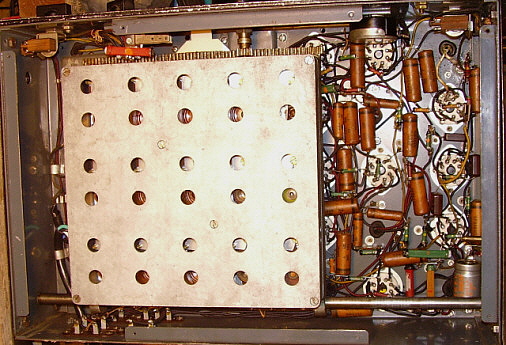
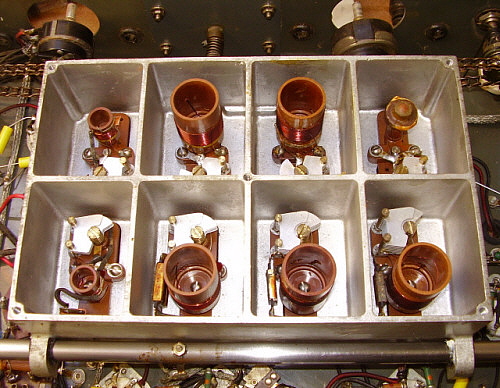
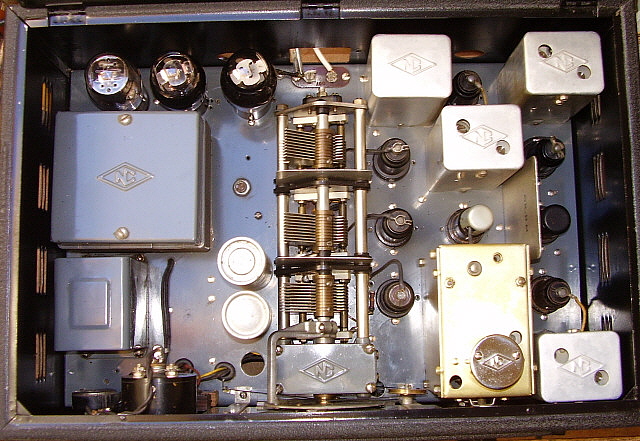
Certainly, National was having fabulous success with the HRO receiver, which had been in production since early 1935. It was well-known that the HRO's legendary performance was in-part due to its plug-in coil sets. The HRO wasn't hassle-free though and Millen realized that for the SWL (Short Wave Listener) and intermediate-level hams, in other words, those who didn't have the experience or couldn't afford the $200+ HRO receiver, there had to be a design that would provide the excellent performance of plug-in coils without all of the hassles and expense. National's mechanical engineers offered a solution that solved most of the negatives of plug-in coils and retained most of the advantages. With the use of a movable cast aluminum coil box called a "catacomb," all of the coils would be mounted in individual shielded compartments with short contact pins mounted in molded insulators on top of the catacomb. A large band selector knob on the front panel of the receiver would turn a rack and pinion gear mechanism that would move the coil catacomb into place, thus engaging the proper coil set pins into short, fixed position, spring-contacts mounted under the tuning condenser in insulator blocks.
The mechanical action simulated plugging in a three coil set for each band with the ease of turning a knob while keeping all of the unused coils isolated and shielded. "Switching noise" was eliminated by routing the RF and IF amplifier screen voltage through the foremost pin split-contacts of the LO coil section. The split-contacts were not soldered together but rather had the screen voltage wires connected to each of the two halves of the contact and when the coil pin, which wasn't connected to anything inside the coil catacomb, engaged in the two halves the circuit is completed and the screen voltage was then routed to the RF and IF amplifiers. >>>
|
>>> To keep the costs down by keeping
the physical size of the catacomb relatively small only three sets of
coils were used per tuning range. A single RF amplifier provided
pre-selection and good reduction of images up to about 15mc. A separate
Local Oscillator reduced the noise associated with the typical
"inexpensive" Converter stage and a separated Mixer stage accounted for
the three tuned circuits that were necessary in each coil set. Due to
the nature of physically moving a metal box underneath the receiver's
chassis the catacomb width dimension was limited by the chassis width
and five tuning ranges were what could be fit into a metal box half the
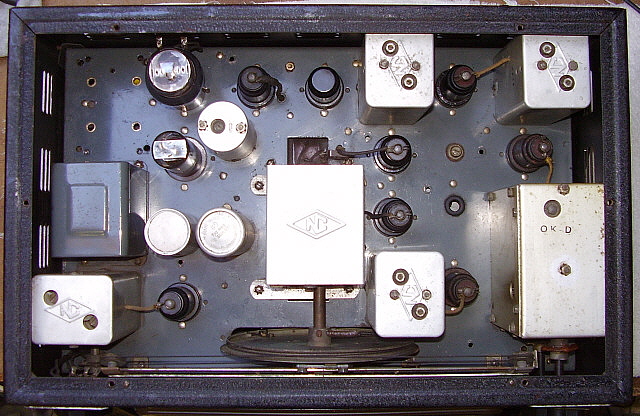
width of the chassis. A finely finished round metal rod that ran the full length of the chassis was mounted at the rear of the chassis to act as a rear bearing for the catacomb. The front of the coil catacomb had a "track" machined into it and the band change shaft, which also carried a pinion gear, protruded beyond the pinion gear and rode in this "track," thus supporting the front of the catacomb. The rack gear was mounted to the front of the catacomb at the proper level to engage the pinion gear to allow moving the catacomb via the band changing shaft. The "detent" action was actually caused by the 15 coil pins engaging the 15 contacts which provided the positive feel of the catacomb "locking" into position. Five marked holes in the front panel allowed viewing a white "flag" that was mounted to the catacomb and indicated which tuning range was selected. When shipped, the coil catacomb was screwed to one side where a guide pin was located to prevent any damage due to rough handling. When the receiver was installed, this screw had to be removed to "unlock" the coil catacomb. Another portion of the design involved the PW gear drive used on the NC-100 series. The famous HRO PW gear drive used a "precision worm" (PW) gear to drive a large split-gear with two ganged variable condensers flanking each side of the gearbox. The NC-100 series was only going to require a three-gang tuning condenser and this was going to be centrally located on the chassis running front to rear with the power supply of the receiver on the left and the receiver circuitry to the right. This required the gear box to drive the condenser from the rear of the box. As with the HRO, an elliptic hub was required to make the PW-D work but inside the NC-100 gear box were several changes. Gone was the large split-gear, replaced with dual driven gears, one of which was spring-loaded for anti-backlash, driving via reduction gearing a large condenser drive gear. This approach eliminated the spring loaded drive of the HRO gear box and replaced it with a much easier to operate gear box. When the NC-100A version was introduced, the elliptic hub had been replaced (along with the PW-D.)
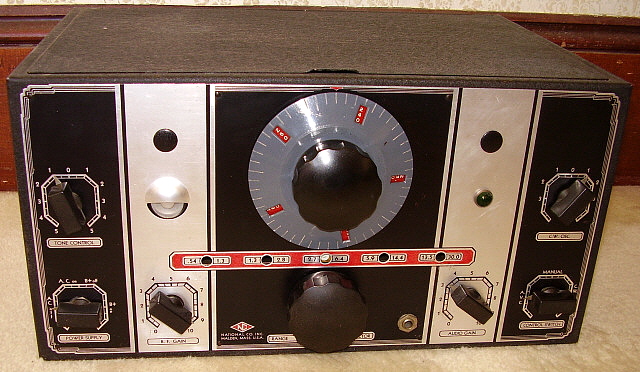
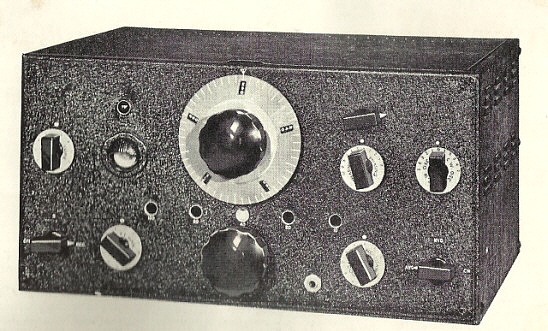
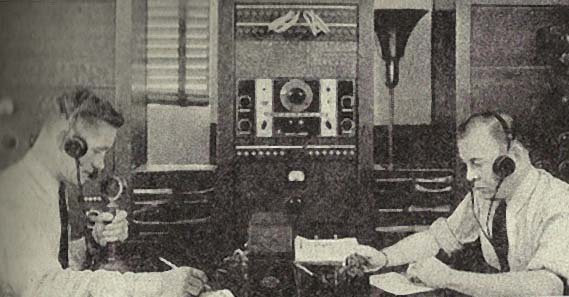
Since the NC-100 was intended for the SWL or intermediate-level ham, a different type of signal strength or tuning indicator was utilized. RCA had just released their "Magic Eye" in 1936 (everything RCA offered in 1936 had "magic" tied to it, "Magic Brain was their radio front-end, "Magic Voice" was a special sound chamber for their console radios, etc.) The "Magic Eye" was a cathode ray tuning indicator tube that glowed a mysterious green color and, as signals were tuned, the "eye" would open and close a "pie-shaped" shadow. Since the "Magic Eye" required a license from RCA to use in a design, not too many manufacturers incorporated it into their designs in 1936 (Zenith waited until 1938 and Philco never did use the tuning eye tube in any of their designs.) Since a cathode ray tuning indicator was part of the NC-100 design it was going to require strong and consistent AVC voltage. This required the incorporation of an Amplified AVC stage in the receiver. Since nearly all hams were running on CW in the thirties and their receivers were always operated with the BFO on and the AVC off, the use of an amplified AVC stage implies that National was designing the NC-100 more for voice reception of AM signals from Shortwave Broadcasters. Finally, there was the Push-Pull Audio output stage using a pair of 6F6 tubes driving a 10" Rola electro-dynamic speaker. Even an optional 12" electro-dynamic speaker was available. Again this great audio section implies the reception of voice and music, not the "dots and dashes" of International Morse. The NC-100 and the NC-100X were introduced in August 1936 and were available from dealers in September 1936, with the initial pricing at $105 and $127 respectively.
As with many of National receivers, the
NC-100 had the potential for commercial use. When supplied as a
Commercial Receiver the NC-100 would be a rack mounted receiver. This
could be accomplished by added brackets to the sides of a standard table
model, by building special racks that adapted to the standard table
model (as in the Highway Patrol photo below) or by supplying the
receiver with a special rack mount front panel. Commercial versions
usually don't have extensive circuit modifications that the later Airway
Communication Receivers employed. The Airway Receivers are detailed in a
section below, "Airway Communication Receiver
Versions."
|
| The NC-101X
- National was aware
that the NC-100 didn't really meet the needs of the average
intermediate-level ham who operated CW and simultaneously released a version of the
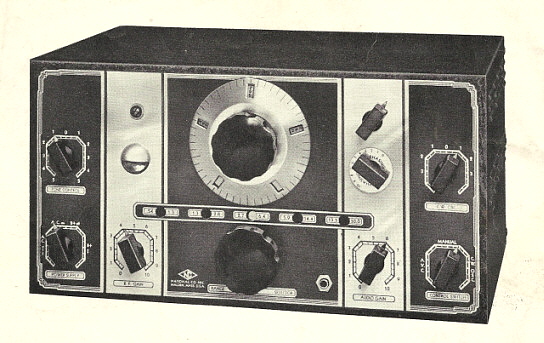
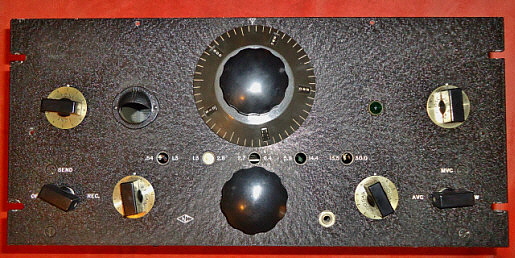
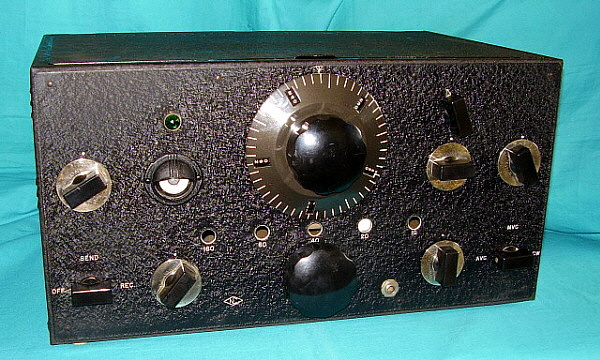
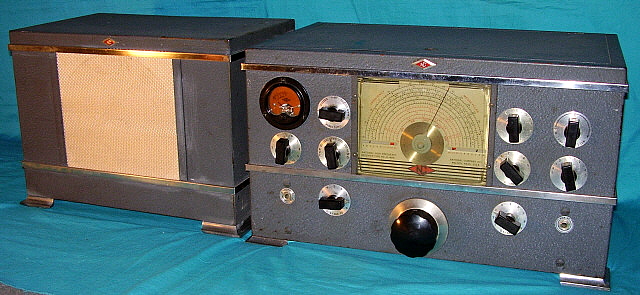
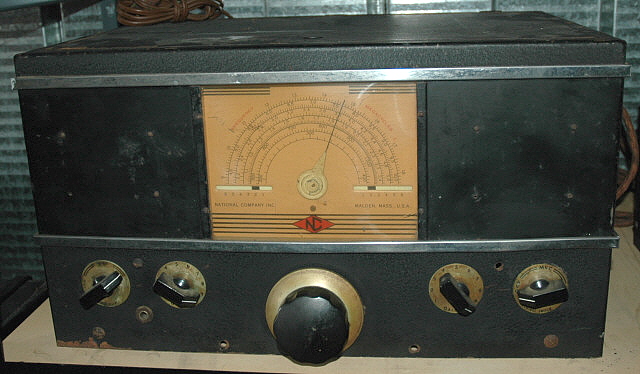
receiver with a crystal filter, the NC-100X (shown in the header photo.) However, it was a
"stop-gap" until National could release the "hambands only" version of the
NC-100X receiver, the NC-101X. The NC-101X seemed to be more of a ham's
receiver, appealing to both CW operators and the few AM phone operators
that were around in the late thirties.
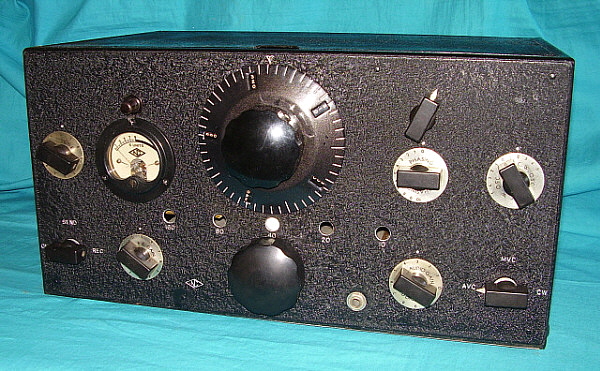
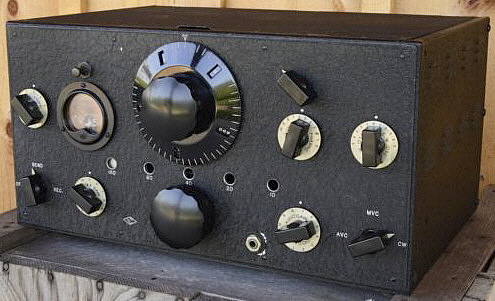
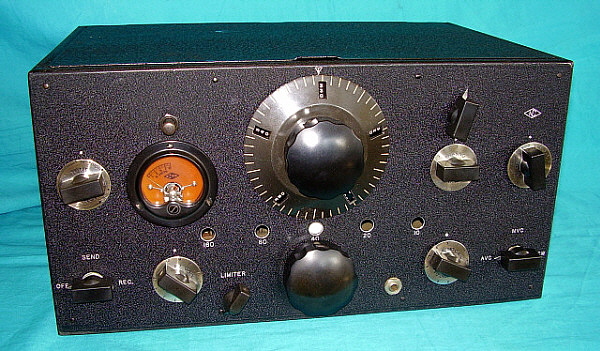
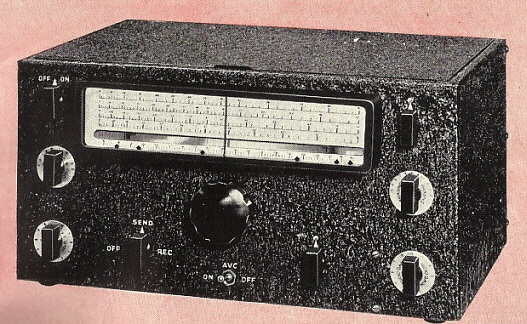
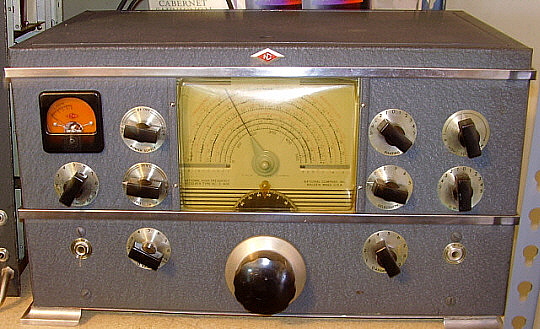
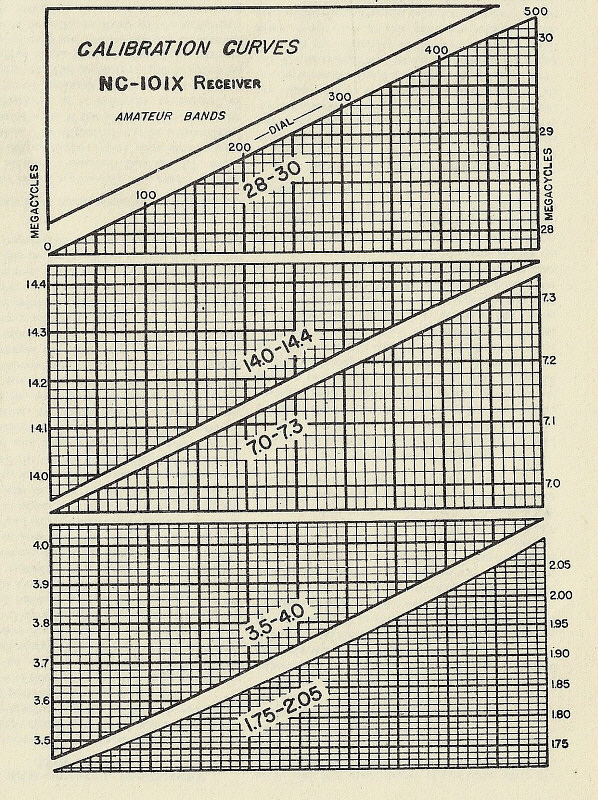
The NC-101X tuned 160M, 80M, 40M, 20M, 10M amateur bands using 400 divisions of 500 divisions of the PW-D. This was exactly as the HRO did with the exception of the 160M band which the HRO didn't band spread. This band spread action gives the operator the impression that the particular ham band being tuned will just go "on and on." The 400 divisions equates to a linear dial over 9 feet long. The Crystal Filter was included on all versions. Note the artwork from the National Co. advertisement from the April 1937 issue of QST shown to the right. This shows the NC-101X with the light grey Index dial, similar to the NC-100X. The earliest versions of the receiver have this PW dial but most NC-101X receivers have the black PW-D, like the HRO Senior. To solidify the image of a ham receiver, the "magic eye" was soon replaced with a true S-meter. The NC-101X was priced at $129 from Allied Radio Corp. in 1939. |
![]() |
| The "Moving Coil" Catacomb - Just as the plug-in coil sets and the PW gear drive and tuning condenser are the "heart" of the HRO design, the "Moving Coil" Catacomb along with its N-PW gear drive and tuning condenser are the "heart" of the NC-100 Series. The Coil Catacomb is a two-piece cast aluminum box containing fifteen tuned coils and their respective trimmer variable capacitors. Each coil is inside a singular chamber that completely shields all of the coils from one another and from the rest of the receiver circuitry. The insulators each have five short, stubby pins that make the contact to the tuning condenser section to complete the tuned circuit. The insulator material is National's brown bakelite mixture called R-39, noted for its superior quality over standard bakelite. Robust in construction, the Coil Catacomb assured that the tuned circuit alignments stayed in adjustment and that receiver stability was solid and consistent of long periods of time. The engagement contacts are located in R-39 insulator blocks that are mounted under the tuning condenser. This allows the connections from these contacts to be very short and accomplished with TC wire. The contacts are dual entry in design allowing the Coil Catacomb pins to enter from either side. This allows the bands to be changed from any direction. |
![]() |
![]() |
The two-piece engagement contacts are insulated from each other and when the connections are soldered on the top side (under the tuning condenser) both sides of the upper part of the contact are soldered together. The exception is the foremost LO contact. Since the LO only requires four connections, the unused contact is wired to act as a screen voltage switch for the RF and IF amplifiers to eliminate noise during band changes on the early models of the receiver. Later models used this contact for the RF amplifier cathode return to "mute" the receiver during band changing. The almost "sealed" nature of the catacomb construction generally protects the coils and trimmer capacitors from damage. Nowadays, most catacomb coils are still in good condition even if the rest of the receiver has not faired so well. |
|
| PW-D Micrometer
Dial - The NC-100 used the same PW-D micrometer dial as
the HRO receiver but with different paint colors. Initially, the NC-100
used a PW-D that had the Index Dial painted a bluish-gray and the Number
Dial was painted red with white numerals. This rather dramatic color
combination went well with the "deco" styling of the metal overlay panel
of the NC-100. Interestingly, for the NC-100X, which was supposed to be
the ham version of the receiver, the PW-D Index Dial was painted light
gray and the Number Dial was painted black with white numerals. This
seemed to be a more conservative appearance that would appeal to the
hams. When the NC-101X version was released, National wanted the
receiver to appear like the HRO, so the standard HRO Senior PW-D was
fitted to that receiver. Some of the advertising photographs of the
NC-101X show it with the light gray PW-D installed but it looks like
most of the actual production used the black PW-D, like the HRO Senior. Internally, all PW-D dials are the same and work by rotating the Number Dial on an elliptic hub. The Number Dial is driven by the Index Dial that is set-screw coupled to the main tuning shaft of the N-PW gear drive. There are two moving parts and seven stationary parts that make up the micrometer dial. Besides the Index Dial (outer dial) and the Number Dial (inner dial) there are two springs that hold the two dials together, three flat-head screws to mount the HRK-style knob to the Index Dial and a single set screw on early versions. During WWII the set screws were increased to two. Elegant in its simplicity, about the only thing that ever goes wrong with a PW-D is caused by technicians who carelessly disassemble the dial and then reassemble it incorrectly. More details on PW-D maintenance will be found further down this article in the "Restoration Hints and Suggestions" section. |
photo above: The early NC-100 PW-D |
| Tubes Used in
the NC-100 Series - Unlike the HRO receiver that continued to
use glass tubes with six and seven pin bases up into WWII, the NC-100
was introduced utilizing octal base tubes with the majority of those
tubes being metal tubes. The eye-tube, the audio output tubes and the
rectifier tube are the only glass tubes used and the rectifier and the
eye-tube are the only non-octal based tubes.
It's interesting that James Millen published a QST letter in 1937 that seemed to condemn the 6.3vac glass tubes used in the HRO in favor of using the even older 2.5vac tubes and yet here was the NC-100 sporting the latest types of tubes available. Many speculate that over-stocking of older parts was the reason for the position that National had on the HRO, although maybe National didn't want to change the design of an obviously superior performer like the HRO. Eventually, in 1945, the HRO was produced with octal tubes and the performance wasn't diminished at all (HRO-5.) |
| NC-100,100X,101X:
RF = 6K7, Mixer = 6J7, LO = 6K7, IF1 = 6K7, IF2 = 6K7, Det = 6C5, AVC
Amp = 6J7, BFO = 6J7, P-P AF Output = 6F6(2), Eye Tube = 6E5, Rect = 80 NC-100A,100XA: RF= 6K7, Mixer = 6J7, LO = 6K7, IF = 6K7(2), Det = 6C5, AVC = 6J7, BFO = 6J7, P-P AF Output = 6F6(2) Rect = 80 NC-101X (late,)101XA: RF= 6K7, Mixer = 6J7, LO = 6K7, IF = 6K7(2), Det/NL = 6C8, BFO = 6J7, 1st AF/ AVC = 6F8, AF Output = 6F6(2), Rect = 80 NC-80, NC-81X: Mixer = 6L7, LO = 6J7, IF = 6K7(3), Det = 6C5, AVC = 6B8, BFO = 6J7, AF Output = 26L6, Rect = 25Z5 NC-200: RF = 6SK7, Mixer = 6K8, LO = 6J5, IF1 = 6K7, IF2 = 6SK7, Det/NL = 6C8, AVC = 6SJ7, BFO = 6SJ7, 1stAF/Phase Inv = 6F8, P-P AF Output = 6V6(2), Rect = 5Y3 NC-240D: RF = 6SK7, Mixer = 6K8, LO = 6J5, IF1 = 6K7, IF2 = 6SK7, Det/NL = 6SL7, AVC = 6V6, BFO = 6SJ7, 1stAF/Phase Inv = 6SN7, P-P AF Output = 6V6(2), Rect = 5Y3 NC-100ASD: RF = 6K7, Mixer = 6J7, LO = 6J7, IF = 6K7(2), Det/NL = 6C8, 1st AF/AVC = 6F8, BFO = 6J7, AF Output = 6V6, Rect = 5Z3 RAO: RF1,2 = 6K7(2), Mixer = 6J7, LO = 6J7, IF = 6K7 (2), Det/NL = 6C8, BFO = 6J7, 1st AF, AVC = 6F8, AF Output = 6V6, Rect = 5Z3 RBH: RF = 6K7, Mixer = 6J7, LO = 6J7, IF = 6K7(2), Det/NL = 6C8, 1st AF/AVC = 6F8, BFO = 6J7, AF Output = 6V6, Rect = 5Z3 Airway Receivers: RF = 6K7, Mixer = 6J7, LO = 6J7, IF = 6K7(2), Det = 6C5, AVC = 6J7, BFO = 6J7, 1st AF (Squelch) = 6C5, AF Output = 6V6, INS Control = 6J7, Rect = 80 |
| NC-80X and
NC-81X - In October 1937, National introduced a
scaled-down version, "moving-coil" receiver, the NC-80X. The receiver
didn't employ an RF amplifier stage but moved the IF up to 1560kc which
National claimed put the image frequencies "so far apart they can be
effectively rejected without a preselector." To further keep
manufacturing costs low, the receiver was an AC-DC type using series
filaments and no power transformer. An improved Crystal Filter was
utilized as were three IF amplifier stages. Additionally, the slide-rule
dial featured a mirrored scale to eliminate parallax and a two-speed
tuning control. Like other radio receivers of the time period, the
tuning knob would tune at a 16:1 ratio when tuning to a station and then
when the direction of rotation was reversed the tuning rate would be
80:1 for approximately half a revolution of the knob in either direction
allowing "fine tuning" of the desired station. Four tuning ranges were
used for coverage of .55mc to 30mc and the receiver used 10 tubes. National also introduced a "ham bands only" version of the receiver which was designated as the NC-81X. This receiver increased the number of tuning ranges to five so that 160M, 80M, 40M, 20M and 10M could be covered. This also required a different catacomb than the NC-80X used. A band indicator was provided on the right side of the dial that pointed to the band in use. Selling price for either the NC-80X or the NC-81X was $88 and the receivers were available from 1937 up to 1939. photo right: NC-80X from QST ad October 1937 |
![]() |
|
Airway Communication Receiver Versions |
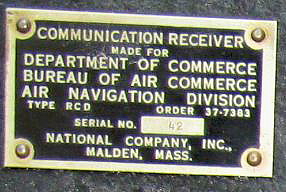
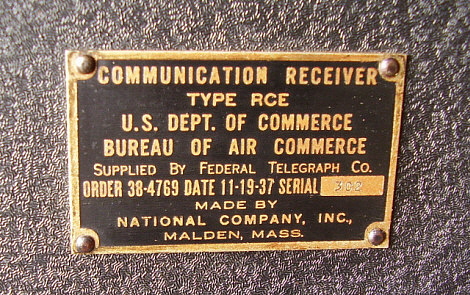
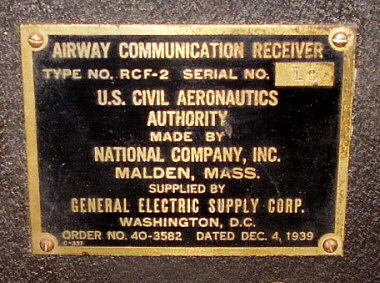
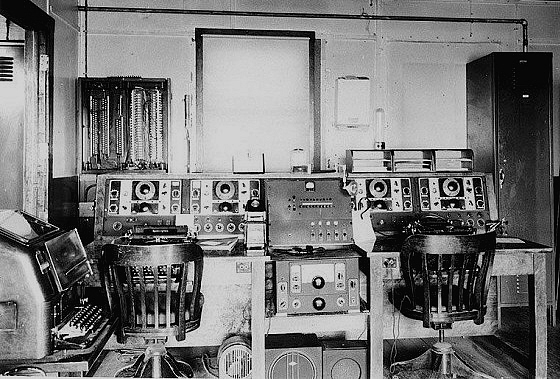
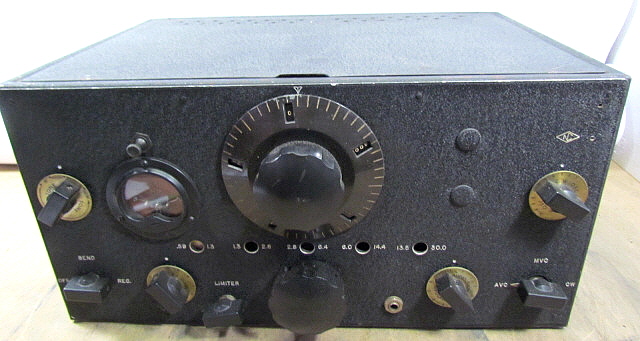
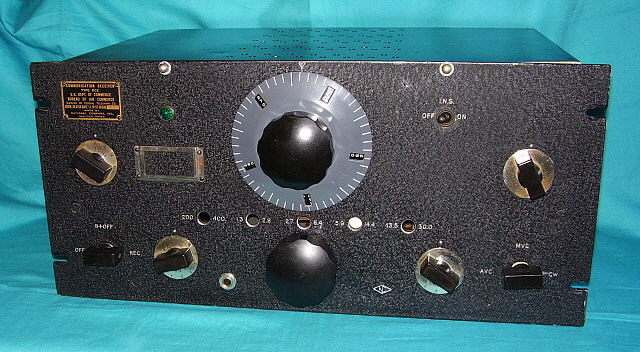
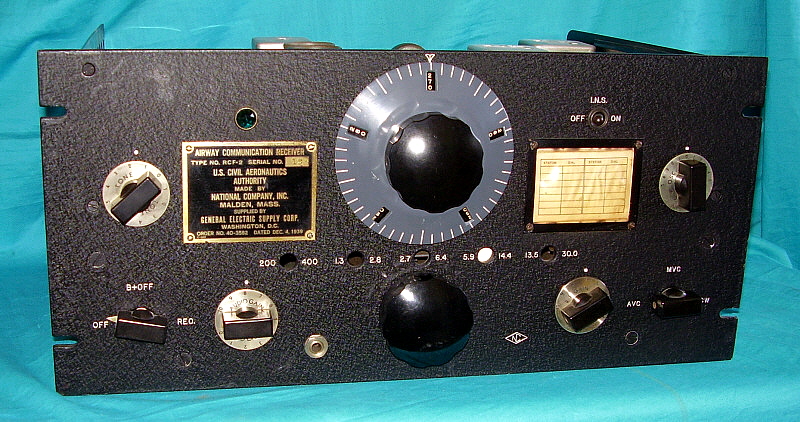
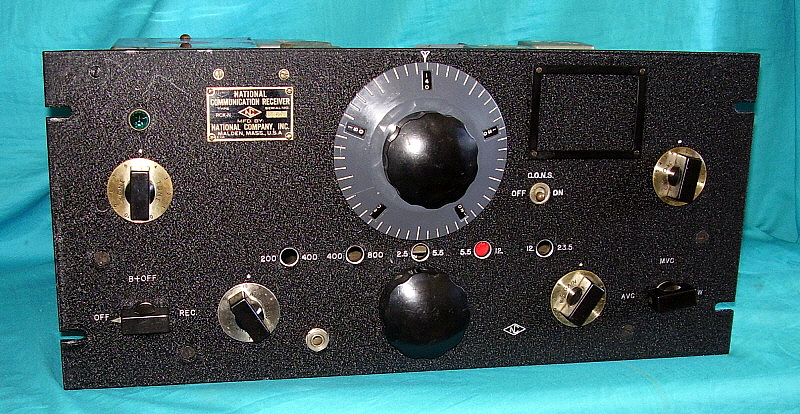
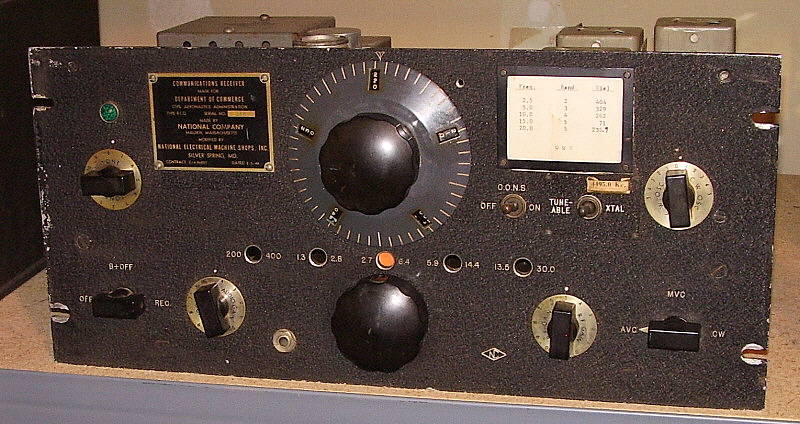
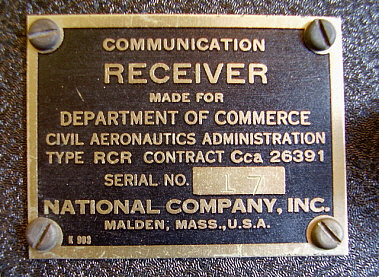
Starting in 1937, National began supplying somewhat modified NC-100 receivers for use at airports for tower communications and for other purposes in aviation communications and monitoring. The continuing improvement of airport to airplane radio communications along with improved radio-based navigation equipment had actually started much earlier when the Department of Commerce and the Bureau of Air Commerce were in charge of airports, airport communication and air navigation. The first National receiver specifically for airport communications was the RHM, a superheterodyne (National's first) supplied in 1932. The first NC-100-based receiver was designated the RCD and it was essentially a rack mounted NC-100X with a frequency coverage that was altered to remove the AM BC coils and replace them with coils to cover 200kc to 400kc. These initial airport receivers used a 3/16" thick aluminum panel that was black wrinkle finished along with retaining the Crystal Filter and the cathode ray tuning indicator. By 1938, the U.S. Civil Aeronautics Authority, the CAA, had taken over the responsibility for airports and air communications. By this time, the Airport receivers had additional circuitry added to further adapt them to airport communication requirements. Most of the CAA Airport versions used 12 tubes, had no Crystal Filter and no carrier level indicator. The audio output was changed from Push Pull tubes operating an output transformer mounted on the electro-dynamic speaker of the "civilian" models to a single audio tube with an output transformer internal to the receiver which allowed PM speakers to be used. The power supply was slightly modified to include an extra filter choke since the field coil of the ED speaker wasn't available for that function. The typical CAA receiver used a 3/16" thick aluminum front panel painted black wrinkle finish with engraved nomenclature. A black PW-D was usually fitted to these receivers but gray PW-D dials were also commonly used. IF was usually 457kc. Some later versions may be found that were professionally modified to include variable coupled IF transformers or a later version Crystal Filter. Many of these upgrades were incorporated by professional companies in the post-WWII period. >>> |
>>> Most CAA versions will have a squelch added
although this is referred to as the Interchannel Noise Suppressor, or
I.N.S., which was activated by a front panel toggle switch. The I.N.S.
circuit used a 6J7 tube that was operated from the 6J7 AVC tube and when
the AVC bias voltage was being driven negative by lack of a signal, the
I.N.S. tube would bias off the 1st AF Amplifier tube (6C5) which reduced
the audio output to a very low level. Although the I.N.S. could be
adjusted to "full squelch," National recommended that the I.N.S
"suppression" be set
to allow a very slight background noise to be just audible and then when
a desired signal was received the I.N.S. would provide a "normal" audio level. The I.N.S.
is adjusted with the two potentiometers that are mounted at the rear of
the chassis directly behind the tuning condenser. Although, typically the
eye-tube of the standard NC-100 or other type of carrier level measuring
device was not used on the CAA receivers at least one example
has turned up with a National S-meter that appears to be a factory
installation.
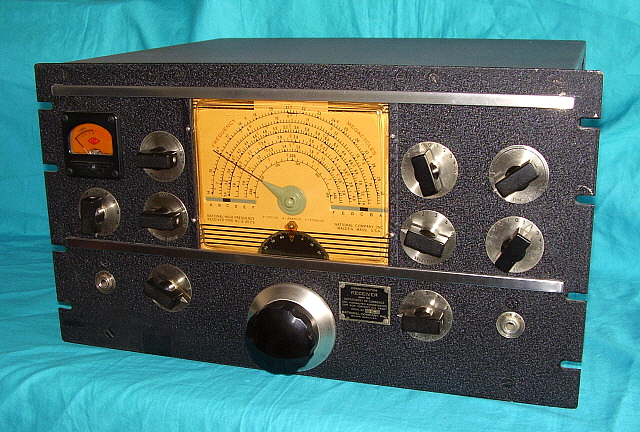
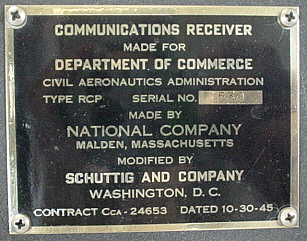
The audio output was rolled off at 3000 Hz by using an in-circuit audio filter that is between the output of the first AF amp and the input of the 6V6 audio output tube. National felt that the necessary voice characteristics that affect intelligibility are all contained in the audio frequencies below 3000 Hz. As with military versions of National receivers, the P-P audio was replaced with a single-ended audio output tube and an internal output transformer provided 600 Z ohm output along with a Hi-Z audio output (20K Z ohm.) The phone jack on the front panel is a 600 Z ohm output. Some versions had an internal relay that operated on 6vdc (supplied externally) to disconnect the speaker but not affect the headset output. A single loud speaker was supplied and also a rack mounted dual speaker assembly was sometimes supplied. Some versions also had remote control available for RF and AF Gain functions. Some versions had a dual fused AC line input while others have a HI AC or LO AC primary on the power transformer which is selected by which fuse clips are used in a dual fuse holder. All versions used oil-filled paper dielectric filter capacitors and have two filter chokes. The early versions of the Airway Communication Receivers were designated as RC followed by a letter identifying the receiver type. Most designation letters run from D up to Q (though not inclusively.) After WWII, many of the earlier versions were modified into the RCP and the RCQ versions. Most RCP modification sets date from around 1948 and the rework was done by companies other than National Company. Schuttig & Co. was one of the contract rework companies commonly used for the RCP rework. |
|
|
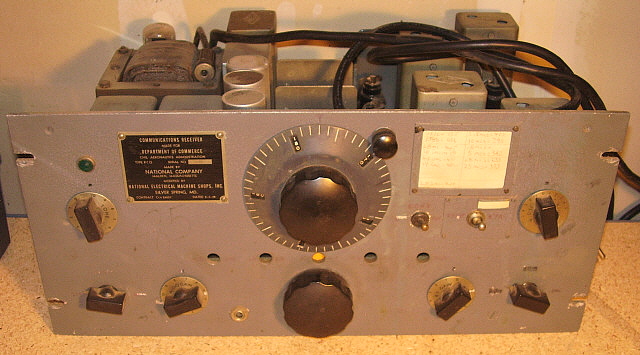
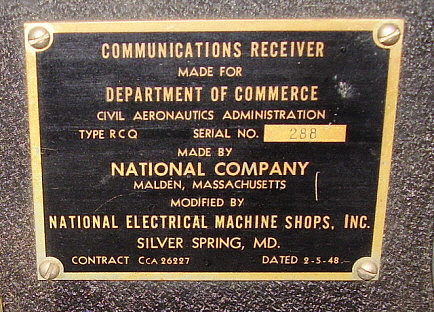
![]() photo above: RCQ receiver modified in 1948 to add a Crystal Filter. The RCP and RCQ versions are later modifications of earlier versions of Airport receivers. These modifications or upgrades usually were performed professionally and were usually post-WWII era. This modification was performed by NEMS, National Electrical Machine Shops (formerly NESCO pre-1937.) - photo: from eBay |
|
![]() |
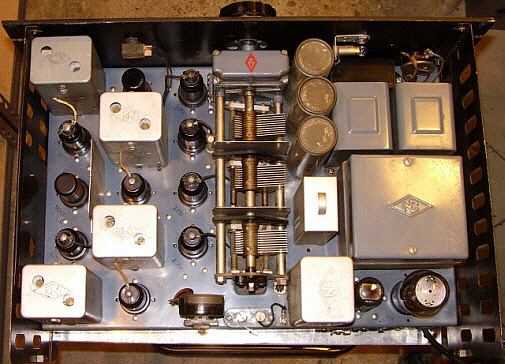
| Shown in the photo to the right is the RCF-2 sn 13 top of the
chassis showing some of the differences the "Airport Receivers" have.
The small cover with the handle on top (next to the power transformer)
protects the
relay that is used for remote silencing of the speaker. Note the extra tubes to the
left of the gear box. These are for the "I.N.S." (6J7) and First AF
Amplifier (6C5) functions. Also, note the single 6V6 audio output tube next to the 80
rectifier tube and the relocation of the audio output transformer to the
other side of the tuning condenser. The
antenna terminal insulator is the later polystyrene type and next to the
antenna terminals are the two potentiometers that adjust the "I.N.S."
threshold and suppression.
Due to the continued use of the National Airway Communication Receivers by airports over a long period of time it's common to find the receivers in poor condition and with several modifications that probably aren't documented. Modifications were usually to upgrade the earlier receivers to later versions and these modifications are professional in quality and normally the work was performed by well-known companies. But the mods still may not be well documented. It also appears that the data plates were sometimes removed on the receivers for various purposes. Removal of a data plate might have been necessary to incorporate the upgrade or sometimes data plates were removed by later "ham owners" just to make the receiver look "newer" and not a military or commercial surplus unit. It's likely that many of the Airway receivers found today will be somewhat incomplete. Certainly the "slide on" dust cover is often times missing as is the frequency chart. Luckily, the frequency chart frame is identical to the HRO chart frames found on the HRO coil sets. |
![]() |
|
NC-100A Versions |
|
|
By mid-1938, the use of an indirect-readout device such as
the PW-D probably accounted for more than a few complaints from casual users who had to constantly refer to the
manual for a graph that provided frequency versus dial readout
correlations. Perhaps the expense of the micrometer dial itself was also
a consideration. The competition's direct-readout dials also could have
factor that resulted in National
revamping the entire NC-100 line to replace the PW-D micrometer dial with a
direct readout illuminated tuning dial. The suffix "A" was added to all
NC-100 receivers that had the new dial installed. For sometime, the
NC-101X was available with either the micrometer dial or the "A" version
dial. After all, it was a ham receiver and many hams enjoyed the
correlation exercises involved with using the PW-D.
One of the interesting features of
the new "A" version dial was its articulated pointer. When the band was
changed, the dial pointer would automatically increase or reduce its
apparent length so that its red tip would line up with the selected
band's tuning scale, thus indicating the "band in use." This required
the pointer "lifter" mechanism to track the tuning while maintaining the
proper length of the pointer. A dial cord that was anchored to the
band changing shaft and then routed via a pulley system to pivot against
the tuning condenser drive shaft so that the action of tuning the
receiver didn't affect the apparent length of the pointer while it
tracked around the dial. The
pointer-lifter mechanism and the entire articulation system seemed
overly complex
for the simple task of a band indicator. Small wonder that during WWII
this feature was eliminated and replaced with an indicator dial mounted
to the band change shaft. Initially, the dial cover was a pane of
glass. Later military versions had the glass
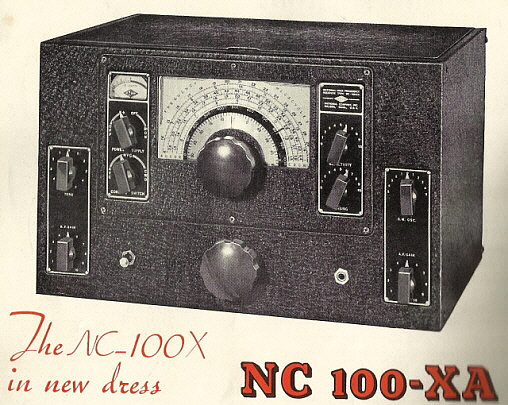
replaced with plexiglass. photo left: National ad for the new NC-100XA from June 1938 QST |
| In addition to the new tuning dial,
the cabinet itself was increased in height from the nine inch height of
the NC-100 to ten and a half inches of the NC-100A. A
"behind the panel" S-meter was installed on
all versions now. A push-pull switch allowed disabling the S-meter when CW was being received, just like the HRO receiver.
When the S-meter was installed, the total tube count of the NC-100A was
reduced to eleven tubes since the cathode ray tuning eye tube was
removed.
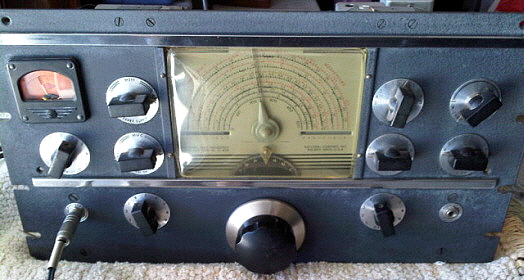
A Crystal Filter was added to the NC-100A with the designation changed to NC-100XA. Some of the controls were moved with the addition of the Crystal Filter. The S-meter switch was moved from adjacent to the meter to the lower part of the panel. Different nomenclature was required so the small panels were changed to reflect the additional controls needed on the "XA" version. The selling price for the NC-100XA was $147.00 from Allied Radio in 1939. Throughout the NC-100A production, the circuit went through several minor changes. Later in production, an adjustable Noise Limiter circuit was added. The NL circuit added another tube and brought the total tube count up to twelve again. Also, with the NL addition, the location of some of the controls was rearranged. The Audio Gain control was changed to a standard grid input and the Tone control was changed to an RC type control which eliminated the audio choke that was used in the earlier versions. Some of the NC-100A versions featured a "weighted" tuning knob that added a fly-wheel affect to tuning the receiver. The weighted knobs are not found on military versions. photo right: The 1941 NC-100ASD without the Crystal Filter |
![]() |
| NC-200, NC-240
& NC-240D
- In 1940, many of the communications receiver manufacturers decided
that their models needed some modernization. In most cases this was more
cosmetic than anything to do with the circuitry, which usually was in a
constant "up-dating" mode anyway. Gray seemed to be the "hot" color for
gear and many manufacturers were offering their products in either gray
or black. National decided to not only go for a color change in a
two-tone scheme with chrome trim but to add
some substantial circuit changes to their new model, the NC-200.
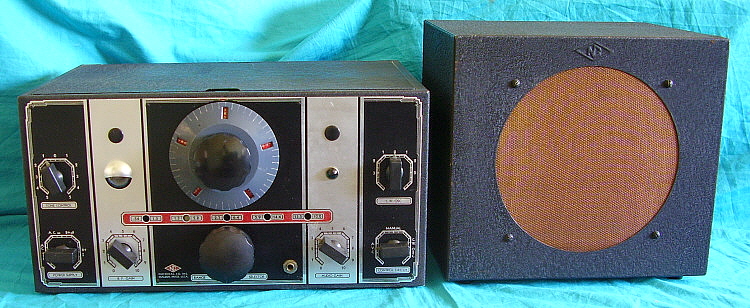
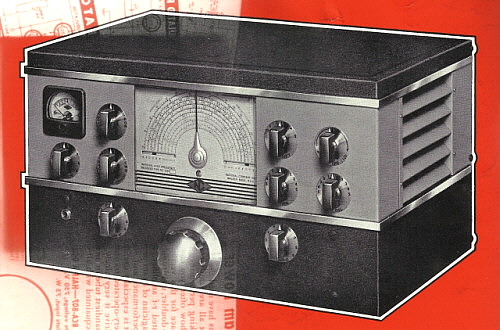
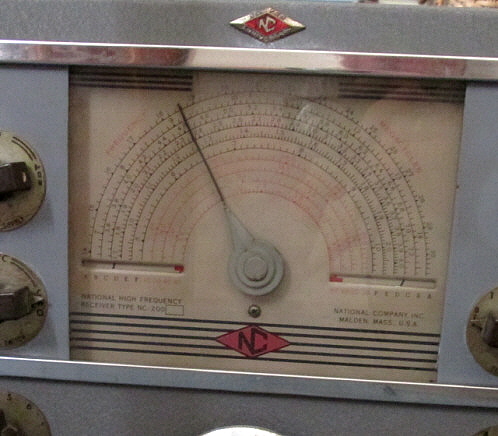
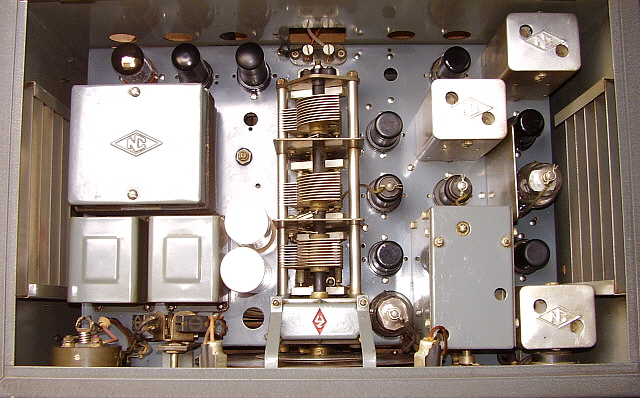
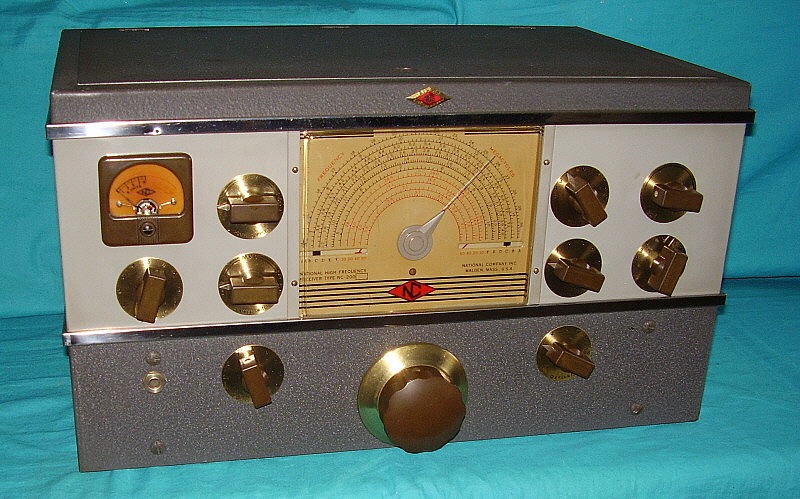
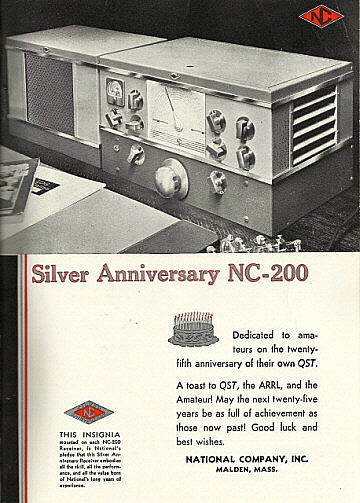
Along with the cosmetic changes, the NC-200 presents another change in the catacomb design (the first was the NC-80.) By reducing the size of the chambers for the coils and trimmers, another band could be squeezed in. The NC-200 featured six tuning ranges. Additionally, what would be better than to also offer the same sort of band spread that was available on the NC-101X receiver. With the NC-200, the operator had general coverage from the AM-BC band up to 30MC and separate band spread coverage of the 80, 40 20 and 10 meter ham bands. Also, why not make the tuning knob double for the band changing. By pulling out in the tuning knob the tuning dial is disengaged and the pinion gear is the engaged into the rack of the coil catacomb allowing the band to be changed. Since there are six main tuning ranges between each of these ranges four band spread ranges can be selected. Turning the knob one revolution selects the general coverage coils while rotating the knob about a quarter of a turn within the one revolution selects the band spread set of coils. The NC-200 replaced the articulated dial pointer and went with a separate dual flag-type indicator that pointed to the scale-in-use on the tuning dial. |
Tubes were changed with the most obvious being the push-pull 6F6
audio output tubes replaced with 6V6 tubes in push-pull. A closer look
shows that the interstage transformer coupling used in the NC-100 Series
was replaced with a phase inverter circuit. Single-ended tubes like the
6SK7 are used as the RF amplifier and one of the IF amplifiers. The 80
rectifier was replaced with an octal 5Y3 tube. National released the NC-200 just before WWII began and though it sold well, it wasn't in production all that long before changes had to be incorporated to make it acceptable for the military. First to be eliminated was the amateur band spread function. This was initially referred to as the NC-200FG. Soon, the NC-200 became the NC-240CS which was essentially the NC-200 without band spread. A few minor changes involved the S-meter style and the return of the type 80 rectifier tube. The NC-200 and the NC-240 were built through WWII and it's possible that just after WWII a few NC-240CS receivers were sold to the post-war civilian market. National quickly returned to the band spread option and the receiver then offered was designated the NC-240D. The NC-240D was sold from 1946 up to 1949. It was the last of the moving coil catacomb receivers produced by National. |
![]() |
photo left:
The 1940 NC-200 as shown in a National advertisement in the November 1940
issue of QST magazine. Models produced during WWII will have a round S-meter and
no bandspread capabilities.
photo right: The 1948 NC-240D, in this case, a rack mount version. The post-war models returned to the amateur band spread feature that was lacking in the NC-200FG and the 1946 NC-240CS. The 240D was produced up to around 1949 or so. Photo from eBay. |
|
|
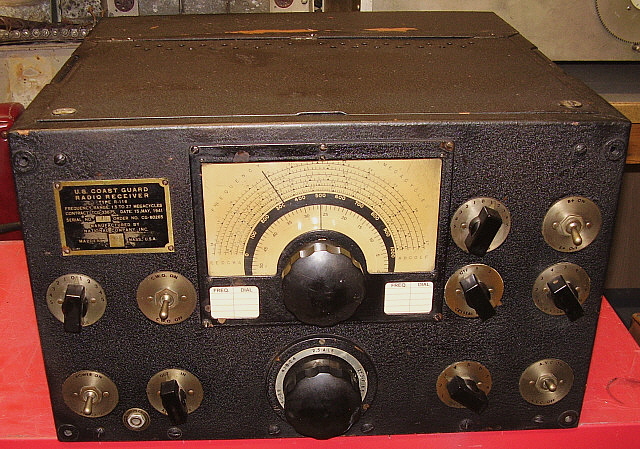
WWII Versions WWII had broken out in Europe and the U.S. military knew that much of their radio equipment was obsolete and needed to be replaced. The U. S. Army Signal Corps ordered NC-100ASD receivers with 200kc to 400kc coverage instead of the AMBC band. The U. S. Navy ordered the NC-100XA which became the RAO series (along with several similar versions, e.g. RBH and others.) The second version of the RAO added a second RF amplifier for reduction of Local Oscillator "leakage radiation" on the antenna with the added benefit of reducing images and increasing sensitivity. By the end of WWII, thousands of RAO receivers had been produced by National and contactor Wells-Gardner. |
|
|
U.S. Navy RAO & RAO-1
- National began
supplying the U.S. Navy with the NC-100A as early as 1940. Designated as RAO,
the first versions are somewhat similar to the standard NC-100XA
receivers. Initially, the RAO circuit used was the standard NC-100XA
although it's likely that a 500 Z ohm audio output transformer was
incorporated into the circuit along with power supply modifications. This was standard procedure for Navy
receivers. In fact, the civilian NC-100A receiver used a field coil
type speaker and push-pull audio output, neither of which the Navy would
have wanted on their receivers. Consequently, the RAO and the RAO-1 should have
single-ended audio output along with an extra filter choke to take the place
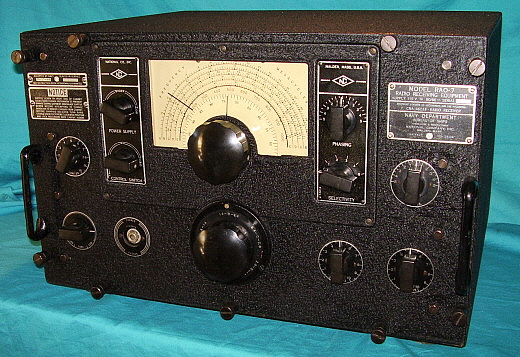
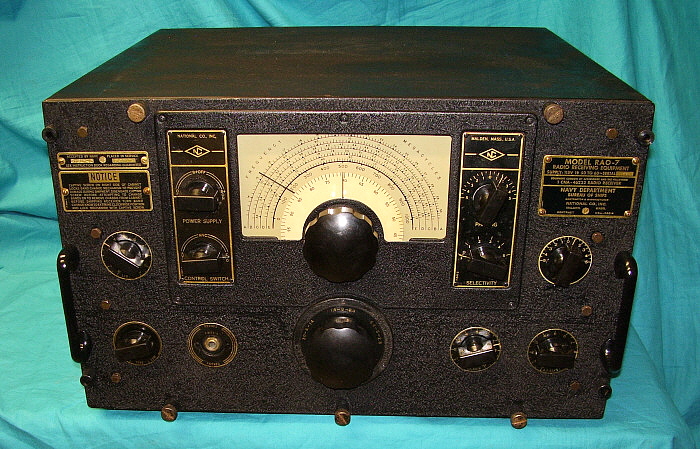
of the "speaker field coil used as a choke." RAO-2 - When WWII began, the Navy wanted minimal radiation from the receiver's Local Oscillator appearing on the antenna. This was primarily to allow the receiver to be used in the presence of other shipboard radio equipment without interference. There was also the remote possibility that an enemy could "Direction Find" (DF) the radio's position from receiving the LO signal. It would be possible to also discern at what frequency the receiver was tuned. Prior to WWII, many of the Regenerative Medium Wave receivers used on commercial ships could easily be received at a distance of five miles or more - and this was from other commercial ships, not the enemy! The Navy believed that if the Germans put their minds to it, they could probably receive and DF inadvertent LO leakage radiation from some types of superheterodyne receivers up to 100 miles away. >>> photo left: 1944 RAO-7 sn:10 built by National Co., Inc. |
|
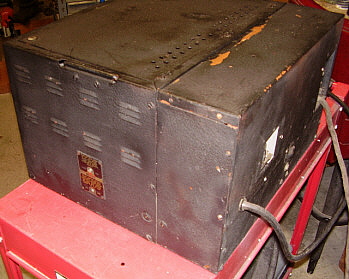
>>> Consequently, the Navy came up with a specification of <400pW as the maximum of LO energy could appear on the antenna. This assured that the receiver would not cause interference and it would be impossible to receive the LO leakage radiation at any distance away from the ship. Beginning with the second of the numbered suffixes, the RAO-2, National added an extra RF Amplifier with an additional coil catacomb and tuning condenser housed in a bolt-on rear chassis and bolt-on cover. The extra RF Amp provided the isolation necessary to keep the LO radiation on the antenna below the designated level of <400pW. This addition increased the depth dimension by about four inches and increased the weight significantly, running the scale up to about 75 lbs for most of the later RAO receivers (see photo of the underneath of the RAO-3 chassis below.) The dial scale background was changed from silver to off-white paint and the articulated dial pointer was eliminated. Instead, a rotating dial mounted to the band change shaft indicated which tuning range is selected. RAO-2 and some RAO-6 receivers had an ID from National of NC-120 on the control panel for the Crystal Filter (along with the National Co. identification and the "NC" diamond insignia.) The early RAO receivers (pre-RAO-7) are 17.5" wide, with an integral panel-cabinet-chassis construction that requires major disassembly if more than tube replacement or alignment is needed. These early versions of the RAO used a cradle-type shock mount that is seldom found with the receiver today. Note in the photo to the right that the RAO receiver and the RBL receiver both are mounted in their proper cradle-type shock mounts. |
|
|
|
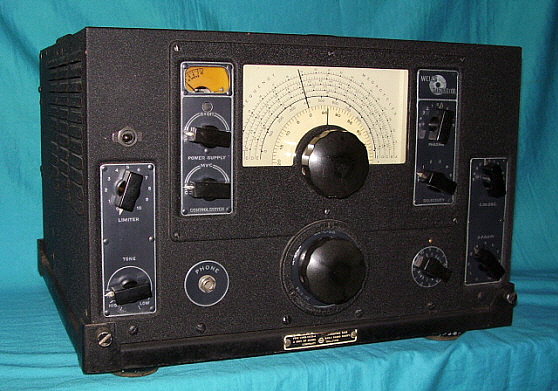
RAO-3, 4 &
5 - Most WWII equipment was
built under contract and not all RAOs were built by National.
Wells-Gardner Company (Chicago, IL) was the second contractor for the RAO series,
building the RAO-3, 4 & 5. The Wells-Gardner versions were generally
intended for shore stations and were not considered "heavy-duty
military-type" construction by the Navy. All W-G versions have the extra RF
amplifier for double preselection and all versions have S-meters
installed. Though W-G used National Co. parts, where specified, many other
components and some shielding was strictly W-G manufactured. The IF
transformers, power transformer, chokes and the chassis all appear to be
W-G components while the knobs, dial, tuning condenser and coil catacomb
were definitely from National and were even marked so. The Crystal
Filter panel was marked with the WELLS-GARDNER logo and name. The RAO-3
operated on 115vac only while the RAO-4 and 5 had a dual primary power
transformer to allow operation on either 115vac or 230vac.
Interestingly, the W-G versions of the receiver had embossed "feet" on
the bottom cover that allowed using the receiver on a table top without
the shock mount assembly. The "feet" were specifically intended for
shore use only and is also probably why so many W-G versions are found
without the shock mount assembly today. Also today, many W-G RAOs
show up without data plates. It doesn't appear that they were removed -
they were just never installed. It's possible that W-G did have
many of the RAO receivers unshipped when WWII ended and they merely "dumped"
them on the surplus market, which would account for the large number of
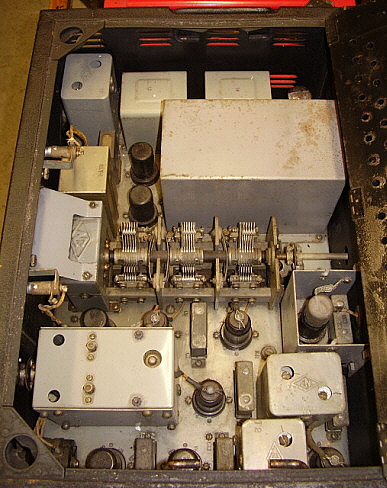
W-G RAOs found without data plates or shock mounts today. The photos below show the chassis of the RAO-3 version of the receiver. The top of the chassis (left photo) shows that though many parts are from Wells-Gardner the main components are made by National. Note the small shielded box for the antenna input next to the First RF tuning condenser. This was one of the first attempts to reduce the LO leakage. |
![]() |
The photo to the right shows underneath the chassis of the RAO-3. Note how the 1st RF Amplifier section consists of a "bolt on" chassis and utilizes a smaller catacomb that contains the 1st RF Amplifier coils for the five tuning ranges. The mechanical coupling from the main catacomb to the smaller catacomb is through a slot in the rear of the main chassis and a matching slot in the smaller chassis. On top of the bolt-on smaller chassis is a single tuning condenser that is mechanically coupled to the main tuning condenser which can be seen in the photo to the right. The 1st RF Amplifier tube is housed in a small metal box that is mounted to the inside rear wall of the main cabinet with a shielded harness to make the connections to the tube socket. This small box also has a top cover for shielding of the entire box. To complete the shielding, the bottom of the chassis is covered by two plates as can be seen by the mounting flanges on each of the boxes. Note that W-G used a different cover for the power transformer. The RAO-3 shown in the photos was in poor condition and its clean-up and restoration has removed much of the silk-screened nomenclature on the various components. See the photo below of the interior of the RAO-7 for the typical IDs found on chassis components in the RAO Series. | ![]() |
|
photo above: The top of the RAO-7 chassis showing the improvements to shielding and the addition of a panadapter output - the SO-239 connector. |
RAO 6, 7 & 9 - National continued on with the Navy contracts building the RAO-6, 7 & 9 (the designation RAO-8 was apparently not used.) These receivers were of robust construction and had increased shielding to further allow their use with other shipboard equipment without interference. The audio output Z was changed to 600 ohms with the later versions. The RAO-7 & 9 eliminated the S-meter in favor of panadapter connections. The early RAO-6 receivers had S-meters but later production receivers did not. The later RAOs (7 & 9) simplified the maintenance of the receiver by designing the chassis so that it was easily removable from the cabinet (handles were added to the receiver front panel to assist removal.) The cabinet itself was redesigned for better shielding and easier mechanical construction by making it a one piece unit and, though some later cabinets did have lids, most did not. While the early RAOs used a separate shock mount system but the new cabinets mounted the shocks directly to the bottom of the cabinet further easing construction and maintenance. The RAO-7 & 9 receivers are physically larger than the earlier versions with full 19" rack width panels although the receivers are not specifically designed for rack mounting. Electronically, there is no difference between the RAO-7 and the RAO-9 with the exception that the RAO-9 has two RF amplifier inputs have an RC filter between the grid and the coil selected. This RC was a low-pass filter to keep VHF radar from interfering with the receiver's operation onboard ship. The photo to the left shows the top of the chassis of the later RAO receivers, this one is an RAO-7. Note the large and completely shielded RF input box. The SO-239 connector to the left is for the panadaper input. Note that the separate chassis for the 1st RF catacomb is still in use. The side panels provide rigidity for the chassis since it is now mounted in a complete cabinet rather than the sheet metal "pieces" that make up the earlier type cabinet. Performance - All of the versions of the RAO receivers have impressive sensitivity and stability. Dial accuracy is usually quite good given that the resolution is limited. The tuning rate, which is standard for the National NC-100XA Series, seems fairly fast but it's still easy to tune in CW signals and SSB can be "fine tuned" using the BFO control. The audio output was modified for the RAO series to eliminate the P-P output in favor of a single audio tube stage that was primarily designed for CW reception using earphones. Audio output of the RAO, especially the later versions, will have the bass rolled off significantly since this enhanced the copy of CW signals. AM signals will be significantly lacking in bass response. Stability is very good with very little drift after a 15 minute warm-up. The RAO does provide a remote standby so it's easy to set one up for a vintage military radio station. As a station receiver the RAO will have great sensitivity, reasonable selectivity, good stability and fair audio. I've used both the RAO-3 and the RAO-7 as station receivers with good results. |
|
The RBH Series - RBH was the Navy designation for the NC-156 receiver, a 10 tube superhet that covered 300kc to 1200kc and 1700kc to 17mc in five bands based on the NC-100XA. To allow continuous coverage of the 300kc to 500kc range the IF operates at 1500kc (which is why there is a gap in the tuning from 1200kc to 1700kc.) The initial RBH receivers will have "NC-156" on the National Co. nameplate (part of the crystal filter panel.) The first RBH receivers date from around 1940 and will have the typical modified audio outputs, this is, single-ended audio output stage driving a 500 Z ohm output transformer. The later versions of the RBH receivers were modified for use at sea. All of the RBH series with number suffixes starting with RBH-2 have an additional stage of preselection added with a bolt-in chassis and cabinet to house the additional catacomb section for the coils and an additional tuning condenser for tuning the stage. This addition was very similar to the RAO receiver change and was for the same purpose of reducing the LO radiation from the antenna (>400pW on the antenna.) Like the RAO, the dial system changed on the later RBH receivers, eliminating the articulated pointer and painting the background white rather than silver. The last of the RBH receivers incorporated the same improved cabinet of the later RAO receivers. The early RBH receiver shown in the photo to the right unfortunately has had all of its Navy tags removed. Sometimes tag removal was a requirement for sales of surplus equipment but more often the new owner wanted visitors to the shack to think his receiver was a new purchase of civilian equipment and not surplus military gear. Performance - When operating an RBH today, strong AM-BC stations around 1500kc might resonate with the RBH's 1500kc IF amplifiers and can cause strong heterodynes when tuning in stations or, if the 1500kc AM-BC station is particularly strong, it may dominate the IF system of the RBH. A 1500kc wavetrap on the antenna lead-in will usually cure any serious problem. |
|
| Miscellaneous U.S.N. Versions - Some of the early RAO series are also marked as NC-120 on the Crystal Filter panel. This generally appears on RAO-2 and some RAO-6 receivers only. NC-156 appears on early versions of the RBH receivers with this designation appearing also on the Crystal Filter panel. The NC-127 was a component receiver of a triple diversity set-up that was designated as NC-127D. The NC-127 is very similar to the RAO-7 receiver with additional outputs on the rear panel for diversity hook-ups. According to Raymond Moore's book, "Communications Receiver's," only one NC-127D was built and therefore probably only three NC-127s were built. |
|
|
U.S. Army Signal Corps
NC-100ASD - The NC-100ASD was built for the Signal Corps
around 1940 and up into WWII. The Signal Corps wanted their version of
the NC-100A to cover 200kc to 400kc in addition to 1.3mc up to 30mc.
Since the size of the catacomb was more or less fixed at being able to
accommodate five sets of coils, National had to remove the AM BC coils
in order to have the 200kc to 400kc tuning range. Additionally, the
Signal Corps had no use for Push-Pull audio output, so a single-ended
6V6 is installed. Also, a second filter choke is installed in the power
supply to take the place of the electro-dynamic speaker's field coil
(acting as a choke and electromagnet.) Another change was to the audio
output which on the standard NC-100A had the audio output transformer
mounted on the speaker was replaced with a single plate Z to 500 Z ohm
transformer mounted in the receiver. This allowed the speaker to be
connected with just a two conductor cable. A matching speaker was
included with the NC-100ASD and it was very similar to the standard 8"
National speaker box but with the 500 Z ohm matching transformer
connected to the 8 Z ohm speaker. No special tags are usually found on
NC-100ASD receivers. Most units will have Signal Corps acceptance stamp
on the back of the cabinet. Performance - The NC-100ASD is just about as close to the civilian NC-100A as the military got. Like all of the military NC-100s, the ASD has oil-filled paper dielectric filter capacitors, so many will work fairly well on all original parts. Calibration is usually very good on the receivers that are in excellent condition and were stored carefully. Many ASD versions were available post-WWII as surplus and were used in many 1950s ham stations quite successfully. |
|
Serial Numbering on the NC-100 Series |
| Serial Number Formats Used - Serial numbers on early NC-100 receivers appear to be the same kind of format used on other National receivers at the time. This consists of a letter that identifies the production run and a number that identifies the specific receiver within that production run. When the NC-100 was introduced in 1936, the HRO receiver was still using serial numbers that consisted of a letter prefix followed by a number suffix. Probably to keep the two receiver type serial number formats obviously separate, the NC-100 serial numbers began with a number prefix followed by a letter suffix. However by 1938, the HRO had used all of the letter prefix serial numbers and then began to use a letter suffix combination, like the NC-100. When the NC-100 series used all of their letter suffix numbers, National switched formats with the serial numbers then using a letter prefix which is seen mainly on the NC-200 series (1940.) During WWII, serial number formats vary somewhat but usually follow the letter prefix format. Often times, the serial number is only found on the particular receiver's data plate. Normally, if the serial number is on a data plate it will just be a number with no letters. Post-WWII serial numbers follow National's change in format to a seven digit serial number that consists of a three digit production run ID followed by a space that is then followed by a four digit number that identifies the receiver. | WHRM Serial Number Log for
NC-100 Series Receivers - In an effort to see what kind
of serial numbering National used on the NC-100 Series, WHRM is starting
up another serial number log. These logs are very effective at providing
production quantity information and year of manufacture information
after a fairly large quantity of serial numbers have been collected.
When providing a NC-100 Series serial number for our log, please be sure
to let me know the model of the receiver that the serial number belongs
to. Also, note any characteristics that will help in determining the
manufacturing year. Also, note any unusual production changes or
professionally installed modifications. See the log below for some of
the identifiers and details we're looking for.
After enough numbers have been collected it may become possible to deduce from the serial number what model receiver it belongs to. Certainly, dating the year of manufacture will become possible. Please send your NC-100 Series receiver serial numbers to this e-mail: |
|
|
Serial Number Locations:
Generally, on the early versions of the receivers the serial number is
stamped into the chassis top usually in front of the antenna terminal
insulator between the rear of the tuning condenser and the front of the
antenna terminal insulator. The serial number will appear upside down if
you look at it from the front of the receiver with the lid lifted. See
photo left for NC-100 Series SN location. When the larger rear mounting
flange was used on the tuning condenser, the serial number was moved
closer to the antenna terminal insulator and more towards the audio
output tubes. See photo right for location on the later NC-100 Series and
NC-200 Series receivers. During WWII serial number locations vary and sometimes appear only on the data plate of the specific receiver. This also applies to the Airport receivers, the serial numbers are usually only on the data plate mounted on the front panel. With the NC-240 series, the serial number is stamped on the top of the chassis on the right side edge midway back. Note that with the NC-240D, the serial number is a seven digit sequence that incorporates the production run identification into the first three digits and the receiver identification into the last four digits. |
photo above: SN location on the NC-200 receiver showing that the placement of the stamped SN has been moved because of the larger mounting flange used on the newer tuning condensers. |
NC-100 - 334-D (thin dividers TC*, brass hubs), 341-F (rack mount, no alum overlay on panel, eye tube), NC-100X - 227-D, 435-D (has original rack mounting brackets), 216-E (early TC), 253-E, 99-J, NC-101X - 62-E, 217-F, 365-G (S-meter),184-N (S-meter, thin dividers TC, brass hubs TC), NC-80X, NC-81X - NC-100A - NC-100XA - 58-R (thin dividers TC, brass hubs), NC-101XA - 130-M (no NL), *TC = Tuning Condenser - early ones have thin metal dividers between sections |
NC-200 - C-265(CS),
D-700(parts set) NC-240, NC-240D - F-104(240CS), 169 0061, 183 0145 (240D), 183 0326 (240D),
RAO - 10 (RAO-7), 1412 (RAO-3), RBH - NC-100ASD - A-49, 948,
Airport Receivers -
15 (RCD), 40 (RCD-40H), 42 (RCD-42H), 101(RCD), 234 (RCF),
|
|
Production and Engineering Changes |
| 1936 Aluminum sheet metal overlay for front panel is silk screened in black and red along with silver - used on both NC-100 and NC -100X PW-D micrometer dial is bluish-gray on the Index Dial and red with
white numbers on the Number Dial on NC-100. PW-D is light gray Index
dial and black with white numbers on Chassis is painted gray on both NC-100 and NC-100X 6E5 cathode ray tuning eye tube is used Rack mount versions will not have aluminum overlay, panel is 3/16" aluminum with engraved markings, black wrinkle finish, eye tube used. Some versions may have single-ended audio output. Some rack mounted versions will use National supplied rack mounting brackets that mount to a standard table cabinet thus allowing rack mounting. 1937 NC-101X is introduced with ham band only coverage, black PW-D on most of production, eye tube on early versions Contracts for Airport "Communication Receiver" from Dept. of Commerce, Bureau of Air Commerce Air Navigation Division 1938 NC-100A and NC-100XA introduced in June 1938. New direct-read dial, articulated pointer, illuminated S-meter, cabinet height increased to 10.5", weighted tuning knob S-meter replaced eye-tube in NC-101X Contacts for Airway Communication Receivers begin - the U.S. Civil Aeronautics Authority, the CAA, was formed in 1938 1939 NC-101XA introduced. Both versions are available up into the early 1940s Noise Limiter circuit added to NC-100A versions 1940 LO tube changed to a 6J5 triode Tuning condenser design changed to replace large bakelite insulator plates with smaller round insulators, thin metal dividers replaced with thicker metal dividers that now support the rotor contact insulators, rotor plate hub changed from brass to steel, support rods dimensions reduced, two screw rear mounting flange. Cost reduction? HRO tuning condenser went through similar changes. When the two-screw rear mounting flange was used on the tuning condenser, the serial number location had to be moved to the left side of the antenna terminal insulator (nearer to the audio output tubes.) NC-200 introduced - features both general coverage and band spread coils within the catacomb thus eliminating the need for a separate "ham bands only" receiver like the NC-101X 1941-45 RAO USN versions - RAO, RAO-1,2,6,7 & 9 built by National, RAO-3,4 & 5 built by Wells-Gardner. RAO-2 through 9 have double preselection. All versions have .54mc to 30mc coverage. Early versions have 500 Z ohm audio outputs, RAO 7 & 9 have 600 Z ohm audio output. RAO-2 thru 6 are 17.5" wide, RAO-7 & 9 are 19" wide. RAO-7 & 9 don't have S-meters installed but have an output for panadapter use instead. RBH USN version of NC-100XA with special frequency coverage of 300kc to 1200kc and 1700kc to 17.0mc, IF changed to 1500kc, single ended audio, 500 Z ohm output NC-100ASD Signal Corps version, ca: 1941 - replaced AM BC coverage with 200kc to 400kc, single-ended audio output with 600 Z ohm output transformer NC-200FG and NC-240CS produced during WWII. These receivers do not have band spread function 1946-49 NC-240CS sold in post-war 1945 as a 1946 model. NC-240D returned the band spread function and was sold from early-1946 up to 1949 |
|
Servicing the NC100 Series Gear Boxes |
|
|
|
Cleaning and Lubrication
- The early gear box has a
cast metal top cap that is mounted with four fillister-head screws. When this
top cap is removed, the gears are accessible. Most of the NC-100 gear
boxes don't have an excessive amount of dried-up grease inside but they
will need thorough cleaning and re-lubrication for smooth operation. I
usually use WD-40 applied with an acid brush to dissolve and loosen the
dried grease. The old grease and residual WD-40 is then removed with a "dry" acid brush
and a cotton cloth rag.
You probably won't be able to remove 100% of the old grease but it really isn't
necessary. Apply a high quality modern light grease to all of the gear teeth.
Check the operation which should be very smooth and easy to rotate the
tuning condenser via the front main tuning shaft.
Setting the Anti-Backlash - If you have to remove the elliptic hub you will unload the anti-backlash spring located on the left side drive gear. The anti-backlash setting will determine how "lightly" the gear box "feels" when tuning. A good setting is about four or five teeth. You'll feel the anti-backlash spring load at about two teeth but you do need a bit more load for proper operation. Too much load will cause gear wear and a "heavy" feel to tuning. Too little load will cause backlash and a very light feel to tuning. You'll have to hold the right side gear in place and then, using your other fingers, hold the anti-backlash gear in place while you insert the main tuning shaft and elliptic hub assembly. Besides engaging both large gears, the end of the main tuning shaft has a small thrust end pin that fits into the thrust socket bearing located in the end of the condenser drive shaft, so be sure that the assembly is fully seated. You'll feel a slight pressure being exerted by the dual leaf spring while you hold the bearing hub in place. Be sure that the "TOP" flange is up and then install the four mounting screws. |
![]() |
NC-100A Versions - Gear Box Details - With the change to a direct readout tuning dial, the gear box used on the NC-100A versions required a few modifications. First would be the elimination of the elliptic bearing hub. Since a PW-D was not used there was no need for the elliptic part of the hub. The new tuning dial featured a tracking "band in use" articulated pointer that used a rather large mechanism to support the pointer. Note in the photos right and left that a large cast metal arm is mounted to the tuning condenser shaft. This arm is cast to have a bend that goes over the gear box and then is attached to the disk of the articulated pointer mechanism. This disk also "rides" on a bearing that is part of the main tuning shaft bearing hub (which isn't elliptical anymore.) To remove the cap, which is now a flat metal piece with the "NC" diamond embossed on top, the pointer mechanism arm must be moved to one side of the other of the gear box top (tune the dial to minimum or maximum frequency on any band.) When the cap is removed, it will be noted that the NC-100A version gear box is almost the same as the earlier gear boxes. The two reduction gears that are driven by the main tuning shaft have been moved slightly so that the right side gear is mounted somewhat higher than the left gear. Otherwise the gear box is identical to the early versions. Servicing is the same as for the early box. |
![]() |
![]() |
NC-200 and
NC240D Versions - Although there appears to be a gear box
in these receivers, seeing the photo to the left reveals that the tuning
shaft merely passes through the box and drives the tuning condenser. The
gear box housing is merely acting as a bearing for the tuning shaft. The
tuning of these receivers works on the large metal disk which is rim
driven. RAO and Other Military Versions - The RAO-2 and later versions will not have the articulated pointer mechanism since this feature was eliminated to simplify the construction and maintenance of the receiver. The cast metal arm that carried the articulated pointer mechanism was removed. To further strengthen the dial itself a bracket is mounted between the top of the gear box and the back of the main dial. You will notice that the RAO dial will have two screws near the top of the dial that are for mounting the bracket. To access the gear box on an RAO will require removal of the tuning dial bezel. This will require removing the associated knobs and control mounting nuts (if used.) With the tuning dial bezel removed, you'll have access to the two screws that mount the top part of the bracket. The mating nuts are located on the backside of the dial. Once this part of the bracket is dismounted, then the two screws that mount the lower part of the bracket to the gear box cap can be removed. The gear box cap is held in place with two hex head screws that are on the sides of the gear box. Loosen the hex head screws to remove the cap. To see how this bracket is attached, reference the photo of the RAO-3 chassis above in the section "WWII Versions." Once the gear box cap is off the remainder of the RAO gear box servicing is just like the NC-100A gear box. The early RBH gear box is similar to the NC-100A while later versions are like the RAO gear box. The NC-100ASD gear box is similar to the NC-100A box. |
|
PW-D Micrometer Dial Servicing - NC-100(X), NC-101X, Airport Receivers |
| The PW-D Micrometer dial only has two moving parts and seven stationary parts. Elegant in its simplicity of design, it is very easy to work on if you know the "tricks." About the only thing that goes wrong with the dial is that it becomes noisy in operation and might have a rough feel when tuning. Synchronization might be a problem too - if the dial was reassembled incorrectly. The inner dial has gear teeth cast into its inner perimeter and also has the bearing that fits on the elliptic hub of the tuning shaft bearing housing. The outer dial has mating gear teeth that are cast into a rim projection and a hub that is set screw attached to the tuning shaft. By having the inner dial ride on the elliptic hub cast into the tuning shaft bearing housing, the gears of the two dials engage and as the outer dial is turned, by way of the mating gears, it turns the inner dial and since the outer dial is coupled to the tuning shaft, it also moves the tuning condenser. The elliptic hub is actually round but since the tuning condenser shaft exits the hub "off-center," the hub bearing surface appears as an ellipse to the tuning condenser shaft. This eccentric placement forces engagement of the inner and outer dial gears, thus driving the inner dial with the rotation of the outer dial. >>> | >>> To disassemble the Micrometer dial, first tune the receiver to "250" then loosen the dial set screw. The dial should come off of the elliptic bearing hub and tuning condenser shaft with very little effort. With the PW-D dismounted, look at the back of the dial and, if the PW-D was synchronized prior to removal, you will notice that the three screws that hold the knob to the dial appear through cast holes in the inner dial. Also note that the two springs that hold the inner dial to the outer dial are pointing straight up. Remove the knob. Then remove the two springs - their ends fit into slots at the end of the shaft hub of the outer dial (where the set screw is.) Now the dials can be separated. Examine the cast gear teeth for condition. Usually they are in good shape and all that is present is old dried grease. Use a tooth brush and light oil to remove all of the old grease and then apply a light coating of Lubriplate (or any modern light weight grease) to the inner dial gear only. Position the inner dial to the "250" position with the cast holes lined up for the knob screws. Then install the two retaining springs. >>> |
![]() |
>>> Before putting the PW-D back on the receiver,
lightly grease the elliptic bearing hub (since the inner dial rides on
this it should be clean, smooth and lightly greased.) The PW-D should
already be set to "250" and the receiver condenser should not have been
moved. Place the PW-D back on the receiver by carefully noting how the
elliptic hub requires the inner dial to be slightly down from center. If
you have assembled the PW-D correctly, it will just slip right on to the
hub. Tighten the set screw and test the operation - it should be
ultra-smooth and very quite in operation. If your PW-D dial doesn't just
slip onto the elliptic hub then it isn't assembled correctly. It can go
together two ways, one correct and one 180º out. If your PW-D doesn't
just "slip onto" the bearing hub, read the section below
"Correct Assembly of the PW-D Micrometer Dial - Details." Around the beginning of WWII, a guide pin was added to the inner dial, located just above the inspection/grease hole. This pin limits the vertical movement of the inner dial and was probably installed to keep the gear alignment fairly tight and allow easier installation of the PW-D onto the elliptic hub. Later production dials will have this guide pin molded in the casting of the inner dial.
photo left: Two moving parts and seven stationary parts are all that are used in the PW-D. A second set screw was used during and after WWII - total of eight stationary parts then. |
|
Correct Assembly of the PW-D Micrometer Dial - Details - When the PW-D is assembled correctly, it will just slip onto the elliptic hub. If you are trying to force the PW-D onto the hub, then the PW-D is assembled incorrectly. There are two ways that the outer index dial can interface with the inner number dial. One is correct and one isn't. Look carefully at the photograph to the right noting the location of the smaller round hole, the two oval holes, the "NATIONAL CO., INC." embossing and the location of the screws that are for mounting the knob. If you orient the reverse side of your assembled PW-D in this position and then look at the outer dial, you should see "250" centered in the window that is directly behind the "NATIONAL CO., INC." embossing. To check your assembly,...position PW-D as shown in photograph to the right. You should see the following: 1. "NATIONAL CO., INC" embossing should be at 12 o'clock 3. Two oval holes should be at 2 o'clock and 4 o'clock 4. Note that all three knob screws are directly centered in the small round hole and the two oval holes 5. Turn dial over from right to left and you'll see "250" centered in the window at 12 o'clock (the window should be directly behind the embossing "NATIONAL CO., INC" on the back of the inner dial.) If your assembled PW-D meets this criteria, then it will slip right onto the elliptic hub. Sometimes even though everything is assembled correctly, the PW-D still won't fit onto the elliptic hub. With the PW-D removed, push the number dial into the gears of the index dial while very slightly moving the position of the number dial. You'll probably hear a "click" as the gears mesh correctly. Check that the "250" is still centered in the index dial window. Now the PW-D should slip onto the elliptic hub easily. |
|
| Dismounting a Stubborn PW-D - Sometimes removing the PW-D Micrometer dial proves to be a very difficult operation. Almost always, the difficulty is caused by excessive marring of the tuning shaft by the knob set screw(s.) If everything seems it indicate that the PW-D is not coming off of the shaft no matter what, this is the procedure necessary to remove the dial. First, you'll need a couple of right-angle screw drivers. I usually have to make them because everything commercial is too big to fit between the back of the front panel and the tuning shaft elliptic bearing hub screws. Make at least two that have different angles for the blade engagement. Now, using the right-angle screw drivers, loosen and remove the four screws that mount the elliptic bearing hub. The bearing hub is just slightly spring loaded with a small dual leaf spring so when the last screw is removed the hub will just slightly come forward. Now, remove the entire PW-D and the bearing hub and the main dial drive shaft out through the round hole in the receiver's front panel. Now, remove the knob from the PW-D assembly. This provides access to the front of the tuning shaft. Then, using a soft metal drift, gently tap out the shaft from the PW-D dial assembly. >>> | >>> You will have to reassemble the gear box and set the
anti-backlash per the instructions in the "Servicing the NC-100
Series Gear Box" section above. Also, be sure to dress down
the marring on the tuning shaft so the next time the PW-D has to be
removed, it will be an easy job.
With the NC-100A Series, the main tuning shaft diameter was greatly reduced - from 5/16" diameter to 3/16" diameter. The smaller tuning shaft diameter doesn't seem to have the marring problems that the large, early style, PW-D shafts experience. Perhaps the material is harder since the diameter was reduced. Also, you'll find that the NC-100A Series receivers don't need an elliptic hub bearing. Generally, tuning knob removal on the later receivers is easy and problem-free. NOTE: When remounting the bearing hub note that "TOP" is embossed on one of the flanges. This flange obviously must be mounted up. This is important because it positions the elliptic bearing correctly for the PW-D dial. |
|
Restoration Hints and Suggestions |
| Manuals
- There are many versions of the NC-100 Series receivers and not all versions
are covered by specific manuals. This is especially true when
engineering upgrades are incorporated into production and aren't
documented until a later version of the manual. Sometimes it will be
necessary to refer to a later version of the manual for an early
production receiver because its actual production date happened to be
post-early manual and the engineering upgrades are shown in the later
manual. Luckily, several versions of the manuals are available on the BAMA website. NOTE: The BAMA posted schematic of the early
version NC-100A has an error in the S-meter switch, meter adjustment pot
and the screen voltage divider section of the schematic. It's common to
find errors in the manuals. Even the original NC-100 manual's schematic
doesn't show that the Mixer coil primary is actually a plug-in coil. Military Manuals - These are generally higher quality and contain a lot of detailed information not found in the civilian versions. However, all of the military NC-100A versions are significantly different from earlier civilian models and these manuals should only be used either for specific military models or as a casual reference. |
Disassembly
Required - Most detailed restorations are going to
require significant disassembly of the receiver. It is recommended that
the cabinet be removed just to check for corrosion which is commonly
found between the chassis and the inside of the cabinet. Any chassis
work is much easier with the cabinet removed. Also, chassis work is much
easier with the coil catacomb removed. The contact pins are going to
need cleaning anyway, so removal of the catacomb is generally a "must
do." You might need to remove the Tuning Condenser, it depends on how
the receiver was stored and how much dirt and grease have collected
under the Tuning Condenser where the tray is that is used to mount the
coil contacts. Watch the glass dial cover used on the pre-WWII versions
as this is glass and can be cracked easily. Importance of "Parts Sets" - It's possible to do any restoration without having a "parts set" as an immediate source of replacement components. However, the restoration is much easier and takes far less time when there's a "parts set" to supply needed replacement parts and to use as a reference when a question comes up regarding component placement or originality. Unfortunately, the expense of shipping heavy communications receivers has made it almost "cost prohibitive" to obtain a receiver just as a "parts set" anymore. Despite the cost, it will probably be worth the expense though since your restoration will be able to use the best parts from either receiver. |
|
Restoration of 1938 NC-100XA sn: 58-R |
| Initial
Assessment - Why were so many receivers painted this
crummy shade of "baby blue?" This old National NC-100XA isn't the first
receiver I've come across with that kind of custom paint job. This
restorer went
even further and painted the 10" speaker cabinet to match. The script
"National"
emblem must have been removed from an old washing machine. I
would have considered this receiver a "parts set" but the
condition of the chassis was impressive. No corrosion with all of the
correct parts and very stock.
Some of the original wiring had been replaced with red-striped white
vinyl insulated wire and there were the various extra holes "hamstered"
into the cabinet and panel. Why did so many "hamsters" mod their
receivers to take an audio input from an external phonograph turntable?
Was the audio from the communications receiver that good? How about being
able to switch your dial lamps on and off? Really necessary? Of course
not, but there was a time when modifying your gear was endlessly advocated by ham magazines
such as
CQ (especially if the gear was military surplus.) Under the chassis was pretty stock and, although the phono addition constituted most of the modifications, there were several wires replaced with the red-striped white vinyl wire and some of the original wires had black electrical tape used as insulation. The entire dial light system had been replaced with bayonet base sockets and new bracket mounts that were riveted to the front panel. The replacement electrolytic capacitors appeared to have been from 10 to 20 years ago. Unfortunately, the original can electrolytics had been removed. These would have to be replaced with originals from "parts sets." A quick check of the transformers revealed that they were in good condition so the restoration of this early version NC-100XA could begin. |
|
| Disassembly - Since body work and a repaint of the cabinet was going to be required, those pieces certainly had to be removed. I find it easier to work on the NC-100 series receivers if the Coil Catacomb is out of the way. Additionally, it was apparent that the tuning condenser had been removed in the past to install some of the vinyl wire underneath. Since this wire was going to be replaced the tuning condenser had to be dismounted. This gave me an opportunity to thoroughly clean and detail the tuning condenser. Another benefit of tuning condenser removal is access to the tray under the tuning condenser and the ability to then easily clean the years of grime usually found there. With a moderate amount of disassembly, the ability to clean and detail the chassis becomes a lot easier. | Chassis Cleaning - On this NC-100XA most of the dirt was greasy so I had to use WD-40 first to easily remove the grease and then use Glass Plus to remove the WD-40 residue. The gray paint used on the National chassis of this period is very glossy and when clean looks incredible. These receiver chassis were "show quality" in their finish with matte aluminum shields on the IF transformers, a chrome cover over the Crystal Filter's crystal all complimenting the gloss gray paint of the chassis and power transformer and choke covers. Thorough cleaning will result in the receiver looking as it did when it was new. Additionally, the tuning condenser detailing and the coil catacomb contact detailing is mandatory for attaining the first class performance that the NC-100s are capable of. |
| Removing and
Servicing the Coil Catacomb
- Unless your NC-100 Series receiver has been modified to have clearance
holes for the rod bearing screws to be removed without removing the
cabinet,...you'll have to remove the cabinet first. I don't advocate
drilling extra holes because if you're contemplating catacomb removal,
you'll probably want to check over a lot of other things too, most of
which will be easier with the cabinet removed. "Cabinet removal" is a
more accurate description of the process rather than "chassis removal."
Remove the bottom cover, remove all knobs, remove the small panel that
holds the glass dial cover, removal all control securing nuts, remove
the large pan head screws from the front panel, remove the screws that
secure the back panel and lid, remove the cabinet by pulling it forward.
Now you have to be careful about turning the receiver over if it's an NC-100A family version because the dial is higher than the components mounted on the chassis so damage to the dial could occur. Be sure to place some spacers that will elevate the receiver chassis off of the workbench when it's turned over. IMPORTANT NOTE: Once the receiver chassis is upside-down, set the band change to a point midway between two of the bands. This way the coil catacomb pins are disengaged. On each end of the round rod bearing there is a large flat head screw that mounts the rod to the rear of the chassis. Remove each of the screws. The rod ends are countersunk and the chassis has a dimple formed to lock the rod bearing in place. >>> |
>>> It will be fairly difficult to dislodge the rod
but pull up on the rod on one end. Once one end is loose the other end
will also be loose. Now lift up on the rear of the catacomb with the rod
and gently pull back. This should disengage the pinion gear from the
rack and also the band change shaft thrust bearing from its track in the
front of the catacomb. Now the entire coil catacomb can be lifted out of
the chassis. To reinstall, just observe that the catacomb is fit into
the receiver in the same position it was removed. That way the dial
indicator will be correct as the catacomb is moved into position for
that band.
Generally, it will be found that the top of the catacomb is dirty and greasy. It should be cleaned with a degreaser like WD-40 and then wiped down with Glass Plus to remove the WD-40 residue. Clean all of the short contact pins with De-Oxit and a clean paper towel. Check over all of the pins to make sure there is no physical damage. They are stout and seldom have any problems other than grease and dirt. The contact pins shouldn't need anything other than cleaning with De-Oxit. Don't grease them with Tuner Grease or anything like that. It will only cause problems in the engagement contacts and collect more dirt. Just De-Oixt is all that is needed. The rod bearing should be cleaned of the old grease and lightly lubricated with Lubriplate or some other light-weight grease. The rack and the pinion gear should also be cleaned and relubricated with the same type of light-weight grease. |
| Dismounting the Tuning Condenser - Due to the mechanical design of the coil contact insulator support, a dirt and grease trap is formed by the tray that exists under the tuning condenser. A close look at almost any NC-100 Series receiver will no doubt surprise anyone who expected this area to remain uncontaminated over a period of sixty years or so. Certainly how bad this area is will depend on how the receiver was stored. If the rest of the chassis is dirty, you can be sure that under the Tuning Condenser is really dirty. Removal of the Tuning Condenser is recommended since this will allow thorough cleaning of not only the tray area underneath the condenser but an intense cleaning of the Tuning Condenser itself. You'll have already removed the cabinet for coil catacomb removal so the next step to removed the Tuning Condenser is to remove the four machine screws that mount the N-PW gear box to the chassis and then there are one or two screws that mount a rear bracket to the chassis. >>> | >>> Later versions, mostly military, will use two
screws for the rear bracket. There are several TC
wire connections to each of the three condenser sections. These are
easiest to remove at the connection at the condenser rather than trying
to access the insulator block. Some versions will have a heavy gauge TC
wire that partially supports the grid-leak RC combination to the LO
grid. This should be removed at the tuning condenser connection side.
With all of the TC wires disconnected the Tuning Condenser can be removed. Depending on how and where the receiver was stored, you might find anything in the tray under the Tuning Condenser. Grease and dirt are the most common but bugs, wire pieces and other contaminates are also likely. Use any type of degreaser-cleaner to remove the greasy dirt and Glass Plus to thoroughly clean up after that. |
![]() photo above: This is the tray that is under the tuning condenser with the tuning condenser removed. Note the dirt, foreign objects, condition problems on the chassis and poor rework that was performed by a former owner. The only way have access to thoroughly clean this area and repair the other problems is to remove the tuning condenser. |
Cleaning the Tuning Condenser - This component is almost always filthy with grease and dirt. The best method of cleaning is to use a WD-40 bath first to remove all of the greasy dirt. Next use Glass Plus or some other degreaser to remove the residual WD-40. I usually go over the metal parts with a soft brass brush. I just want to remove dirt and minor corrosion not scratch up the metal. A long handle paint brush works best for cleaning. If corrosion is very apparent on the plates of the condenser you can spray the plates with a heavy coating of Easy Off Over Cleaner. Sodium Hydroxide is the active ingredient in EOOC and it reacts with aluminum quickly to remove dirt and corrosion. Rinse the EOOC with cold water after about two minutes. Then switch to a hot water rinse for a minute to warm up the parts. Blow dry with compressed air or a heat gun on low to dry the remaining water. The tuning condenser will look like new but will need careful lubrication. Use De-Oxit on the rotor contacts and 10W oil on the bearings. |
| Remounting the Tuning Condenser - I usually install new TC wires so that I can bend them for the best routing to the connections at the Tuning Condenser. The original TC was about 20 gauge wire. Notice that the wire to some of the Tuning Condenser terminals was sleeved with "spaghetti" tubing to prevent any shorting of the TC against the metal parts of the chassis or the Tuning Condenser. You'll find that the wires easily can be routed to the terminals after the Tuning Condenser is mounted to the chassis. Be sure to check that the foremost LO contact is actually two connections and electrically separated before mounting the Tuning Condenser. This is the switch for removing the RF/IF screen voltage while the coil catacomb is being moved. >>> | >>> You will need to use a small soldering iron for the connections. Something like a Weller 25 watt Soldering Station works quite well. After all of the connections are soldered, try the Tuning Condenser and make sure that nothing contacts the rotor. Check to be sure no wires are shorting against the stator. If you used sleeving as original, there will be no problems. If you've already cleaned and lubricated the N-PW gear box, the operation of the Tuning Condenser should be very light and smooth. |
| Coloring Cloth Insulation - When replacing original wires that have deteriorated beyond the point of restoring, finding the correct color cloth insulated wire is next to impossible. I don't bother except that I look for the correct gauge and correct type, that is, stranded or solid wire. Once I have the correct cloth covered wire, I use Artist's Acrylic paint to mix up the correct color for the cloth insulation. Once I have the paint mixed, I put about a teaspoon into the fold of a paper towel that has been folded multiple times (so it's thick enough for what we're going to do next.) Now, pull a foot or two length of the cloth covered wire through the paint in the fold. You'll have to do this several times and twist the wire as you're pulling so the paint gets all around the cloth insulation. Now, with another paper towel, wipe off the excess paint and let the wire dry for about 20 minutes. Now you have the correct color wire to install in the receiver. | Re-stringing the Dial Pointer Lifter Mechanism - Bill Fizette has written up a procedure with drawings about re-stringing the Dial Pointer Lifter Mechanism. Bill's procedure is available on BAMA. There was also a procedure published in Electric Radio a few years ago that is also available on BAMA. |
| Wrinkle Finish
Painting - The NC-100XA cabinet pieces had to be stripped
and this required removal of the four panels that are riveted to the
dial bezel and the main cabinet. Drill the backside of the rivet and
then drive it out from the back using a small metal punch.
With the panels removed, the cabinet pieces can be stripped. Use Methyl Chloride stripper like JASCO Epoxy Paint Stripper. You'll have to do this outside and use Nitrile gloves that are covered by Platex gloves. Platex refers to the material not the brand name. Platex is not affected by Methyl Chloride and protects the Nitrile gloves which are. JASCO is about the only brand stripper that will be powerful enough to remove the original paint. The three pieces are the main cabinet, the back and lid piece and the dial bezel. After the pieces are stripped, the holes are filled with Bondo. After the Bondo has set-up it can be sanded flat. At this time prime the Bondo patches with a small paint brush using lacquer paint. The next step is to paint the gloss black, which is on all of the interior parts of the cabinet. Mask the top edge that forms the lid lip and paint the lip part gloss black. Be sure to use gloss black lacquer paint. After the gloss has dried, you can set up for wrinkle finishing. I use VHT High Temperature Jet Black Wrinkle Finish available at many auto stores, like O'Reilly's here in Northern Nevada. You will need two aluminum bell reflector lamps with 100 watt incandescent lamps installed for overall heating of the paint. Also have a hand held heat gun handy for spot heating. Set up so you can paint the piece on a board so you can then place the board and the piece under the lamps. Have the lamps about 10" to 12" above the painted surface. Mask the gloss finish paint job that is on the lid lip pieces so that paint won't be wrinkled over. >>> |
>>> Now, apply three coats of wrinkle paint with about
one to two minutes between each coat. Then place the piece under the
lamps. I wait about 5 minutes or so and then begin using the heat gun to
apply heat to the edges where the lamps don't heat up very well. Don't
apply to much heat directly or you'll "gloss" the paint and it won't
match the overall finish. If possible, apply the heat gun heat from the
backside of the piece as this works much more affectively and doesn't
"gloss" the paint. The wrinkle will start within five to ten minutes
with the beginning pattern starting under the lamps. Continue to apply
heat from the heat gun in a general area around where the wrinkling has
started. This will help the wrinkle to migrate towards the edges of the
piece to complete the wrinkle process. When finished, allow the pieces to remain untouched for about an hour to cool down. The wrinkle paint is very soft when warm and easily damaged. After the cool-down, it's better and can be handled gently but it's still very soft. Allow the wrinkle finish to "cure" at least over night. Curing for a week is better. The longer you can wait before mounting everything back on the painted surface the harder the paint will become and less likely it will be to mar when mounting the parts. Delayed Assembly - As with many projects around here, the NC-100XA restoration was put on hold for about four months. During that time, the wrinkle finish had time to really "harden up." If it's possible to wait a week or two before assembly, you'll find that the paint has become much more durable than if you try to assemble the receiver the next day. Major Delay - Our November 2012 move from Virginia City, Nevada to Dayton, Nevada has caused all of our restoration projects to be put on hold for several months while we get everything set back up in the new shop. We'll be getting back to restoration work as soon as possible. |
|
- completion coming soon - |
|
Restoration of the Wells-Gardner RAO-3 |
How I Found the
W-G RAO-3 |
Phil had been in the Radio-TV repair business since 1946
and I had worked for him during the summers when I was in high school. I
knew he would have the tubes that were missing and some suggestions on
restoration. Of course, in 1969, restoring a WWII relic was more of "get
it running" than anything else. With the rocks removed, I saw that about
half of the tubes were still present and we needed the easy ones, the
6K7, 6L7, etc. After "tubing up" the RAO, we found a power cord that fit and a
speaker (that was the wrong impedance - but who knew that then.) The RAO
came to life and played pretty well with just a connection to the test
TV antenna at the shop. Phil said, "Sounds pretty good. Run it for a
week or so and then do an alignment and it should be a good set." It wasn't too long before the audio output transformer opened up. I had taken the receiver down to Rios' shop and had the bottom off. After poking around for a while with no progress, Phil must have felt sorry for my inexperience and started issuing orders. "Measure the 6K6 pin 3. Okay, now measure pin 4. Okay, you have an open audio output transformer." Phil knew all the connections in his head from years of experience. I went over to Schirmer's Electronics, the local parts house, and bought a small universal audio output transformer. Who knew that the RAO was supposed to have a 500 ohm audio output impedance? Well, I installed the new transformer inside the old housing and everything looked original but of course the output impedance was now 8 ohms. The RAO came back to life and was ready for use as my new ham receiver. How I made any contacts on 15M CW I'll never know, but I did. As far away as VE3BAW. Exciting stuff then. I later replaced the RAO with a Collins 75A-4 which was a vast difference in performance to a fairly new ham. I didn't get rid of the RAO though. I kept in storage through several moves. In 2006, after more than thirty years of storage, I thought that the old RAO needed to be "revisited" again. Poor ol' Phil was long gone having been hit by a car while crossing the street in front of his shop. That was in 1989. I was a different person now, with 25 years of Industrial Electronics experience in prototyping, test fixture design and field service repairing behind me. I also now had about 12 years (at that time) experience with owning and operating the Western Historic Radio Museum. The things I found that I had done to the RAO over thirty years ago were amazing - maybe even embarrassing! The goal now was to bring the RAO back to working condition and original appearance. This was going to require a total repaint and locating several correct type parts for the restoration.
*"Rios Radio Revisited" was an article that I wrote for "Antique Radio Classified" that was published in that magazine around 1990. It combined a "found radio story" about the RAO-3 with a bio of Phil Rios. |
| Plexiglass Dial Cover -
Who knew this cover was supposed
to be plexiglass? Not me, obviously, since I had installed a pane of
glass. I guess that assumption was based on seeing an old NC-100A at the
neighboring ham's shack when I was a kid. I remember that receiver's
dial cover was cracked, so it had to be glass. Like most RAOs, the
plexiglass on this one was warped and discolored, so glass went in.
Thirty some odd years later, after realizing for some time that the
glass was incorrect, during this rebuild I replaced the glass with a
correct plexiglass dial cover. Interesting Painting Problems - At first I thought I was going to be able to just spray over the original wrinkle finish with new wrinkle finish paint and the cabinet would look okay. Luckily, I tested the idea on the dial escutcheon first. Wells-Gardner used some sort of dark olive drab primer on the sheet metal that reacted with the new paint by "lifting" - almost like paint stripper was being used. So, with that idea eliminated, I had to strip each of the cabinet sheet metal pieces first. This was probably better anyway, since the paint job will be higher quality. The RAO-3 was painted using the same procedure that is described for painting the NC-100XA above. Heat lamps, heat gun to assure that the wrinkle is complete and a little time for curing before assembly. Shown in the photo to the right is the main cabinet piece after wrinkle finish was applied. NOTE - this application is using Krylon Black Wrinkle Finish paint, not the VHT paint I now use. At the time I painted the RAO in 2006, only Krylon had wrinkle finish paint and when the Krylon was compared to true "black" paint, one will see that the Krylon is sort of a charcoal black, not deep, jet black. |
![]() |
| Minor Stuff
- I had to make a cover for the small housing for the 1st RF Amplifier
tube. This box is mounted to the rear panel of the cabinet and due to
the necessity for complete shielding, the box does have a small cover.
Additionally, the dial lamp harness was in terrible shape so I rebuilt
it using correct period lamp sockets since the originals were missing
their mounting brackets and the dial lamps were just shoved into the
lamp holes. The four small control panels were straightened and then
repainted. Mounting these panels, which were originally riveted,
required making "fake rivets." These are 4-40 slotted head screws that
have the heads turned down to look like rivets. The panels are then
mounted with "fake rivets" and nuts. I usually remove any excess length
of screw that extends past the nut to prevent any interference problems
during reassembly. Observing the photo above in the RAO section of this article which shows the RAO-3 after detailing of the chassis, it can be noted that there are some minor problems remaining. Due to the cleaning most of the silk screened nomenclature is missing on the IF cans and from the chassis. Remember, this receiver was filled with rocks when I found it! Note that W-G used a different power transformer cover than National did. The filter capacitors are not electrolytics. They are oil-filled paper dielectric capacitors which is why most of the RAO receivers will usually work somewhat with mostly original parts. Replacement of the paper-wax capacitors is recommended for best and safest performance, however. On the Air, Again - After many years of storage and then a second restoration, I finally did use my old RAO-3 "on the air." It was on the Saturday morning West Coast AM Net on 3870kc at 8AM. The transmitter was a Collins 32V-2. All I can say is that the RAO-3 performed quite well with its typical great sensitivity. Of note though, the RAO receivers do not have any significant bass reproduction in the stock configuration. The audio reproduction was pretty thin sounding - but, that's normal for the RAO. My initial use in 1970 was as a CW receiver, which really was it's most common mode of operation with the Navy. The Net operations went fine and the RAO-3 finished the entire Net without having to resort to using a back-up receiver. Although I wasn't configured for remote stand-by, that option is available on the RAO-3. I used the B+ OFF switch as the remote stand-by. Although I haven't used the RAO-3 with any military transmitters on the Vintage Military Radio Net, I have used my RAO-7 on several occasions and it also is a dependable receiver, providing plenty of sensitivity and stability, although not much bass response. The header photo in this section shows the finished RAO-3. |
|
Expected Performance Today |
|
- completion coming soon - |
| References
Hardcopy Material 1. Original Manuals for NC-100, NC-100ASD, RAO-7/9, RCF-2 - Original manuals will provide circuit descriptions and operational procedures that reflect the manufacturers' design intent. 2. QST Magazine 1936 to 1948 - Original advertisements are good for providing a time line in the evolution of the design and which of the features the manufacturer believed were important at the time. 3. Communications Receivers, 4th Ed. - Raymond Moore - The best reference book for production details on early receivers. Online Material 4. BAMA, Boatanchor Manual Archive - aka BAMA Mirror site is a great online source for many old manuals. Great for reference on rigs you don't own (but maybe want to.) 5. Thanks to all of the National Co., Inc. radio enthusiasts - who have provided photos, serial numbers, circuit and performance data and other information via the National Radio Reflector and via e-mails. |
|
Henry Rogers/Western Historic Radio Museum © 2012
____________________________________________________________________
Donations to Radio Boulevard - Western Historic Radio Museum's Website
If you enjoy using Radio Boulevard - Western Historic Radio Museum's website as an information resource and have found our photos, our hard to find information or our restoration articles helpful, then please consider a donation to the WHRM website. A small donation will help with the expenses of website operation, which includes research, photographing and composition. WHRM was a real museum that was "Open-to-the-Public" from 1994 to 2012 - eighteen years of operation. WHRM will continue to provide its on-line information source with this website, which has been in operation since 1997.
Please use PayPal for sending a donation by clicking on the "Donate" Button below
Website Navigation Index
|
- WHRM History ~ Nevada Radio History ~ The KOWL XMTR ~ Full Length Articles with Photos - |
|
Western
Historic Radio Museum - Information |
Nevada Radio History - 1906 to 1930 |
|
- Wireless Apparatus, 1920s Radio and Communications Equipment ~ Full Length Articles with Photos - |
|
M.H. Dodd's 1912 Wireless Station |
THE
COLIN B. KENNEDY COMPANY |
A.H. GREBE & CO., INC. |
|
|
SE-1420, IP-501
& IP-501A |
Vintage
Long Wave Receivers |
|
- Vintage Communications & Amateur Radio Equipment ~ Full Length Articles with Photos - |
|
National Co. - HRO Receiver |
National Co. -
NC-100 Series |
Hallicrafters SX-28 |
Hallicrafters DD-1 "Skyrider Diversity" |
|
- Rebuilding Communications Equipment ~ Full Length Articles with Photos - |
|
Rebuilding the R-390A Receiver |
Rebuilding the Hammarlund SP-600 |
Rebuilding the
ART-13 Transmitter |
|
Rebuilding the BC-348 Receiver |
Successfully
Operating the BC-375 on the Ham Bands Today |
Building
an Authentic 1937 Ham Station |
|
|
- WHRM Radio Photo Galleries with Text - |
|
Entertainment Radios from 1922 to 1950 |
|
Communications Equipment from 1909 to 1959 - Commercial, Military & Amateur |
|
WWII Communications Equipment |
Commercial & Military |
|
Vintage Broadcast Equipment, RTTY & Telegraph Keys |
|
Radio
Teletype - RTTY - with Real Machines |
Telegraph Keys - 1900 to 1955 |
|
Radio Boulevard
Western Historic Radio Museum
Vintage Radio Communication Equipment Rebuilding & Restoration Articles,
Vintage Radio History and WHRM Radio Photo Galleries
1909 - 1959
This website created and maintained by: Henry Rogers - Radio Boulevard, Western Historic Radio Museum © 1997/2013